
INTRODUCTION
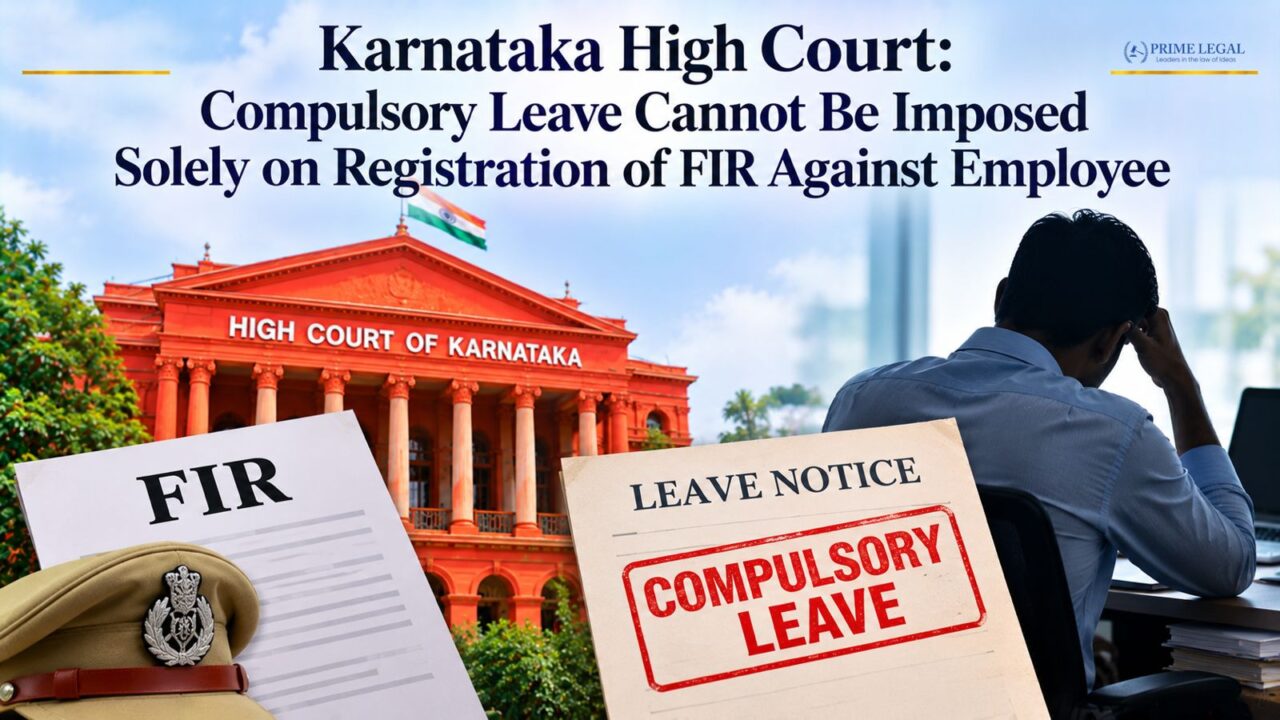
Recently, in the verdict of Dr Mohandas K. v. The Vice Chancellor, Vijayanagara Sri Krishnadevaraya University, W.P. No. 101755 of 2026, decided on November 4, 2026, the Karnataka High Court ruled that an employee cannot be put on compulsory leave just because an FIR is lodged against him. According to Justice M. Nagaprasanna, the lodging of an FIR cannot be equated with chargesheeting or conviction. The Court also stated that forcing someone to work without providing him wages could be called “begar”, which is prohibited under Article 23 of the Indian Constitution.
BACKGROUND
Dr Mohandas K., who is working as an Assistant Professor at Vijayanagara Sri Krishnadevaraya University, Ballari, went to the High Court in search of his salary, which was withheld by the University. An FIR was filed against Dr Mohandas on 16 January 2025 because he had instigated someone to commit suicide. The FIR led the University to place him on compulsory leave.
However, according to the petitioners, the compulsory leave notice was never served upon him. But despite the same, he kept performing his duties. Nevertheless, he was not paid his salary after 16 January 2025. The University later withdrew his compulsory leave order and reinstated him on 17 June 2026, before even the ‘B’ report of the police in respect of the criminal case was filed.
KEY POINTS
- Mere registration of an FIR is insufficient for placing an employee on compulsory leave.
- An FIR cannot be compared with a chargesheet or conviction.
- The university should have looked into the possibility of suspension until departmental inquiry.
- Work done without getting paid might constitute ‘begar’ as per Article 23 of the Constitution.
- The University was asked to decide the representation made by the employee within eight weeks.
ANALYSIS
The High Court pointed out that putting the petitioner on compulsory leave merely due to the registration of an FIR against him is entirely unacceptable legally. An FIR is simply an indication that a criminal investigation has been undertaken and can never be considered an admission of guilt. The Court noted that all the University could have done was to put him on suspension until a departmental inquiry took place.
The question of payment of salary also came up for consideration. Citing People’s Union for Democratic Rights v. Union of India (1982), the Court ruled that asking someone to do work without remunerating him constitutes ‘begar’ and is violative of Article 23 of the Constitution of India, which makes forced labour illegal. If the petitioner was to continue working without being paid, the University couldn’t neglect his claim for payment.
Consequently, the High Court asked the University to look into his plea for payment for the period he was on compulsory leave and the period thereafter when he was brought back into service. The University was ordered to decide the matter within eight weeks.
CONCLUSION
This decision reaffirms that the filing of an FIR against an employee does not automatically make the employee guilty. It underscores the difference between the processes followed in criminal proceedings and departmental proceedings and stresses the need for employers to follow legal procedures while dealing with their employees. It also emphasises that work done without wages can amount to forced labour under Article 23.
“PRIME LEGAL is a National Award-winning law firm with over two decades of experience across diverse legal sectors. We are dedicated to setting the standard for legal excellence in civil, criminal, and family law.”
WRITTEN BY: DEBARATI CHATTERJEE

