
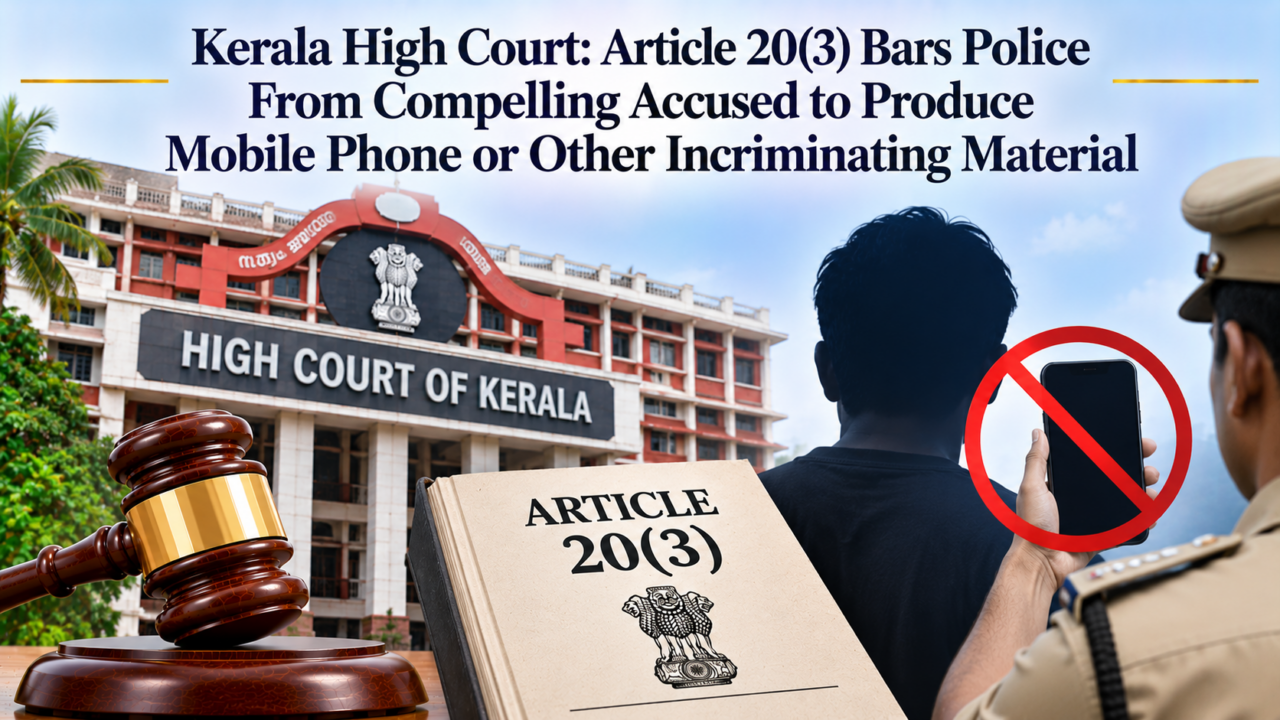
Case Name: Abdul Rafeek @ Rafeek v. State of Kerala and Others
Case Number: Criminal M.C. No. 8940 of 2026
Date: 4 November 2026
Court: High Court of Kerala at Ernakulam
Quorum: Justice Jobin Sebastian
FACTS
Abdul Rafeek was the first accused in Crime No. 54/2026 reported at Payyoli Police Station, Kozhikode. The offences under the Bharatiya Nyaya Sanhita, 2023 (BNS) and the Protection of Children from Sexual Offences Act, 2012 (POCSO Act), were alleged against the petitioner in respect of sexual abuse of a minor girl of 9 years old. The mother of the girl was also accused as an abettor for facilitating the offence.
While investigating the case, the petitioner was out of the country and was not available for arrest. In the final report, he was shown to be absconding. Subsequently, the petitioner appeared in the Fast Track Special Court, Koyilandy, in compliance with summons served upon him, and he was bailed out. The police applied for further investigation and cancellation of bail in the interest of carrying out custodial investigation and recovery of mobile phones. The bail of the petitioner was accordingly cancelled by the Special Court.
ISSUES
- Could bail have been cancelled for further investigation and custodial interrogation without any breach of bail conditions?
- Whether the mobile phones of the accused be taken under Section 94 of the BNSS?
- Whether taking the phones is violative of Article 20(3) of the Constitution, the right against self-incrimination?
LEGAL PROVISIONS INVOLVED
- Section 94, Bharatiya Nagarik Suraksha Sanhita, 2023 (BNSS): Gives authority to the court or the police officer to ask for the production of documents or objects that are necessary for investigation and proceeding.
- Article 20(3), Indian Constitution: Ensures that no individual accused of an offence shall be compelled to be a witness against himself.
- Section 6(1), in conjunction with Sections 5(1), 5(p) and 5(m), POCSO Act: Concerns aggravated penetrative sexual assault.
- Sections 12, 16 & 17, POCSO Act: Concerns sexual harassment of a child, abetment, and punishment for abetment respectively.
- Sections 332(a), 49, 64(2)(m), 65(2) with Section 3(5), BNS: Provisions related to the offences committed which are taken into consideration by the prosecution in its final report.
ARGUMENTS
PETITIONER: It was argued by the petitioner that custody interrogation would be an unreasonable restriction on his bail since it would only serve to further the investigation process. No condition relating to bail had been broken, and no misuse of bail had taken place. He was ready to cooperate and submit himself for potency testing and even handing over of mobile phones and passport if so required. Therefore, custody interrogation was not a necessity.
RESPONDENTS: The prosecution argued that the accusations were serious and the petitioner had spent the entire period of investigations abroad. Important material such as mobile phones and details of the places where these alleged acts took place remained pending. Thus, custody interrogation was necessary to conduct a proper investigation. The prosecution further argued that forcing an accused person to hand over damning mobile phones was against Article 20(3).
ANALYSIS
In addition, it was stated by the Court that the grounds for awarding and withdrawing bail differ. This is because forfeiture of bail is not only due to the abuse of such liberty by the accused, but also due to compelling reasons, or if the bail was granted disregarding certain material. In Dolat Ram v. State of Haryana, (1995) 1 SCC 349, the Supreme Court stated that compelling reasons are necessary for the cancellation of bail. In Puran v. Rambilas, (2001) 6 SCC 338, the Court said that a bail order which overlooks material may be set aside.
In CBI v. Anil Sharma, (1997) 7 SCC 187, the Supreme Court opined that custodial interrogation is distinct from interrogating a person under the protection of bail, as it will help in gathering information and evidence.
Another case relied upon by the Court was State of Bombay v. Kathi Kalu Oghad, AIR 1961 SC 1808, wherein testimonial evidence has been distinguished from physical evidence. The Court referred to State of Gujarat v. Shyamlal Mohanlal Choksi, AIR 1965 SC 1251, V.S. Kuttan Pillai v. Ramakrishnan, (1980) 1 SCC 264, Gopalakrishnan Nayanar v. Sasidharan Nambiar, Kurian v. Joseph, (2021) 2 KHC 124, and Rajesh T.K. v. State of Kerala, 2023 KHC OnLine 9993 to establish that an accused cannot be forced to produce any incriminating documents or things by way of a summons under Section 94 BNSS.
It was contended by the Court that the mobile phones could not be forcefully produced under Section 94 BNSS if the production of such items amounted to self-incrimination. In any case, investigation, detention, and recovery through legal procedures were still legitimate activities.
JUDGEMENT
The Criminal Miscellaneous Case came before the Kerala High Court on 4 November 2026, and the High Court held that bail had been rightly cancelled and that there was nothing illegal in the order of the Special Court. The court held that the accused needed to be in custody in view of the interrogation.
CONCLUSION
It is evident from the ruling that bail may be withdrawn for special reasons to make an investigation efficient, despite there being no violation of the conditions for which bail was imposed. This is due to the fact that the ruling focuses on the constitutional right which protects against self-incrimination of the accused in Section 94 of BNSS.
“PRIME LEGAL is a National Award-winning law firm with over two decades of experience across diverse legal sectors. We are dedicated to setting the standard for legal excellence in civil, criminal, and family law.”
WRITTEN BY- DEBARATI CHATTERJEE
Find the attached Judgement copy here: Abdul Rafeek @ Rafeek v. State of Kerala and Ors.

