
INTRODUCTION
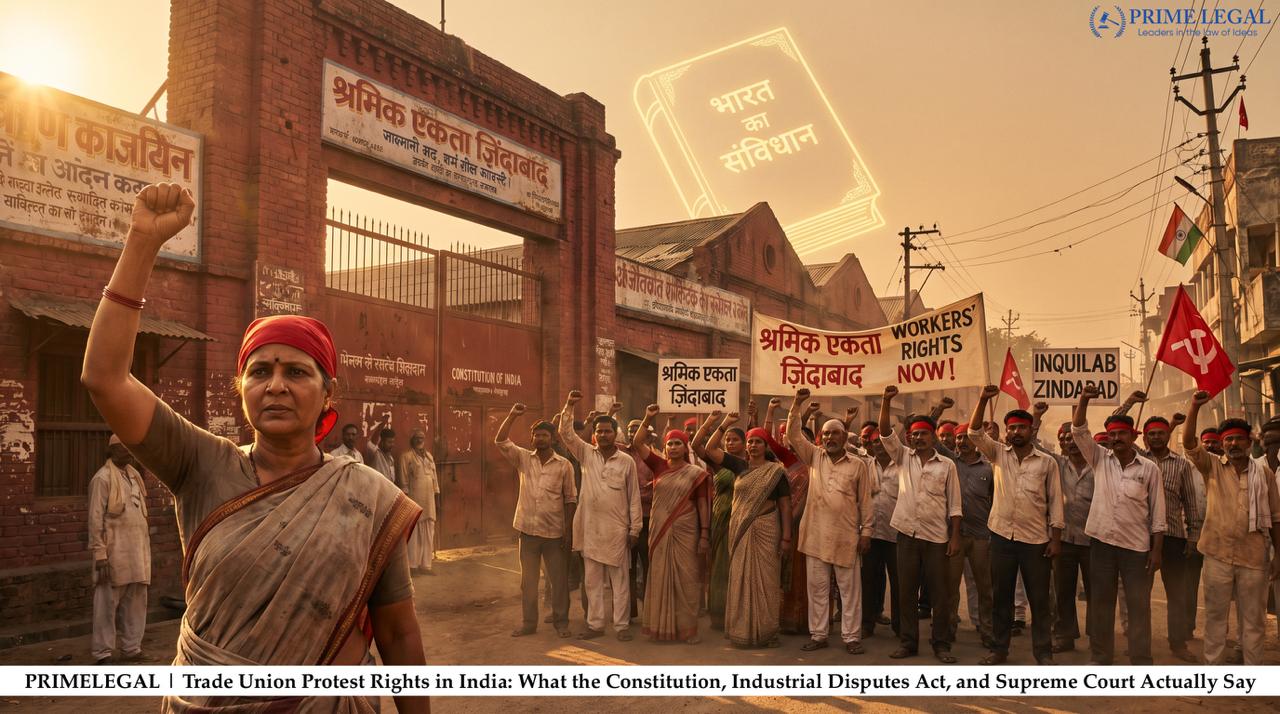
The workers’ protest that erupted across Noida’s industrial belt on April 13, 2026, and turned violent, has brought to the fore a critical legal question: what are the permissible limits of trade union action under Indian constitutional and statutory law? The factory workers protested in thousands because they wanted their salary increase which the government of Uttar Pradesh finally approved by raising minimum wages to take effect on April 1 2026. The police made more than 350 arrests because of the stone pelting incidents and arson attacks and vehicle vandalism and highway blockades which resulted in seven registered FIRs. Let’s examine the constitutional right to protest under Article 19(1)(a) and 19(1)(b), trade union protections under the Trade Unions Act, 1926, and the Industrial Disputes Act, 1947, and the point at which protest conduct crosses into criminal liability as well as the State’s own legal obligations under wage legislation.
BACKGROUND
The industrial sectors of Noida experienced their most serious labour dispute because workers from various manufacturing companies staged a protest which took place in Sector 62 together with nearby areas. The workers for the manufacturing units in Sector 62 established their protest to demand two things: a salary increase and the implementation of the government-minimum wage which required employers to pay their workers Rs. 700 per day. The demonstration started as a peaceful event but reached a violent stage when Phase 2 began because people started throwing stones and setting vehicles on fire and destroying properties. The major city routes experienced total gridlock because protesters blocked both the Sector 62 to NH-9 corridor and the Akshardham entry point from Delhi.
This case connects fundamental rights with statutory labor regulations and criminal justice system rules. The legal analysis requires examination through two perspectives: first, the rights that workers and trade unions possess to organize protests and strikes and engage in other forms of agitation; second, the legal restrictions that exist which prevent such activities from which violent outcomes originate. The State failed to enforce minimum wage laws which led to unrest for which the government bears responsibility.
KEY POINTS
- The Constitutional Right to Protest and Its Limits
The right to protest in India is a constitutionally recognised though not explicitly enumerated right the right to assembly without arms exists as a constitutional right which derives from Article 19(1)(a) and Article 19(1)(b). The Supreme Court established in Ramlila Maidan Incident v Home Secretary Union of India (2012) 5 SCC 1 that peaceful protest constitutes a right protected by the Constitution of India. The State holds power to impose reasonable restrictions on rights under Articles 19(2) and 19(3) because restrictions serve public order and state sovereignty. Constitutional protection of a protest ends when the protest becomes violent or creates major disruptions to public transportation systems. The Noida workers’ initial assembly and demonstration was constitutionally protected, the subsequent blockade of national highways and incidents of arson were not.
- Trade Union Rights Under the Trade Unions Act 1926 and the Industrial Disputes Act 1947
Registered Trade Unions enjoy significant statutory protections under the Trade Unions Act 1926. Section 17 grants immunity from civil suits for acts done in contemplation or furtherance of a trade dispute. The Industrial Disputes Act 1947 provides workers with the right to strike under specific procedures which require public utility services to give advance notification before striking. The two statutes provide no protection against criminal activity because they neither provide. The distinction between peaceful dharna and strike and procession which law protects and the crime of property destruction and stone pelting and highway blockades which law prohibits represents a fundamental difference.
The responsibility of trade union leaders who organize worker protests requires them to safeguard the genuine protest activities from transforming into violent mob actions because their failure to accomplish this task brings them under potential criminal charges which arise from common intention doctrine.
- Criminal Liability Arising from the Violence
The Gautam Buddh Nagar Police registered seven FIRs and arrested over 350 individuals in connection with the protests. The acts of arson, stone pelting, and vandalism attract liability under the Bharatiya Nyaya Sanhita (BNS), 2023, which replaced the Indian Penal Code. The applicable legal rules include those which deal with property destruction through mischief (Section 324 of BNS), rioting (Section 191 of BNS) and physical harm to others. The Sector 62 to NH-9 route blockage through public street access by unauthorized means generates legal responsibility under laws which prohibit public street access obstruction. The common intention doctrine under BNS Section 3(5) BNS (which replaced Section 34 IPC) allows law enforcement to establish vicarious criminal responsibility against all members who participated in an unlawful assembly because they shared the assembly’s common objective, even if they did not take part in actual violent acts.
- The State’s Legal Obligation Under Minimum Wage Law
A significant legal dimension often overshadowed by the violence is the State’s own failure to enforce minimum wage legislation. The Minimum Wages Act of 1948 and the Code on Wages, 2019 establish that paying wages below the minimum requirement constitutes a cognizable offense (Section 52 of the Code on wages, 2019). The total lack of knowledge among women workers from Sector 121 about the government-mandated wage of Rs. 700 per day demonstrates that both employers and the labour administration failed to enforce regulations while they failed to communicate with workers. The UP government will implement its upcoming minimum wage raise which will begin on April 1 2026 as proof that workers lost their legal employment rights. The Supreme Court in Workmen v. Reptakos Brett & Co. 1 SCC 290 [1992] held that a living wage is a constitutional imperative. The act of protest functioned as a political demonstration which responded directly to an existing legal injustice.
- Writ Jurisdiction and the Role of Courts
The formation of a high-powered panel by the UP-Labour Department following Chief Minister Yogi Adityanath’s directives reflects an executive attempt at dispute resolution. Workers and trade unions can use Article 226 of the Constitution to go to High Courts which will enforce their wage rights against both State and employers. Writ jurisdiction extends to private employers who perform statutory or public functions through their wage compliance activities which adhere to central labour law. The courts would allow parties to seek arrears payments while investigating employer misconduct and enforcing proper implementation of wage revisions.
CONCLUSION
The Noida workers’ protest and the violence that followed demonstrate how fundamental rights conflict with public order and statutory labour protections conflict with criminal law. Workers had a valid complaint because their employers refused to pay the legally required minimum wage which they had to protest peacefully according to their constitutional rights. The participants who engaged in violent activities and destroyed property and blocked highways lost their legal protections which resulted in severe criminal consequences.
“PRIME LEGAL is a National Award-winning law firm with over two decades of experience across diverse legal sectors. We are dedicated to setting the standard for legal excellence in civil, criminal, and family law.”
WRITTEN BY: PRANAVI KOLLU

