
INTRODUCTION
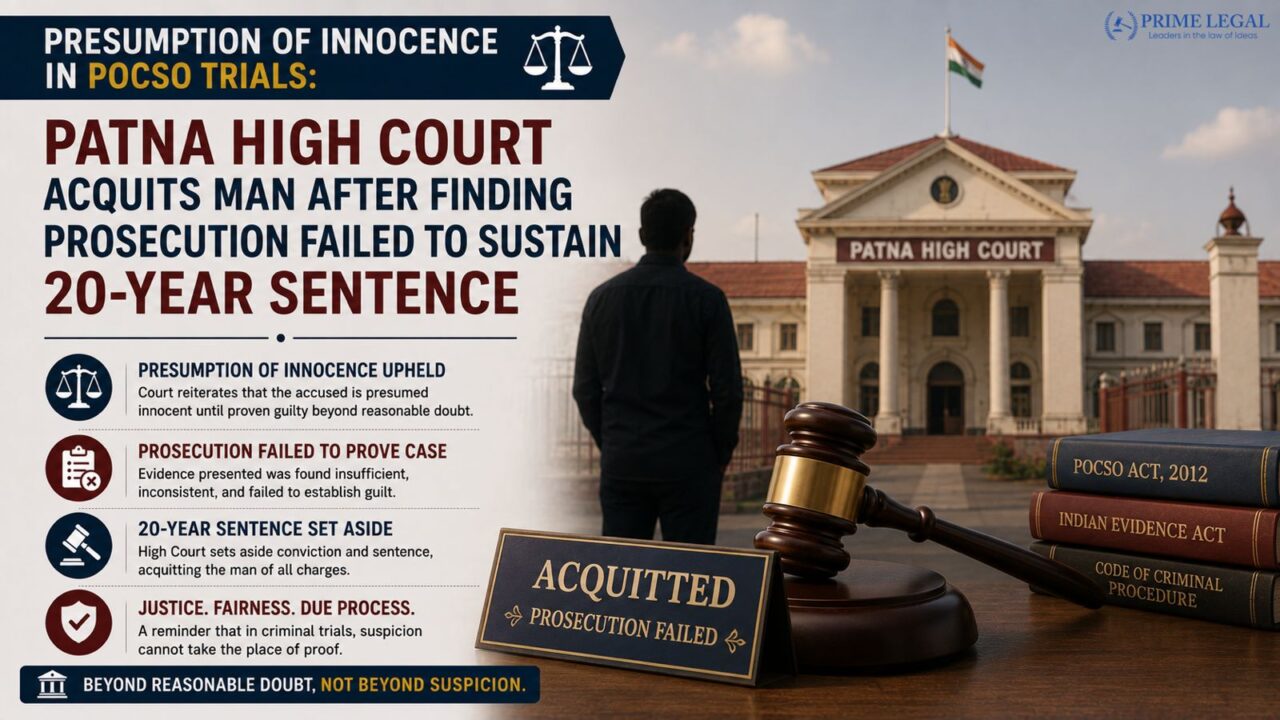
On 22 August 2026, the Patna High Court, in Ratan Mahto v. State of Bihar and Anr., Criminal Appeal (DB) No. 383 of 2023, acquitted a man who had been convicted under Section 4 of the Protection of Children from Sexual Offences Act, 2012, and sentenced to twenty years’ rigorous imprisonment, holding that the statutory presumptions under Sections 29 and 30 of the Act cannot substitute for proof of the basic foundational facts of an offence. A Division Bench of Justice Rajeev Ranjan Prasad and Justice Ramesh Chand Malviya observed that the presumption of innocence which is not lost in cases under the POCSO Act continues to operate alongside these statutory presumptions.
BACKGROUND
The prosecution’s case was that in April 2015, the appellant entered the house where an eleven-year-old girl was staying with her maternal grandparents and sexually assaulted her while she was alone; the case was lodged by the victim’s mother the following day. The trial court convicted the appellant under Section 4 of the POCSO Act and sentenced him to twenty years’ rigorous imprisonment along with a fine of Rs 25,000. During trial, however, the victim, examined as a witness, denied that any such occurrence had taken place, stated that she did not know why her mother had lodged the case, and denied having made any statement to the police alleging rape; she was consequently declared hostile by the prosecution. The investigating officer did not depose that either the victim or her mother had supported the prosecution’s version during investigation, and the prosecution otherwise failed to prove the victim’s purported earlier statement. The appellant challenged his conviction before the High Court.
KEY POINTS
The High Court found that the medical evidence did not support the prosecution case either: the examining doctor found no injury on the victim’s body, her hymen was intact, no spermatozoa was detected in the vaginal swab, and the doctor’s opinion was only that an attempt at sexual intercourse might have occurred. The Bench also noted significant inconsistencies in the prosecution’s account: although the prosecution alleged the victim was alone when the offence occurred, the evidence of her maternal grandmother showed that she was present in the house at the relevant time, and the victim’s mother, who claimed to have learnt of the incident from a neighbour over the phone, could not identify that neighbour. Addressing the statutory presumptions, the Court held that while it was mindful of the presumptions under Sections 29 and 30 of the POCSO Act, it was equally mindful of the presumption of innocence which is not lost in cases under the POCSO Act. It found that the basic foundational facts of the case were lacking, and questioned how the trial court could have invoked the statutory presumptions when the victim herself stated that she did not know why the case had been lodged and had made no statement to the police. Observing that the trial court had been swayed by a misreading of the statutory presumptions, the High Court described the case as one of no evidence, and recorded that it had reason to believe the complaint may have been lodged to extort money, granting the appellant liberty to pursue remedies under Section 22 of the POCSO Act concerning false complaints.
RECENT DEVELOPMENTS
The Court separately identified an error in sentencing: the alleged offence occurred in 2015, when Section 4 of the POCSO Act prescribed a minimum sentence of seven years’ imprisonment, and the enhanced minimum of twenty years was introduced only through the 2019 amendment to the Act. The Bench observed that the trial court appeared to be unaware of the date on which the amendment came into force, and had consequently applied the wrong sentencing provision to an offence that pre-dated it. This aspect of the ruling adds to an emerging corpus of POCSO jurisprudence cautioning trial courts against mechanically applying amended, more stringent sentencing provisions to offenses committed before the amendment came into force, and against using statutory presumptions as a substitute for establishing the foundational facts of an offense.
CONCLUSION
Setting aside the conviction and sentence, the High Court acquitted the appellant and ordered his immediate release if not required in any other case. The judgment reiterates that the presumptions available to the prosecution under the POCSO Act operate only once foundational facts are established, and cannot be used to overcome a case where the principal witness disowns the allegation, the medical evidence is inconclusive, and the prosecution’s own account is internally inconsistent.
“PRIME LEGAL is a National Award-winning law firm with over two decades of experience across diverse legal sectors. We are dedicated to setting the standard for legal excellence in civil, criminal, and family law.”
WRITTEN BY: GAURAV VIBHU RANJAN
Read the Judgement copy below:

