
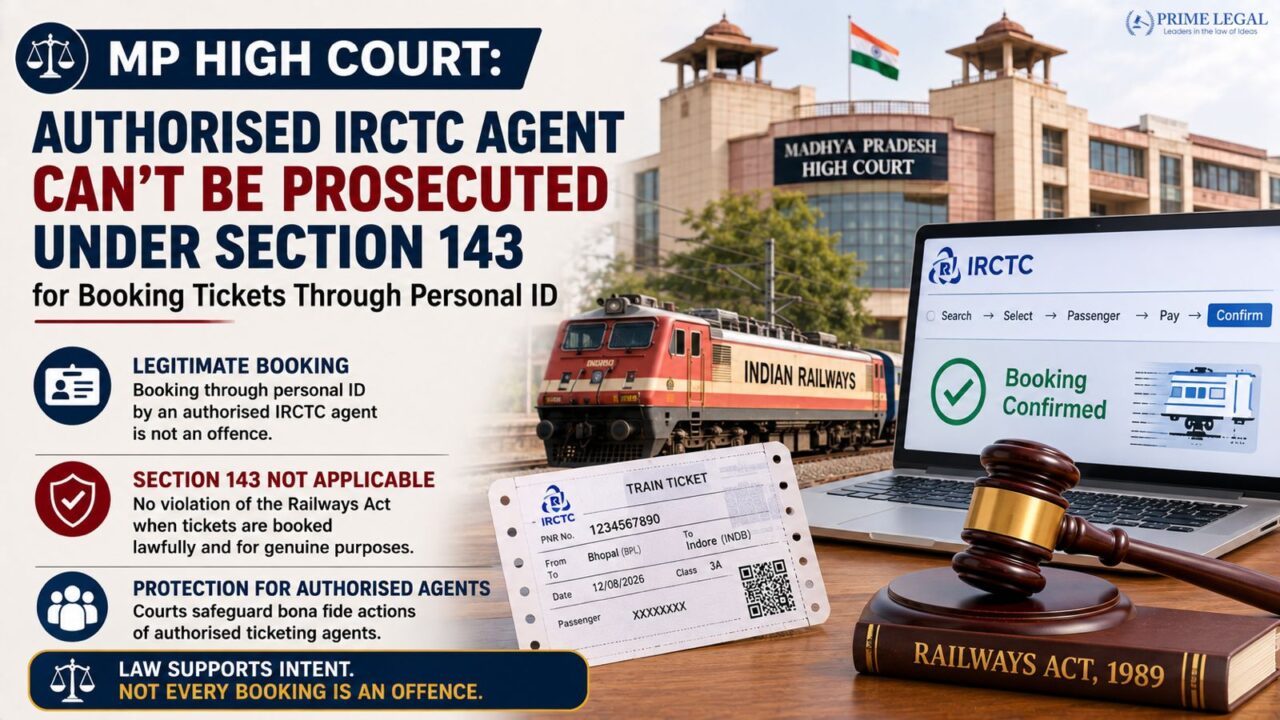
CASE NAME: Avinash Kumar Soni v. Railway Protection Force
CASE NUMBER: Misc. Criminal Case No. 9527 of 2023
COURT: High Court of Madhya Pradesh at Jabalpur
DATE: 11 August, 2026
QUORUM: Hon’ble Shri Justice Himanshu Joshi
FACTS
Petitioner being an IRCTC ticket booking agent since 2015, owning a shop named “Soni Cyber Cafe” in Singrauli, according to his agent ID ICTKTRP00093, was booked under Section 143 of the Railways Act, 1989 after the investigation carried out by RPF officials in which it was found out that two tickets for TATA-JAT Express and Durg-Ambikapur Express have been booked by himself using his own IRCTC ID and not his agent ID. After the investigation into the case, a charge sheet was filed, and Criminal Case No. 233/2020 was registered in the Railway Court, Jabalpur. The petitioner sought quashing under Section 482 CrPC, contending, among other things, that he was at Varanasi pursuing his studies at the time of the raid, that independent witnesses gave a different raid date than the prosecution’s version, and that no misuse or wrongful gain was alleged.
ISSUE
Whether an authorized IRCTC e-ticketing agent can be prosecuted under Section 143 of the Railways Act, 1989 solely on the allegation that tickets were booked through his personal IRCTC ID instead of his authorized agent ID, absent any allegation that his authorization was cancelled or that he was acting as an unauthorized person.
LEGAL PROVISIONS
- Section 143, Railways Act, 1989
- Section 482, Code of Criminal Procedure, 1973
- Case Law: Inspector, RPF v. Mathew K. Cherian and J. Ramesh v. Union of India, Criminal Appeal Nos. 4169 of 2024 and 139-140 of 2025
ARGUMENTS
PETITIONER: It was claimed that the continuation of the criminal prosecution was an abuse of process because there was no case of any crime committed under Section 143, the petitioners were authorized agents, and there were no allegations of any unpermitted transactions of the ticket. In addition, the inconsistency in the witness account regarding the raid, the absence of the petitioner from the shop on the day of the raid, and the illegal search of equipment were raised as well.
RESPONDENT: The plea was raised that the investigation brought to light the fact that the petitioners were issuing Tatkal tickets under their own name and indulging in the business of providing tickets, thereby making out an offence under Section 143 of the Act and that the material seized by way of records, arrest memo, and statements of witnesses established the same.
ANALYSIS
The Court held that Section 143 penalizes only unauthorized persons carrying on the business of procuring and supplying railway tickets, and applied the Supreme Court’s ruling in J. Ramesh, where an authorized agent facing similar allegations of using multiple user IDs was held not to fall within the section’s scope. It reasoned that Section 143, being a penal provision, must be construed strictly and does not create liability for an authorized agent’s alleged breach of IRCTC’s operational conditions such breach, if any, is a matter for civil or contractual remedy, not criminal prosecution. Since the charge-sheet neither alleged cancellation of the petitioner’s authorization nor treated him as an unauthorized person, but merely alleged use of a personal ID instead of the agent ID, the essential ingredients of Section 143 were not satisfied even taking the prosecution’s case at its highest. The Court accordingly held the other factual disputes raised (date discrepancy, alleged absence, witness statements) unnecessary to examine, since the case failed on the foundational legal ground regardless of how those disputes were resolved.
JUDGMENT
The petition was granted and the whole process of criminal case number 233/2020 including the prosecution under section 143 of the Railways Act, 1989 was set aside.
CONCLUSION
If the individual is an approved IRCTC agent, he/she cannot be booked under Section 143 of the Railway Act for booking of tickets on his/her personal account rather than booking on the account of the approved agent; since there is no question of his being unauthorized or the authorization being cancelled, the violation is one of contract and not of the law.
“PRIME LEGAL is a National Award-winning law firm with over two decades of experience across diverse legal sectors. We are dedicated to setting the standard for legal excellence in civil, criminal, and family law.”
WRITTEN BY: DRISHTITA BANIK

