
INTRODUCTION
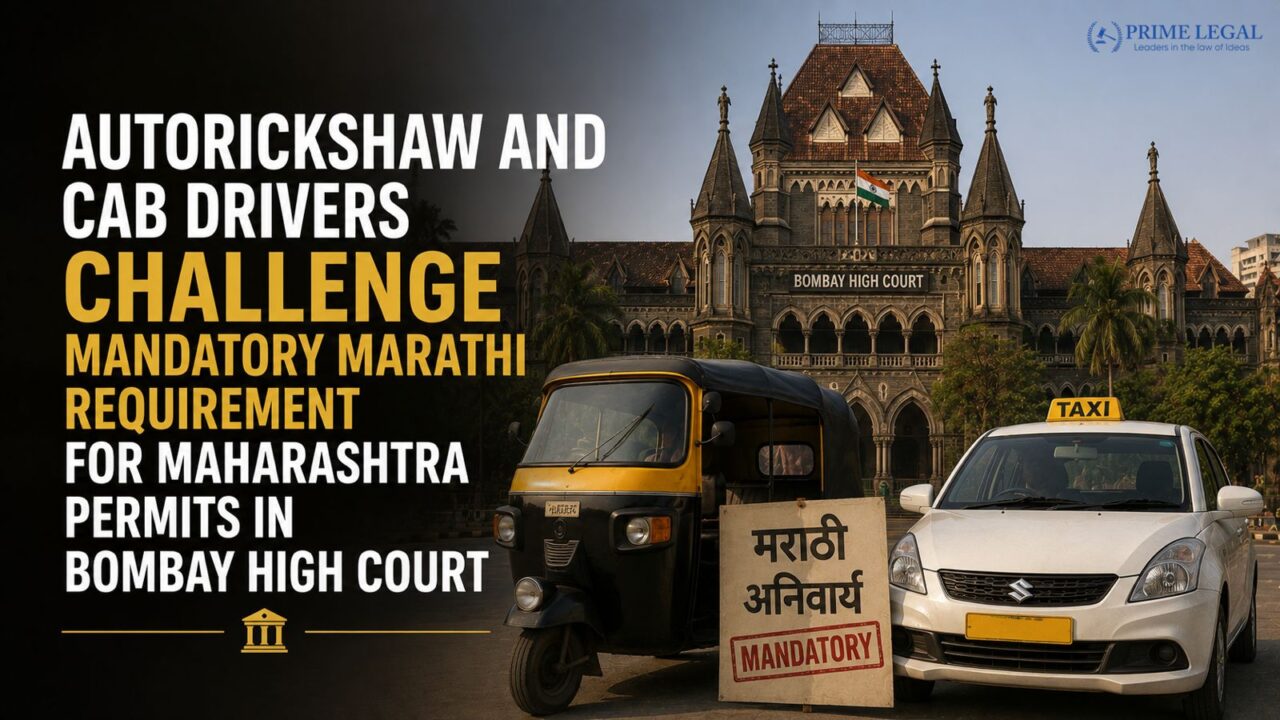
On 25th August, 2026, a Public Interest Litigation was filed before the Bombay High Court by four app-based cab drivers, Mohd Kasim Ahmad v. State of Maharashtra, challenging the Maharashtra government’s notification dated 12th August, 2026, which made “working knowledge of Marathi language” mandatory for autorickshaw, taxi and app-based cab drivers across the State. The petitioners, all drivers operating through cab-aggregator platforms, contend that the requirement is unconstitutional and beyond the rule-making power granted to the State under the Motor Vehicles Act, 1988. The plea is expected to be mentioned before Acting Chief Justice Ravindra Ghuge for urgent directions, including an interim stay on the notification’s operation.
BACKGROUND
By the impugned notification, the Home (Transport) Department amended the Maharashtra Motor Vehicles Rules, 1989, to make working knowledge of Marathi a condition for autorickshaw, taxi and app-based drivers, including those operating through platforms such as Ola, Uber and Rapido. Under the rule, a driver who fails to satisfy a Regional Transport Officer of this knowledge faces suspension of his badge for three months, followed by permanent revocation, and the same condition applies to the grant of new permits and renewal of existing ones. Enforcement began on 20 August 2026, with dedicated “Vayuyega” flying squads checking drivers at autorickshaw stands across the State; on the first day of the drive alone, 522 drivers were checked and 61 were issued notices warning of suspension in the Vasai-Virar belt, an area with a large population of migrant drivers from Uttar Pradesh and Bihar.
KEY POINTS
The petitioners argue that the notification violates their fundamental rights under Articles 14, 19 and 21 of the Constitution, including the rights to move freely and reside anywhere in India under Articles 19(1)(d) and 19(1)(e), and that the parent Motor Vehicles Act confers no power on the State to prescribe knowledge of any language as a qualification for a licence, badge or permit. The plea places significant reliance on a 1 March 2017 order of a Division Bench of the Bombay High Court, comprising Justice Abhay Oka and Justice Anuja Prabhudesai, which had quashed a similar November 2016 circular making Marathi compulsory for the grant of autorickshaw permits, terming it illegal. The petitioners have clarified that they hold the Marathi language in high regard and that several among them already possess functional knowledge of it, framing their objection not to the promotion of Marathi but to conditioning licences and livelihoods upon it. The petition highlights that the notification could affect nearly 9.65 lakh autorickshaw and taxi permit and badge holders across Maharashtra, a large proportion of whom are economically vulnerable migrant workers.
RECENT DEVELOPMENTS
The petition seeks quashing of the 12 August notification in its entirety, along with an immediate stay pending final disposal, citing the imminent risk of checking, notices and suspension faced by the petitioners and similarly placed drivers on a daily basis. It also draws attention to reports that the Transport Commissioner and Transport Minister had directed strict and immediate enforcement of the notification, intensifying the urgency of judicial intervention sought by the petitioners.
CONCLUSION
The case squarely raises the question of whether the 2017 precedent quashing an almost identical requirement will be followed by the High Court, and more broadly, whether a State can condition the grant or continuation of a driving permit or badge on proficiency in a regional language absent any such requirement under the central Motor Vehicles Act. The outcome will also bear on how far state transport rules can go in regulating aggregator-based mobility platforms, which have increasingly been brought within the ambit of rules originally designed for traditional taxis and autorickshaws. Given the scale of the affected workforce and the livelihood consequences of suspension or cancellation, the outcome of this petition is likely to be closely watched by transport unions, gig-economy platforms and migrant worker groups across the State.
“PRIME LEGAL is a National Award-winning law firm with over two decades of experience across diverse legal sectors. We are dedicated to setting the standard for legal excellence in civil, criminal, and family law.”
WRITTEN BY: Gaurav Vibu Ranjan

