
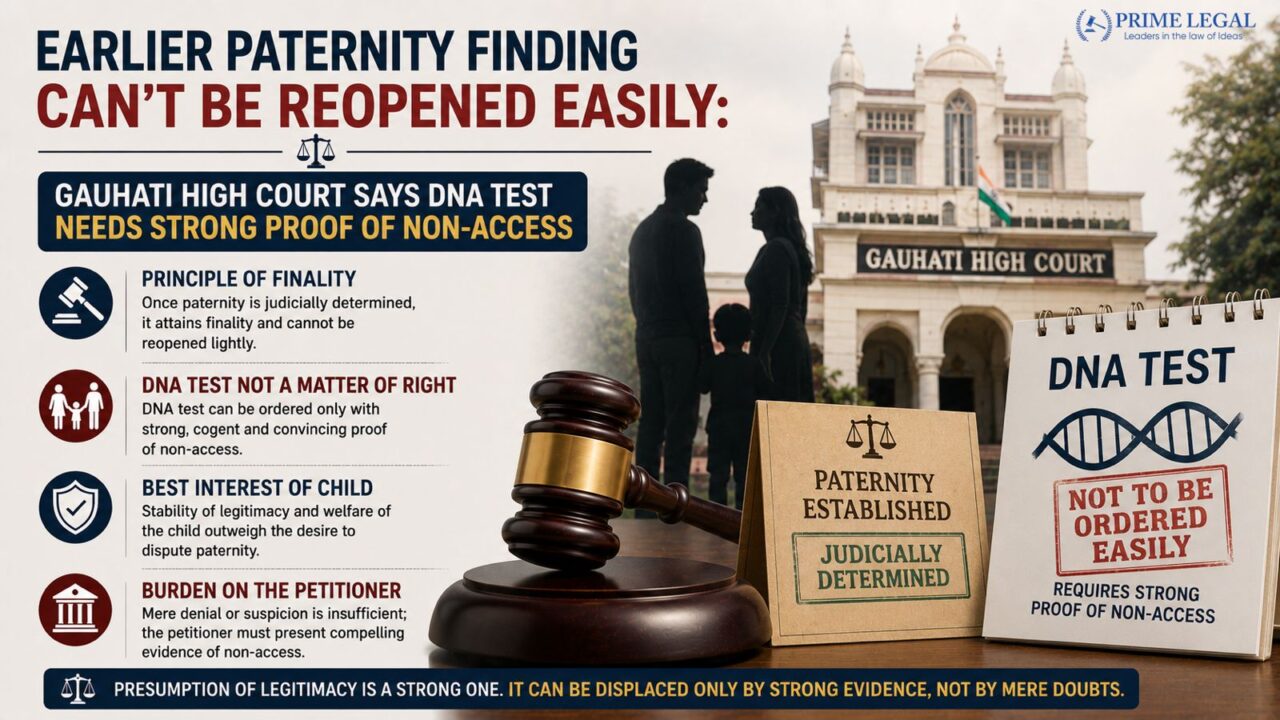
CASE NAME: Rafique Uddin Sekh @ Rafique Uddin & Another v. Saina Begum Sheik Case
No. Crl.Pet./212/2022
COURT: Gauhati High Court (Assam, Nagaland, Mizoram and Arunachal Pradesh)
DATE: August 21, 2026
QUORUM: Hon’ble Mr. Justice Sanjeev Kumar Sharma
FACTS
In 2015, the respondent approached the Chief Judicial Magistrate, Hailakandi under Section 125 CrPC, seeking Rs. 5,000 a month for herself and an equal sum for her minor child, naming the petitioner as the father. He denied the allegations in his written statement. The CJM dismissed her plea in 2019. On revision, the Sessions Judge, Hailakandi partly allowed it, directing him to pay Rs. 3,000 a month toward the child’s maintenance, with arrears running from the date of the CJM’s order. The petitioner then approached the High Court under Section 482 CrPC to quash that direction, arguing that the evidence against him didn’t add up.
LEGAL ISSUES
Were the respondent’s inconsistent statements regarding the time of her pregnancy so unreliable as to justify reversing the finding of paternity? Could a finding on physical relationship recorded in an earlier, separate criminal trial be relied upon to settle the question of paternity in a subsequent maintenance proceeding? Was the petitioner entitled to a DNA test to contest paternity, given he had made no attempt to establish non-access?
LEGAL PROVISIONS
Section 482, Section 125 of the Code of Criminal Procedure Section 417 and Section 376 of the Indian Penal Code Section 112 of the Indian Evidence Act
Case Laws: Pritam Singh v. State of Punjab, AIR 1956 SC 415; Bhagat Ram v. State of Rajasthan, (1972) 2 SCC 466; State of Rajasthan v. Tarachand Jain, (1974) 3 SCC 72; Sambasivam v. Public Prosecutor, Federation of Malaya, (1950) AC 458; Goutam Kundu v. State of West Bengal; Sharda v. Dharmpal; Bhabani Prasad Jena v. Orissa State Commission for Women; Ivan Rathinam v. Milan Joseph, 2025 3 Supreme 600.
ARGUMENTS
PETITIONER: Counsel for Rafique argued that the respondent’s own deposition didn’t hold together she claimed to have conceived around a year and a half before her testimony, yet also stated her child was six months old at the time, statements he said couldn’t both be true. He further pointed to a medical examination around the time of her FIR, which he said showed no sign of the two-month pregnancy she’d later claimed, and urged that the Sessions Court should have ordered a DNA test before fixing paternity.
RESPONDENT: The Legal Aid Counsel countered that maintenance had been granted for the child, and even a child born outside marriage is entitled to be maintained by its father. She pointed to the petitioner’s separate conviction under Section 417 IPC in a Sessions trial arising from the same FIR, where the court had already found, as a matter of fact, that he’d been in a continuing physical relationship with the respondent, a finding he never challenged.
ANALYSIS
Justice Sharma went back to the 2017 Sessions Court judgment and found its finding hard to get around: the trial court there had recorded, in fairly plain terms, that the parties had been in a relationship for years, that intercourse had occurred repeatedly on a promise of marriage, and that the child was born of it. Rafique hadn’t appealed that finding, nor had he tried, in the maintenance proceedings, to show non-access or seek DNA testing.
That gap mattered. The Court turned to how res judicata operates in criminal law, tracing the principle through Pritam Singh, Bhagat Ram, and Tarachand Jain each affirming that once a competent court decides a question, that finding binds the parties in later proceedings touching the same issue. Since the Sessions Court had already settled the question of physical relationship, and that question was foundational to paternity, the same ground couldn’t be reopened in the Section 125 proceeding.
On DNA testing, the Court applied the Supreme Court’s recent ruling in Ivan Rathinam, which restated the Goutam Kundu position: courts don’t order such tests routinely, and never to enable a roving inquiry. A strong prima facie case of non-access has to be shown first, and Rafique had made no such showing if anything, the record pointed the other way. The Court also noted that while the precedents on this point usually arise where a marriage is undisputed and only paternity is contested, the underlying logic held even here, where the marriage itself was denied.
JUDGMENT
The High Court found no merit in the petition and dismissed it, leaving the maintenance order including the arrears undisturbed.
CONCLUSION
The ruling is a useful reminder that criminal findings don’t stay boxed into the case they arose in. Where a competent court has already determined something as foundational as a physical relationship underlying a paternity claim, that finding can carry forward into a maintenance dispute, closing off arguments a party might otherwise have hoped to relitigate from a clean slate.
“PRIME LEGAL is a National Award-winning law firm with over two decades of experience across diverse legal sectors. We are dedicated to setting the standard for legal excellence in civil, criminal, and family law.”
WRITTEN BY: MAHFUZA FATHIMA
Read the Judgement copy below:
Rafique Uddin Sekh @ Rafique Uddin v. Saina Begum Sheik

