
INTRODUCTION
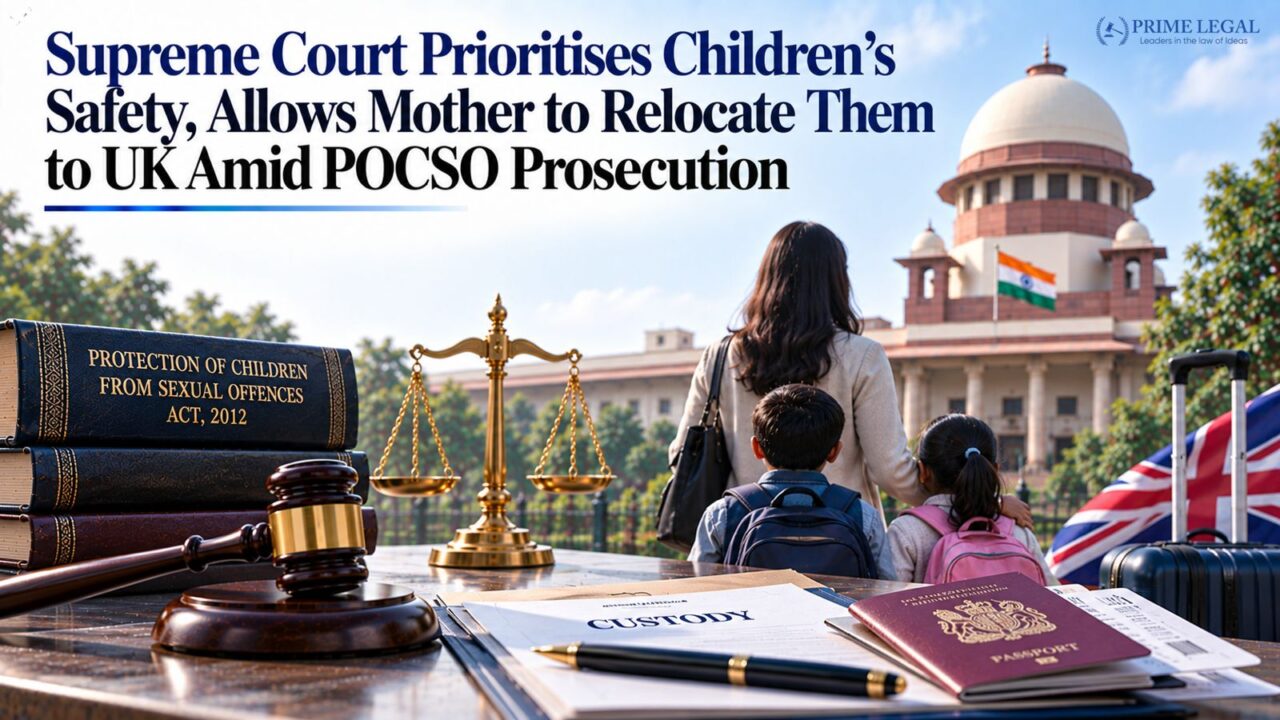
In a high stakes custody battle, the Supreme Court of India has come out with a major judgment allowing a mother to take her two young children to the United Kingdom, while at the same time decisively rejecting the custody rights of the father, who has been charged with an offence under the Protection of Children from Sexual Offences (POCSO) Act, 2012. A bench of Justice Vikram Nath and Justice Sandeep Mehta held that the parental custody cannot be given to a parent who is accused of offences under the Protection of Children from Sexual Offences Act, 2013, and the safety and welfare of children must be paramount. The judgment by Justice Mehta was challenging the Delhi High Court’s earlier order and upheld the principle that allegations of criminal proceedings of child sexual abuse should carry great weight when deciding custody cases, even if the parent has stable and healthy living conditions and a good standing in the family.
BACKGROUND
The case goes back to a marriage between the parties in September 2011, followed by the birth of a son in April 2013 and a daughter in January 2019. In 2018, the mother abandoned the matrimonial home while she was four months pregnant, after which she switched multiple jobs before landing a lecturer’s role at the University of Hull in the UK. The son was examined at NIMHANS in 2023 following some aggressive behaviours, where he revealed sexual abuse by his father. This resulted in a police complaint and POCSO FIR and a chargesheet was later filed by the police. The case of the father challenging the FIR is pending in the Calcutta High Court. But the mother had appealed against both the Family Court and the Delhi High Court’s decision, which both had given custody to the father, in alleging the mother was living a nomadic life and that her frequent moves were a symptom of that.
KEY POINTS
- The Court said that if a parent is facing prosecution under POCSO, he or she should not be granted custody as this will be “totally unwarranted and unjustified.
- The principles of participation, best interest, safety and non-waiver of rights were cited by Justices Nath and Mehta referring to Section 3 of Juvenile Justice (Care and Protection of Children) Act 2015.
- The bench held the son’s disclosure and safety could not be subordinated to the father’s custody claims while the criminal case remains pending.
- The Court flagged that granting custody to the father could compromise the son’s ability to give free and fair testimony in the ongoing POCSO trial.
- It harshly rebuked the Delhi High Court for commenting prematurely on the credibility of allegations, describing it as a “counterblast” and ordered the observations struck down.
- The mother was allowed to move the children with her to the UK and send them to school and the school details to be filed on affidavit within 6 weeks.
- The quashing petition pending in Calcutta High Court should be considered in isolation from the expunged remarks issued by the Delhi High Court.
RECENT DEVELOPMENTS
The judgment came on September 23, 2026. The Supreme Court’s intervention differs from the reasoning of the lower courts that applied a penalty on the mother for her professional mobility, but did not examine the criminal proceedings pending against the father. The mother was represented by senior advocates Zoheb Hossain and Ruchi Kohli, and the father by Shyam Divan. It was pertinent to note that the bench did not make any final decision on guilt, allowing the Calcutta High Court’s independent hearing of the quashing plea to remain unspoiled. The matter has been listed for re-hearing in January 2027 and the custody arrangement remains provisional until further judicial hearing is held in the pending criminal trial.
CONCLUSION
It reiterates that in cases where custody proceedings are pending and are concurrent with POCSO prosecution, the welfare of the child and his/her psychological well-being take precedence over any process or lifestyle concerns. The Supreme Court has thus created a clear precedent, that custodial rights must not be separated from the continuing criminal accountability, by stating that the High Court should refrain from commenting on the truth value of the allegations and instead rely on the protective provisions of the Juvenile Justice Act. In the judgment, the court has taken a sensitive approach towards safeguarding the rights of the child victims of sexual abuse, while also upholding the right of the father to a fair trial, thereby striking a balance between family law and the Indian child protection jurisprudence.
“PRIME LEGAL is a National Award-winning law firm with over two decades of experience across diverse legal sectors. We are dedicated to setting the standard for legal excellence in civil, criminal and family law.
WRITTEN BY: HARSHMEET KAUR SUDAN

