
INTRODUCTION
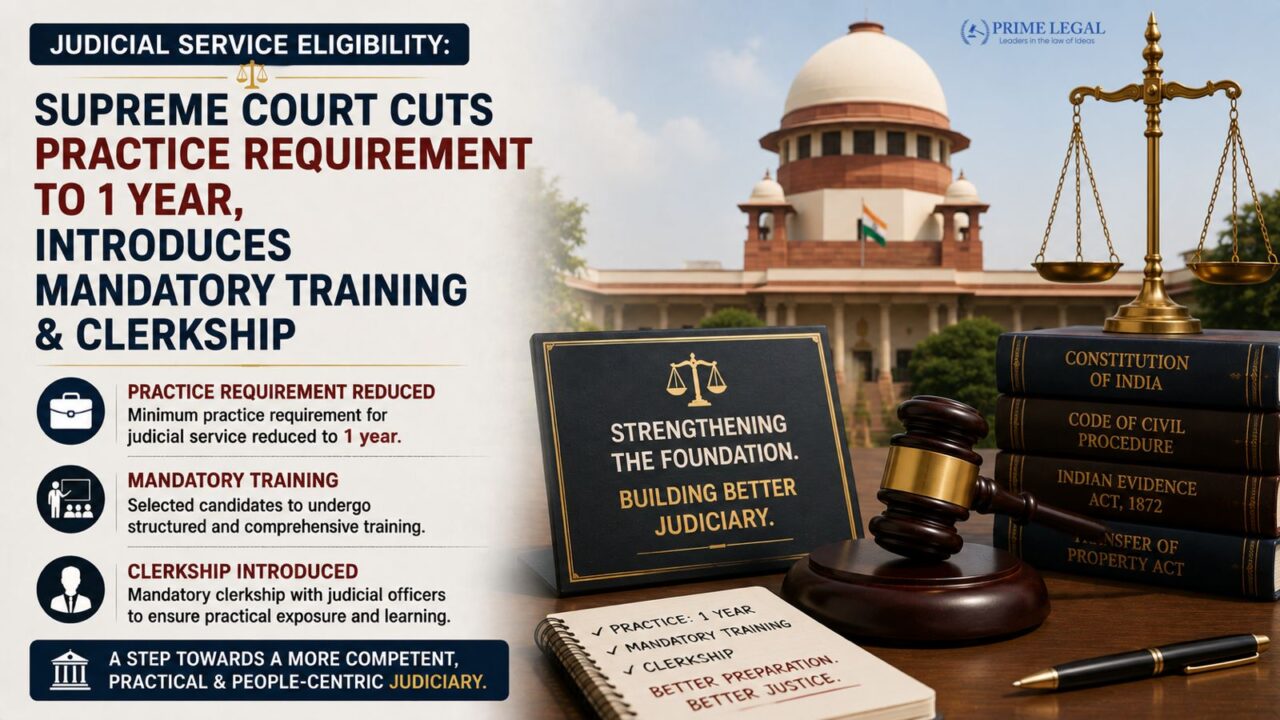
Fifteen months ago, the Supreme Court shut the door on fresh law graduates walking straight from campus into a judge’s chair, insisting on three years of courtroom practice first. That decision triggered a wave of review petitions from aspirants who felt the rule had come down too suddenly and cut too deep. The Court has now revisited its own verdict, and on 21 August 2026, in a 2:1 split, brought the practice requirement down from three years to one, while building in a fairly elaborate training and clerkship structure to make up the difference. This piece walks through what changed, why the Court didn’t simply scrap the requirement altogether, and what the new pathway into judicial service actually looks like.
BACKGROUND
The original ruling came on 20 May 2025, when a Bench led by then Chief Justice B.R. Gavai, along with Justices Augustine George Masih and K. Vinod Chandran, barred fresh graduates from appearing for entry-level judicial service exams for Civil Judge (Junior Division) posts, holding that courtroom exposure was essential before someone could competently sit in judgment over others. That verdict didn’t sit well with everyone. Recently enrolled advocates and several National Law Universities pushed back, arguing the rule would delay entry into service, disadvantage candidates who’d already planned their careers around immediate eligibility, and wasn’t really necessary given that judicial academies across the states already exist to build the skills the Court was worried about. Review petitions followed, and this time the Bench comprised Chief Justice Surya Kant along with Justices Augustine George Masih and K. Vinod Chandran, who reconsidered the framework without disturbing the underlying principle that some real-world legal exposure matters.
KEY POINTS
- The Court declined to remove the practice requirement altogether, holding by majority that professional exposure before judicial appointment remains necessary, but reduced its duration substantially, from three years down to one.
- Selected candidates will now be brought in as Trainee Judicial Officers rather than being confirmed immediately, and will go through a year of intensive training at their State Judicial Academy.
- That training is followed by a year-long structured clerkship, split into two six-month halves, the first under a Principal District Judge or Higher Judicial Service officer, and the second under a sitting High Court judge.
- The Court has treated this combined two-year academy-and-clerkship period as functionally equivalent to two years of legal practice, which is really how the maths behind the reduction works: one year at the Bar plus two years of structured training adds back up to the original three-year benchmark.
- A transition window has been carved out too. Candidates appearing for exams notified between 25 May 2025 and 31 March 2027 can do so regardless of prior practice experience, and will be deemed to have completed the requisite practice without needing to furnish any certificate for it.
- From 1 April 2027 onward, the standard pathway becomes one year of actual practice at the Bar before the exam, followed by the year of academy training and the year of clerkship after selection.
RECENT DEVELOPMENTS
The judgment itself wasn’t unanimous, and that split matters. During the hearing, Senior Advocate Colin Gonsalves had argued the practice requirement shouldn’t exist at all, pointing out that nearly every state already runs a functioning judicial academy capable of training graduates straight out of law school, and that NLUs across the country had opposed retaining any mandatory practice period. The amicus curiae, Senior Advocate Siddharth Bhatnagar, had suggested a middle path rather than a full climbdown, which is broadly the direction the majority ended up taking. The Court was careful to note that recruitment processes already underway or governed by rules in force at the time of their advertisement would continue under those existing rules, so this change doesn’t retroactively upend ongoing selections.
CONCLUSION
What this ruling really does is trade a blunt eligibility bar for a more structured, staged pathway into the judiciary. Instead of asking every aspirant to spend three years litigating before they can even sit the exam, the Court has shifted a large part of that preparation to after selection, under direct institutional and judicial supervision, where arguably it can be more consistently delivered than three years of variable, unsupervised courtroom experience ever was. Whether this compromise satisfies both the aspirants who wanted the rule gone and the High Courts that originally pushed for it remains to be seen, but for now, the path to becoming a Civil Judge looks meaningfully shorter, and considerably more structured, than it did a week ago.
“PRIME LEGAL is a National Award-winning law firm with over two decades of experience across diverse legal sectors. We are dedicated to setting the standard for legal excellence in civil, criminal, and family law.”
WRITTEN BY: MAHFUZA FATHIMA

