
ABSTRACT
“Sedition has probably caused more arguments in Indian criminal law than almost any other single provision. It comes from Section 124A of the Indian Penal Code, a colonial-era law, and for over a century it has forced the same question again and again: where does the State’s right to protect itself end, and a citizen’s right to criticise it begin? This article goes back to the case that set the terms for that debate Kedar Nath Singh v. State of Bihar (1962) and tracks how that judgment has been used, stretched, and eventually left behind. It covers the Supreme Court’s 2022 order suspending sedition prosecutions in S.G. Vombatkere v. Union of India, the repeal of Section 124A under the Bharatiya Nyaya Sanhita, 2023, and its replacement, Section 152, and asks a fairly direct question: has India actually changed how it deals with dissent, or just changed the name of the law that punishes it?”
KEYWORDS: Sedition, Article 19(2), Kedar Nath Singh, Section 124A IPC, Section 152 BNS, Freedom of Speech, Reasonable Restrictions.
INTRODUCTION
Section 124A was added to the IPC in 1870 by British administrators who wanted to stop Indians from criticising British rule that was, quite literally, its purpose. And somehow the same provision stuck around, barely touched, through Independence, through the drafting of a Constitution that promises every citizen the right to free speech. Article 19(1)(a) gives us that right. Article 19(2) then lets the State carve out “reasonable restrictions” on it, for things like public order and the security of the State. Sedition has always lived in the space between those two clauses, and for sixty years, the way courts read that space came down almost entirely to one case: Kedar Nath Singh, decided by the Supreme Court in 1962. This article works through what that judgment actually held, how it fared once real cases started testing it, and where things stand now that Parliament has repealed the very section the judgment was interpreting.
BEFORE KEDAR NATH SINGH: THE LAW WAS ALREADY IN TROUBLE
Sedition ran into constitutional problems even before it reached the Supreme Court. The Punjab High Court struck Section 124A down as unconstitutional in 1951, and the Allahabad High Court did much the same in 1959, holding that it undercut free speech at a fairly basic level. None of this was particularly surprising; a law that punishes disaffection toward the government doesn’t sit well next to a right that exists specifically to protect criticism of the government. So by the early 1960s, the question had built up enough pressure that the Supreme Court had to step in and settle it properly.
KEDAR NATH SINGH: THE LAW SURVIVES, BUT ON NARROWER TERMS
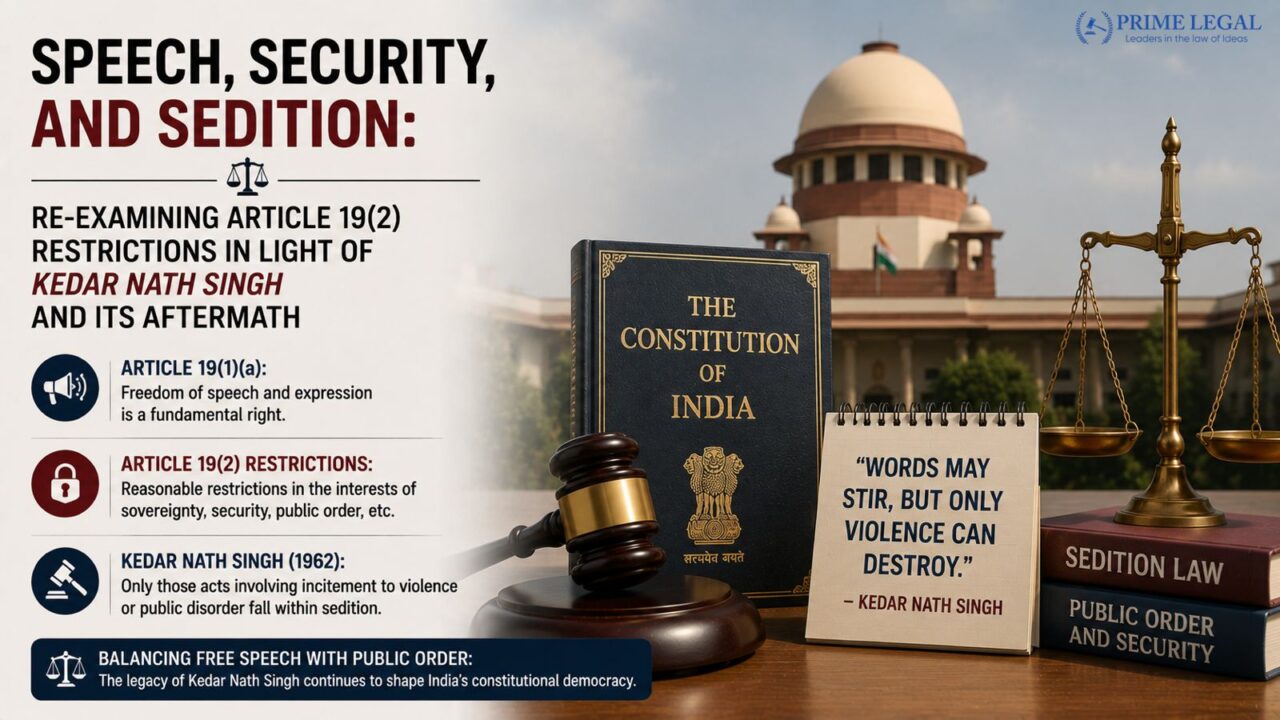
What the Court actually did in 1962 was neither strike the law down nor leave it untouched. A five-judge bench upheld Section 124A, accepting that the State needed some tool to guard against genuine threats to order. But it attached a real condition to that: the judgment separated disloyalty to the government from ordinary criticism of its policies, and said only the former could be punished. Practically speaking, this narrowed the law a great deal. You could say almost anything about the government, however harsh, as long as it wasn’t paired with incitement to violence or a clear intent to cause public disorder. That line of strong words versus words meant to incite something worse became the test every later sedition case was measured against.
WHERE THE TEST BROKE DOWN IN PRACTICE
The Kedar Nath Singh test reads well on paper. In practice, it didn’t hold up nearly as cleanly. Cases like Balwant Singh v. State of Punjab (1995) show courts working hard to separate casual sloganeering from anything that actually threatened public order in that case, acquitting the accused because slogans alone, without any resulting violence, didn’t meet the bar. But most cases never got that far up the judicial chain. NCRB data from 2015 to 2020 shows 548 people arrested under Section 124A, with only 12 convictions in that entire period. That gap says a lot on its own. Journalists, students, activists booked, held, sometimes for months, and then the case simply fizzles out. By the time it does, the arrest and the custody have already done whatever damage they were going to do. This pattern, repeated often enough over the decades, is really what pushed the issue back to the Supreme Court sixty years after Kedar Nath Singh.
2022: THE COURT PRESSES PAUSE
In May 2022, the Supreme Court, in S.G. Vombatkere v. Union of India, suspended Section 124A altogether, describing it as a relic of the colonial era that had been misused. It stopped short of striking the law down that’s not really within the Court’s power but it told the government not to register any new FIRs under the section while the law was being reconsidered, and put existing cases on hold. For a provision that had survived every constitutional challenge thrown at it since 1962, this was about as close as it had come to being shut down without Parliament actually doing the shutting.
SECTION 152 OF THE BNS: NEW LAW, OLD QUESTIONS
Parliament’s answer came in 2023 with the Bharatiya Nyaya Sanhita, which replaced the IPC from July 1, 2024 onward. Section 124A was formally repealed. What replaced it is Section 152, which targets acts that endanger India’s sovereignty, unity and integrity things like exciting secession, armed rebellion, or “subversive activities.” The word “sedition” is gone from the text entirely, and the government has pointed to that as evidence the law now targets genuine threats to the nation rather than criticism of whoever happens to be in power. Not everyone buys this. The Rajasthan High Court, in Tejender Pal Singh v. State of Rajasthan (2024), flagged how closely Section 152 resembles the old sedition provision and warned it could just as easily be turned against legitimate dissent. And there’s a fairly obvious problem underneath all this: Section 152 might actually be broader than Section 124A ever was, since it criminalises “subversive activities” without any settled definition, and none of the case law built up around the old provision automatically applies to a section written in different words. Courts will effectively have to work all of that out again, from scratch.
SO WHAT DOES THIS MEAN FOR ARTICLE 19(2)?
Underneath the section numbers, the real question hasn’t changed: how far can “public order” and “security of the State” be stretched before they stop being a genuine restriction and start becoming an excuse? Kedar Nath Singh answered that by tying the restriction to actual incitement, not mere criticism. Whether Section 152 gets interpreted with the same care is still an open question; it hasn’t been tested at the Supreme Court the way Section 124A eventually was. That test is probably coming, and when it does, courts will have to decide whether to just import the old framework wholesale or build a fresh one around language that reads quite differently.
CONCLUSION
Sixty years on, lawyers still reach for Kedar Nath Singh whenever the conversation turns to the limits of political speech in India, even though the provision it interpreted technically doesn’t exist anymore. Its central point that disagreeing with the government and inciting people against it are two very different things, and only the second should be a crime was important then and hasn’t stopped being important. What’s genuinely uncertain is whether that same protection carries over into Section 152, or whether the country ends up having the same fight all over again under a different name. Until the Supreme Court rules on it directly, that’s still up in the air, and anyone dealing with a Section 152 case would do well to treat Kedar Nath Singh as a starting point for the argument, not a guarantee.
“PRIME LEGAL is a National Award-winning law firm with over two decades of experience across diverse legal sectors. We are dedicated to setting the standard for legal excellence in civil, criminal, and family law.”
WRITTEN BY: MAHFUZA FATHIMA

