
INTRODUCTION
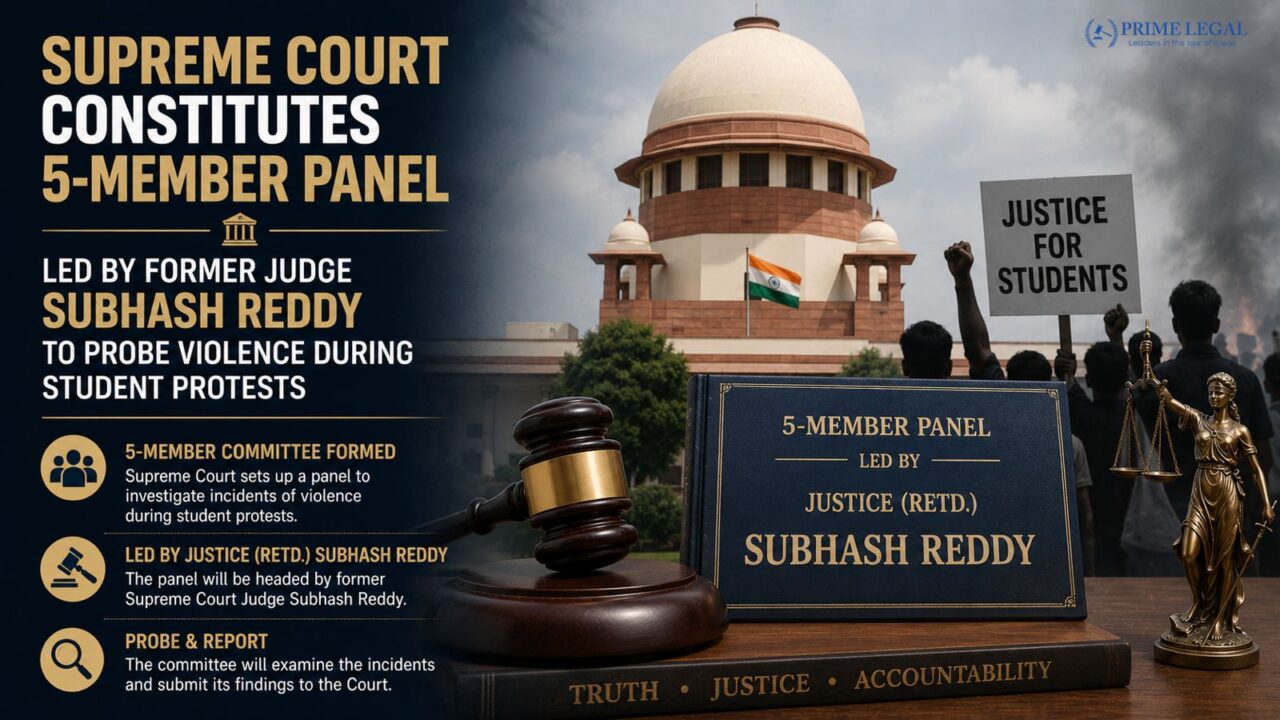
Whenever a protest turns violent, you get two competing stories almost instantly. Protesters say the police overreacted. Police say they were provoked, even attacked. Sorting out what actually happened, under normal circumstances, falls to the very machinery that one side is accusing. The Supreme Court clearly wasn’t satisfied leaving it there this time. On 20 August 2026, a Bench of Chief Justice of India Surya Kant, Justice Joymalya Bagchi and Justice V. Mohana set up a five-member High-Powered Enquiry Committee, headed by former Supreme Court judge Justice R. Subhash Reddy, to independently look into what happened during the recent student protests in Delhi. Here’s a look at how this came about, who’s actually on the committee, and the scope of what it’s been told to examine.
BACKGROUND
The trigger was a protest led by the Cockroach Janta Party against the NEET paper leak, which led up to a “Parliament Chalo” march on 20 July that ended in violence at Jantar Mantar. From there, the story split into two versions, as these things usually do. Protesters alleged the police used disproportionate force, lathi charges and tear gas against what they describe as a largely peaceful crowd. The police, in turn, said their own personnel were attacked during the clashes. Several writ petitions on the matter reached the Supreme Court, and fairly early in the hearing, the Bench observed that the allegations from both camps were serious enough, on the face of it, to justify handing this over to an independent body rather than letting either side investigate itself.
KEY POINTS
- Heading the committee is Justice R. Subhash Reddy, a former Supreme Court judge who also served as Chief Justice of the Gujarat High Court before that.
- Joining him are former Punjab and Haryana High Court Chief Justice Ravi Shankar Jha, former Delhi High Court judge Justice Shalinder Kaur, former CBI Director Rishi Kumar Shukla, and retired Meghalaya DGP Dr. L.R. Bishnoi, a deliberate mix of judicial and law-enforcement background.
- The committee has to look both ways: allegations of excessive force by police and paramilitary personnel against protesters, and allegations of violence by protesters against security personnel. Neither side gets a free pass here.
- There’s a specific instruction to give priority to complaints of targeted violence, harassment or molestation against women protesters, treating that category as needing urgent handling rather than getting buried in the general inquiry.
- The Court ordered all relevant evidence preserved and handed over, CCTV footage, drone recordings, body-camera data, communication logs, so nothing conveniently goes missing while the committee does its work.
- Importantly, the Bench made clear that this inquiry running in the background doesn’t stop the concerned authorities from taking their own disciplinary action against officers if service rule violations turn up independently. The two processes are meant to run side by side, not wait on each other.
RECENT DEVELOPMENTS
Beyond just figuring out who did what, the committee has also been asked to consider interim compensation for those injured and to assess property damage from the protests, so its job stretches into questions of accountability and redress, not just fact-finding. The Bench wants interim findings submitted as soon as possible, and the matter comes back for hearing on 10 September 2026. This is far from the first time Indian courts have been pulled into the space between protest and policing. Similar requests for independent probes have come up around past instances of student and civil unrest, though courts haven’t always agreed to set up committees, sometimes sending petitioners elsewhere instead. What makes this order stand out is how fast the Supreme Court moved, and the seniority of the people it’s put on the panel, rather than leaving things to routine departmental review.
CONCLUSION
At its core, this order reflects a certain discomfort on the Court’s part with letting the state investigate allegations made against the state. Bringing in a former Supreme Court judge, a former High Court Chief Justice, a former CBI Director and a retired senior police officer is an attempt to build something both sides might actually trust. Whether that trust holds, and whether the findings translate into real accountability once they’re out, is something that will only become clear once the matter is back before the Court on 10 September.
“PRIME LEGAL is a National Award-winning law firm with over two decades of experience across diverse legal sectors. We are dedicated to setting the standard for legal excellence in civil, criminal, and family law.”
WRITTEN BY: MAHFUZA FATHIMA

