
INTRODUCTION
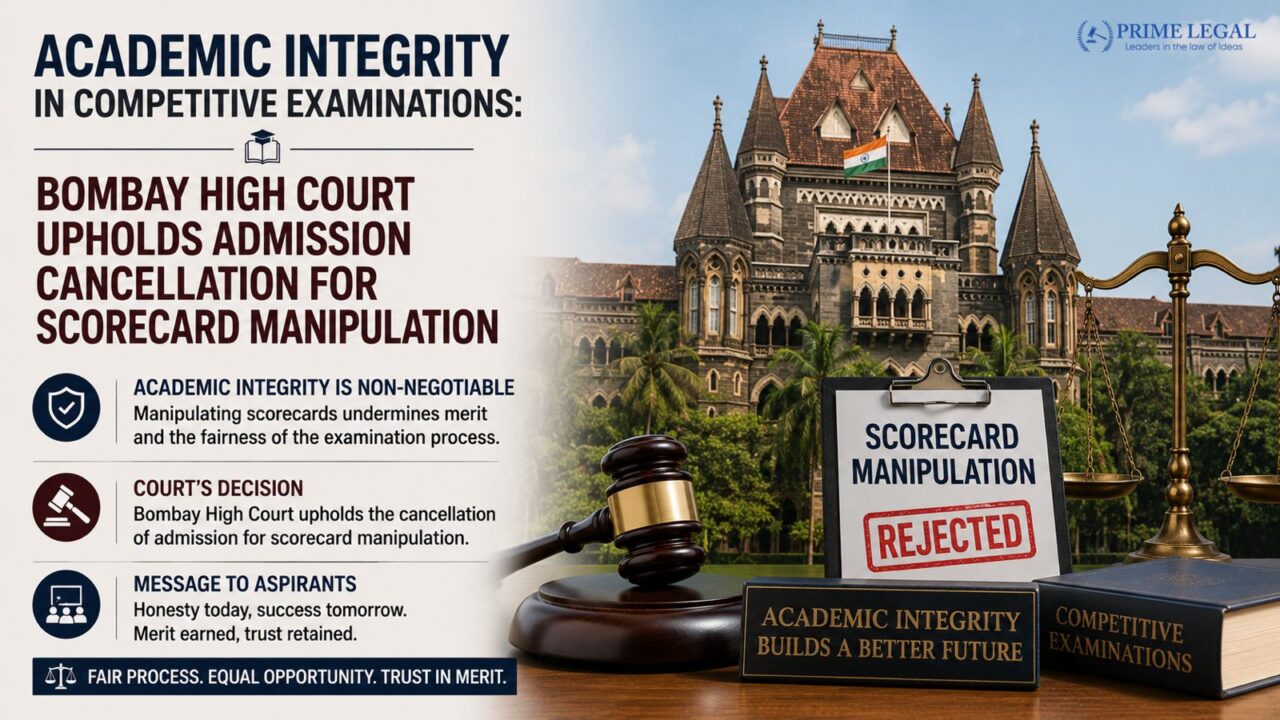
On 14 August 2026, the Bombay High Court, in Shubham Vijay Mangire v. State of Maharashtra, 2026 LiveLaw (Bom) 394, Writ Petition No. 9114 of 2026, refused to restore the provisional B.Tech admission of a student after finding that the scorecards he had relied upon for admission contained percentiles inconsistent with the official MAH-MHT-CET 2026 examination data. A Division Bench of Justice Riyaz Chagla and Justice Farhan Dubash dismissed the writ petition, holding that no admission, however desirable, can justify manipulation of an examination record, and upheld the university’s decision to cancel the petitioner’s provisional admission.
BACKGROUND
The petitioner, Shubham Mangire, had appeared for the MAH-MHT-CET 2026 PCM examination in two attempts, in April and May 2026. Relying on scorecards showing an overall percentile of 78.874707 in the first attempt and 73.5482364 in the second, he secured provisional admission to a B.Tech course in Renewable Energy Engineering at MIT-World Peace University, Pune, on 23 June 2026. The university subsequently found that the mark sheet submitted to it showed a percentile higher than the scorecard uploaded on the official MHT-CET portal for the same candidate, and cancelled his provisional admission. The petitioner challenged the cancelation before the High Court and the High Court directed the State CET Cell to conduct an inquiry into the discrepancy between the two mark sheets and submit a report.
KEY POINTS
The CET Cell’s supplementary report found that the scorecards relied upon by the petitioner had not been generated by the Cell and had been tampered with or fabricated; his actual percentiles were 7.8474707 in the first attempt and 13.5482364 in the second, not 78.874707 and 73.5482364 as claimed. The Court also noted several discrepancies in subject-wise scores, and observed that one of the disputed percentiles had not been awarded to any candidate in that examination session at all. Accepting the report, the Bench clarified that its findings were confined to the authenticity of the scorecards and the petitioner’s entitlement to relief in the writ petition, and did not amount to a finding of criminal liability, leaving competent authorities free to take any permissible action. The Court described the facts as deeply disturbing, observing that an examination meant to allocate scarce educational opportunities depends entirely on the integrity of the process and the authenticity of documents submitted by candidates. It held that no admission, however desirable, can justify manipulation of an examination record, and that allowing such conduct to go unchecked would be an injustice to every student who competed honestly.
RECENT DEVELOPMENTS
The Bench declined to record any finding on who had actually manipulated the scorecards, leaving that determination to the university, the State CET Cell, ors any other competent authority to examine independently and in accordance with law, including the possibility of disciplinary, administrative or criminal proceedings. The ruling comes amid heightened scrutiny of malpractice in competitive entrance examinations feeding into professional courses, and reinforces that courts will not use their writ jurisdiction to protect an advantage secured through inauthentic documents. With engineering and other professional courses becoming increasingly competitive for admission, the judgment observes that any incongruence between the records of the institutions and the official examination data will be seen as a serious assault on merit-based selection, rather than a mere procedural irregularity.
CONCLUSION
Academic integrity in competitive examinations is paramount and a provisional admission based on a score card fabricated or manipulated cannot be protected under the writ jurisdiction, the judgment reiterates. In affirming the cancellation, the Bombay High Court made it clear that it would not adjudicate on the issue of the respondent’s criminal/complaisional liability, and would leave further inquiry and action to the competent authorities, adding that “Merit-based examination process must be free from manipulation”.
“PRIME LEGAL is a National Award-winning law firm with over two decades of experience across diverse legal sectors. We are dedicated to setting the standard for legal excellence in civil, criminal, and family law.”
WRITTEN BY: GAURAV VIBHU RANJAN

