
INTRODUCTION
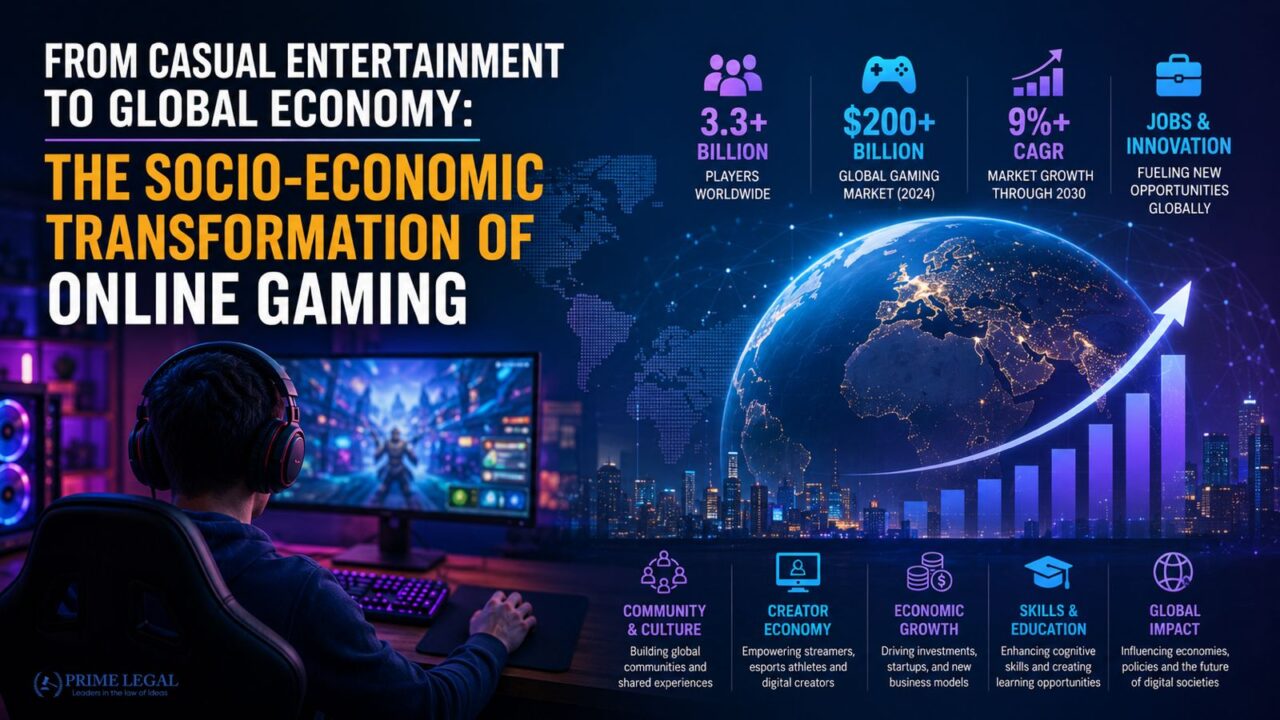
Online gaming began as a way to kill time between classes or during a commute. Today, it is one of the fastest growing segments of the global digital economy, and one of the most fiercely contested regulatory battlegrounds in India. According to Newzoo’s Global Games Market Report, the industry crossed 3.6 billion players worldwide in 2025, generating revenues of roughly USD 188.8 billion, a scale that rivals the global film and music industries combined. What began as casual entertainment, played for nothing more than bragging rights, has become an economy with its own labour market, its own tax disputes, and now, in India, its own constitutional crisis. This article traces that transformation: how gaming moved from arcades to app stores, how it built an economy around itself, and how governments, India’s in particular, are now scrambling to regulate a sector that grew faster than the law could keep pace with.
FROM ARCADES TO APP STORES
The commercial history of gaming moved through fairly distinct phases: coin-operated arcades in the 1970s and 80s, home consoles through the 1990s, and then, with the arrival of affordable smartphones and cheap mobile data in the 2010s, a genuinely mass medium. Games no longer required a console or a PC, just a phone and an internet connection, which meant gaming stopped being a hobby confined to a demographic and started reaching, quite literally, anyone with a smartphone. This is what turned gaming from a leisure activity into infrastructure for two much larger industries: advertising, since games became one of the most engaging places to hold a user’s attention, and finance, since a subset of these games, real money games involving rummy, poker, fantasy sports and similar formats, turned gameplay directly into a payments and wagering product.
THE NUMBERS BEHIND THE BOOM
The scale involved is difficult to overstate. Fortune Business Insights values the global online gaming market at roughly USD 244.68 billion in 2026, projected to more than double to about USD 501.91 billion by 2034. India’s story runs in parallel: a 2024 FICCI-EY report found the country had roughly 488 million online gamers, projected to cross 517 million by the end of 2025, among the largest gaming user bases in the world. India’s real money gaming segment alone had grown into an estimated USD 3.7 billion industry contributing more than INR 200 billion in annual tax revenue, while broader estimates of the wider online and real money gaming market put its value closer to USD 23 to 29 billion. These are not marginal numbers for a pastime. They represent an industry that, before 2025, was drawing serious venture capital, employing hundreds of thousands of people directly and indirectly, and becoming one of the more visible faces of India’s digital economy.
ESPORTS AND THE NEW CREATOR ECONOMY
Alongside the money-gaming boom, a parallel and less controversial economy has grown around competitive and casual gaming: esports, streaming and content creation. Tournament titles, streaming platforms and mobile esports leagues, including large-scale efforts like Krafton’s expanded 2026 Esports Roadmap for Battlegrounds Mobile India, have created an entire employment ecosystem of professional players, coaches, tournament organisers, broadcasters and streamers. Even as real money gaming ran into legal trouble in India, esports and non-monetary online social games were treated differently by policymakers, precisely because they generate economic activity, jobs and international visibility without the addiction and wagering concerns attached to money games. This distinction, between playing for stakes and playing for skill, sponsorship or spectacle, sits at the very heart of how India ultimately chose to regulate the sector.
INDIA’S REGULATORY RECKONING
For years, India’s approach to online gaming rested on a judge-made distinction between games of skill and games of chance, with skill-based real money games such as rummy, poker and fantasy sports generally treated as legitimate business protected under Article 19(1)(g) of the Constitution. That framework was upended on two fronts within a single year. First, on 27 May 2026, the Supreme Court in State of Tamil Nadu v. Junglee Games India Pvt. Ltd., 2026 INSC 594, held that the moment money is staked on the uncertain outcome of any game, whether skill or chance, the activity constitutes betting and gambling under Entry 34 of List II, which is res extra commercium and therefore outside the fundamental right to trade at all. The Bench of Justice J.B. Pardiwala and Justice R. Mahadevan upheld the Tamil Nadu and Karnataka legislations banning online money games, and in a companion ruling upheld the retrospective application of 28 percent GST on the full face value of stakes rather than merely the platform fee, a tax dispute that had itself been running for years. Second, and more sweepingly, Parliament passed the Promotion and Regulation of Online Gaming Act, 2025, which received Presidential assent on 22 August 2025 and came into force on 1 May 2026. The Act does something the courts had never done: it does away with the skill-versus-chance distinction altogether, banning all online real money games regardless of the element of skill involved, while separately promoting and recognising esports and non-monetary online social games. It also created the Online Gaming Authority of India to register esports organisers and social game operators, and prescribes criminal penalties of up to three years imprisonment or a fine of up to INR 1 crore for operating or advertising banned real money games, extending liability even to banks and payment intermediaries who facilitate such transactions.
THE CONSTITUTIONAL BATTLE STILL BEING FOUGHT
The Act was challenged almost immediately before the Karnataka, Madhya Pradesh and Delhi High Courts, and on 8 September 2025 the Supreme Court transferred all pending and future challenges to itself under Article 139A. Petitioners, including major real money gaming platforms, argue that a blanket ban on games of skill breaches the right to trade under Article 19(1)(g) and the right to livelihood under Article 21, and that Parliament’s sweeping delegation of classification powers to the executive amounts to excessive delegation of legislative function. The government has defended the law as a legitimate exercise of its power over an activity that is extra commercium, citing concerns over addiction, financial distress, money laundering and even national security. The matter has moved slowly, first delayed pending the constitution of a larger bench, then heard in stages through 2026 before a Bench led by Chief Justice Surya Kant, with the law already in force and the industry operating, in the words of one senior counsel, under conditions of civil death while the constitutional question remains unresolved.
A GLOBAL PATCHWORK OF REGULATION
India’s approach, a near-total prohibition, sits at one extreme of a much wider global spectrum. The United Kingdom regulates online gambling and gaming through a single licensing authority, the Gambling Commission, which permits real money gaming under strict consumer protection and advertising rules rather than banning it outright. The United States has no single federal framework at all; each state decides independently whether and how to permit online real money games, producing a patchwork where a game is legal in one state and effectively prohibited in another. Several jurisdictions, including a handful of Indian states like Nagaland, Sikkim and Meghalaya, have instead opted for licensing regimes rather than prohibition, taxing and supervising real money games rather than eliminating them. India’s central legislation is unusual precisely because it forecloses this middle path nationally, at least for now.
THE SOCIAL COST NOBODY CAN IGNORE
None of this regulatory upheaval happened in a vacuum. Lawmakers and courts alike have repeatedly pointed to documented harms behind the numbers: gaming addiction, especially among young people, families driven into debt by real money wagering, and a string of reported suicides linked to gambling losses that were cited directly in Tamil Nadu’s own statement of objects and reasons for its 2021 amendment. The economic transformation of gaming, in other words, has run alongside a genuine public health concern, and any honest account of the industry’s rise has to hold both truths together: gaming has created enormous economic value and opportunity, and a meaningful slice of that value, particularly in real money formats, has been extracted from vulnerable users at real human cost.
CONCLUSION
Online gaming’s journey from casual pastime to global economic force happened faster than most regulatory systems were built to handle, and India’s experience over the past year shows what that mismatch looks like in practice: a multi-billion dollar industry, hundreds of millions of users, a landmark Supreme Court ruling on taxation and federal power, a sweeping new central statute, and a constitutional challenge still working its way through the courts, all compressed into little more than twelve months. Whatever the Supreme Court eventually decides on the validity of the Promotion and Regulation of Online Gaming Act, 2025, the underlying story will remain the same: an entertainment medium that grew into an economy large enough, and consequential enough, that no government could afford to leave it unregulated for much longer.
“PRIME LEGAL is a National Award-winning law firm with over two decades of experience across diverse legal sectors. We are dedicated to setting the standard for legal excellence in civil, criminal, and family law.”
WRITTEN BY: GAURAV VIBHU RANJAN

