
INTRODUCTION
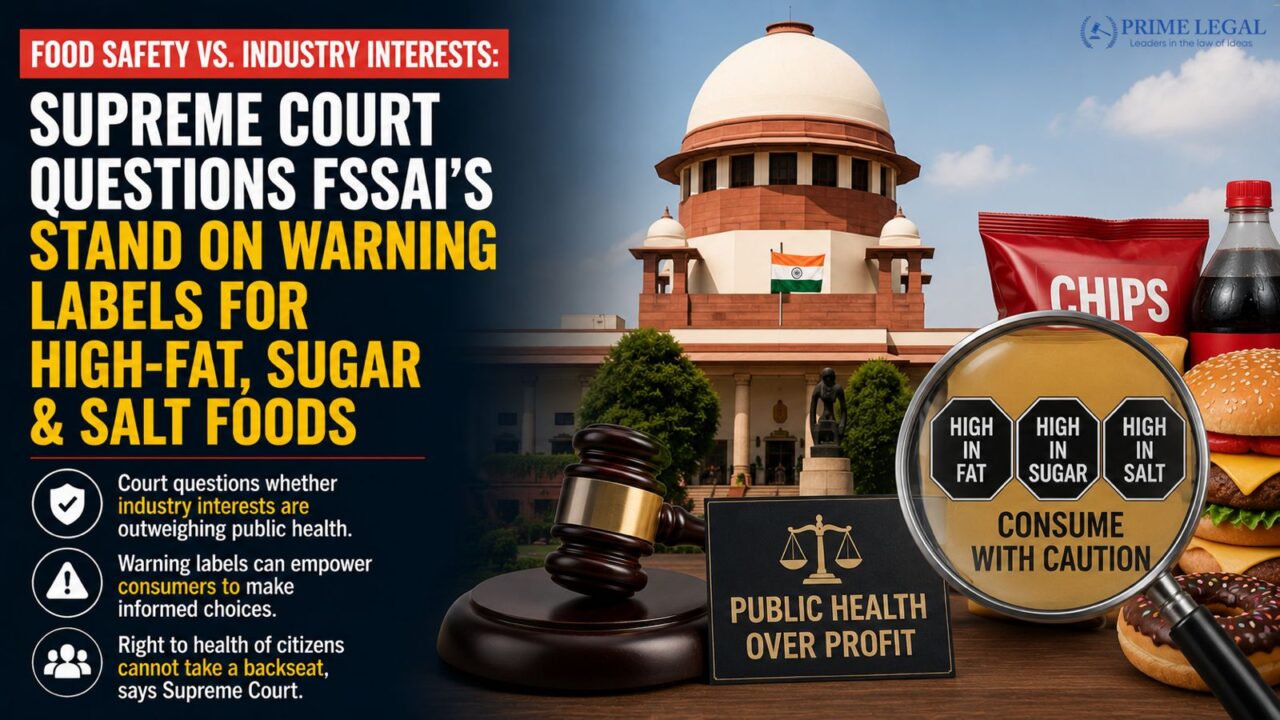
Should India dilute international food-safety standards because its cuisine is traditionally richer in salt, sugar and fat? The answer was an emphatic no when, on August 13, 2026, the Supreme Court of India slammed the Food Safety and Standards Authority of India (FSSAI) for failing to implement warnings on packages of processed food products.
BACKGROUND
These cases have emanated from a public interest litigation petition filed by 3S and Our Health Society for mandatory front-of-packaging labelling (FOPL) in order to alert consumers about the packaging of foods that contain excessive amounts of sugar, salt, or saturated fats. In April 2025, the Court had disposed of the case on a direction that the constituted expert committee by FSSAI should finalize their recommendations. In the second week of February 2026, dissatisfied with the affidavit of compliance filed by the regulator, the Court had directed FSSAI to consider such warning messages as “High Sugar Level” or “High Saturated Fat Level.” Instead, FSSAI’s latest affidavit proposed a different approach: displaying daily recommended consumption limits for sugar, salt and saturated fat in pictorial form, based on the 2024 ICMR–NIN Dietary Guidelines, rather than an interpretive warning symbol.
KEY POINTS
-
- The Bench held that its February 10th order was a direction, not a mere suggestion, and expressed displeasure that FSSAI’s revised proposal departed from it.
- Additional Solicitor General Brijender Chahar argued that interpretive warning labels used internationally were unsuited to India, since staple items such as namkeens, and even two eggs (at roughly 11g of fat against a 10g daily benchmark), would end up carrying warning symbols.
- The Court was unpersuaded, observing that consumers already know food contains sugar, fat and carbohydrates, and that the object of FOPL is to build public awareness, not to single out any product.
- Advocate Rajiv Shankar Dvivedi, appearing for the petitioner, contended that forcing people to read numbers, match them to daily allowances and find out if a particular product is “high” in any nutrient defeated the entire purpose of front-of-pack labelling in light of low health literacy levels amongst sections of the population; a colour coded pictorial warning does the job in one go.
- The court rejected the contention that dietary norms in India should be different from international practices, asking sharply if India was willing to stay “underdeveloped”, and further observed that affordability issues made children more likely to choose packaged snacks over healthier options.
- The Court ignored Senior Advocate Maninder Singh’s plea on behalf of a food manufacturer stating that the food manufacturer had no locus standi in a matter which was essentially related to public health.
- Finally, the Court has granted FSSAI and the Union a last chance of two weeks’ time to present its considered view, failing which, the Court itself will decide how labelling should be done.
RECENT DEVELOPMENTS
The consultation carried out by FSSAI itself on March 19, 2026, is said to have shown that the majority of industry associations were against interpretive warning labels and preferred instead a method of informing without “creating fear” among consumers, an attitude that was received with much scepticism by the Bench, noting that the business interests of manufacturers should not prevail over consumer rights. The ASG’s submission that roughly a third of MSME revenue comes from traditional foods likely to attract warning labels did not move the Court, which reiterated that the two-week deadline was final before it would pass its own directions.
CONCLUSION
The hearing reflects a sharpening judicial stance that regulatory caution attributed to industry sensitivities cannot indefinitely defer measures aimed at public health, particularly where children’s health is concerned. With FSSAI now facing a court-imposed deadline, the coming weeks will likely determine whether India adopts a direct, symbol-based warning system on packaged foods or continues with a more technical, disclosure-based model and whether the judiciary itself steps in to settle the format if the regulator does not.
“PRIME LEGAL is a National Award-winning law firm with over two decades of experience across diverse legal sectors. We are dedicated to setting the standard for legal excellence in civil, criminal, and family law.”
WRITTEN BY: DRISHTITA BANIK

