
INTRODUCTION
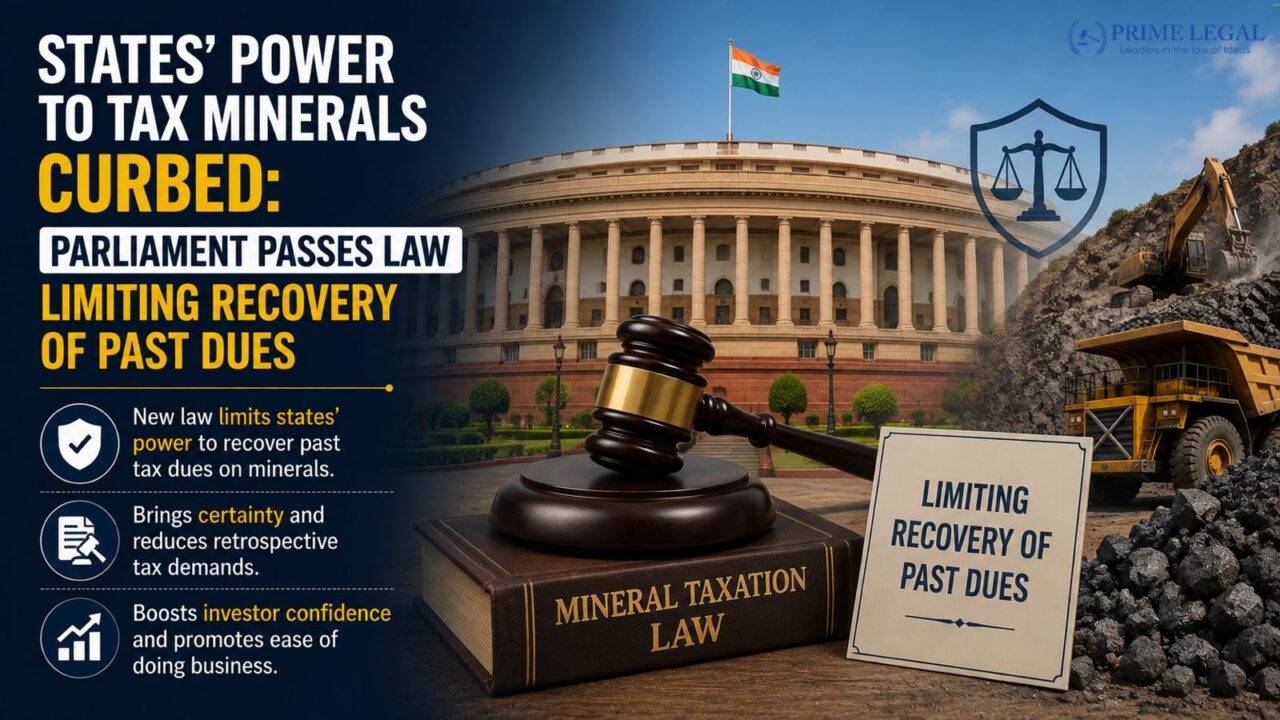
Two years ago, states won a hard-fought battle at the Supreme Court to tax mineral rights, and were told they could even chase dues going back to 2005. Parliament has now stepped in and taken a good chunk of that victory back. On 13 August 2026, both Houses cleared the Mines and Minerals (Development and Regulation) Amendment Bill, 2026, curbing states’ power to levy taxes on mineral rights and mineral-bearing lands, and wiping out unrecovered past dues in the process. The Bill now awaits presidential assent before it becomes law. This piece looks at how we got here, what the new law actually does, and why mineral-rich states are unhappy about it.
BACKGROUND
The story begins with a nine-judge Constitution Bench ruling delivered in July 2024, where the Supreme Court, led by then Chief Justice D.Y. Chandrachud held that royalty on minerals is not a tax, and that states do have the legislative competence to impose taxes on mineral rights and mineral-bearing land, unrestricted by the Union’s Mines and Minerals (Development and Regulation) Act, 1957. When the Centre asked for the ruling to apply only prospectively, the Court refused and allowed states to recover past dues dating back to 1 April 2005, exposing mining companies, PSUs like Coal India and SAIL among them, to potentially enormous retrospective tax demands. The Centre’s response, three years later, is this amendment, introduced on the ground that a patchwork of differing state-level levies was creating unpredictability and multiple layers of taxation for the mining industry.
KEY POINTS
- States are now barred from imposing any new tax, cess or levy on mineral rights or mineral-bearing lands relating to major minerals, without approval from the Central Government going forward.
- Any past dues that were assessed or demanded but never actually deposited with or recovered by a state government before this amendment takes effect will be treated as invalid and unenforceable, effectively wiping the slate clean for mining companies with pending liabilities.
- Amounts already deposited with or recovered by a state before the amendment’s commencement will not have to be refunded, so states get to keep what they’ve already collected, they just can’t chase what remains outstanding.
- The Bill carries a non-obstante clause, meaning it overrides any other law, judgment, decree or court order to the contrary, including, in effect, the operative part of the 2024 Supreme Court ruling on retrospective recovery.
- The Centre will regulate major minerals such as coal, limestone, iron ore, copper and manganese, while states retain their taxation powers over 49 minor minerals, a division the government has repeatedly stressed to argue this isn’t a wholesale takeover of state authority.
- Mines Minister G. Kishan Reddy told the Rajya Sabha that states’ share of overall mineral revenue has actually gone up over the past decade, from 65% to 85%, and their share of coal revenue from 51% to 96%, positioning the amendment as a stability measure rather than a revenue grab.
RECENT DEVELOPMENTS
The Lok Sabha passed the Bill on 12 August, and the Rajya Sabha followed a day later amid vocal opposition sloganeering, with several MPs objecting that the law effectively legislates around a Supreme Court judgment rather than respecting it. Jharkhand stands to lose the most, given it was expecting to recover a substantial sum in backdated mineral taxes under the 2024 ruling, and mineral-rich states are reportedly weighing a constitutional challenge to the amendment, particularly its non-obstante override and the retrospective nullification of pending dues. For mining companies and PSUs, though, the amendment removes a significant overhang, given estimates that a fully retrospective application of the 2024 verdict could have cost the industry tens of thousands of crores.
CONCLUSION
This is really a story about the boundary between judicial interpretation and legislative correction. The Supreme Court read Entry 50 of List II broadly in favour of state taxation power, but it also acknowledged that Parliament retains wide authority to impose restrictions on that very field, and Parliament has now used exactly that authority. Whether this amendment survives a constitutional challenge, if mineral-rich states do move to file one, will likely turn on how the courts view the non-obstante clause overriding a nine-judge bench ruling. Until then, the practical effect is straightforward: state governments keep what they’ve already collected, but their power to chase anything more, retrospectively or otherwise, has just been meaningfully cut down.
“PRIME LEGAL is a National Award-winning law firm with over two decades of experience across diverse legal sectors. We are dedicated to setting the standard for legal excellence in civil, criminal, and family law.”
WRITTEN BY: MAHFUZA FATHIMA

