
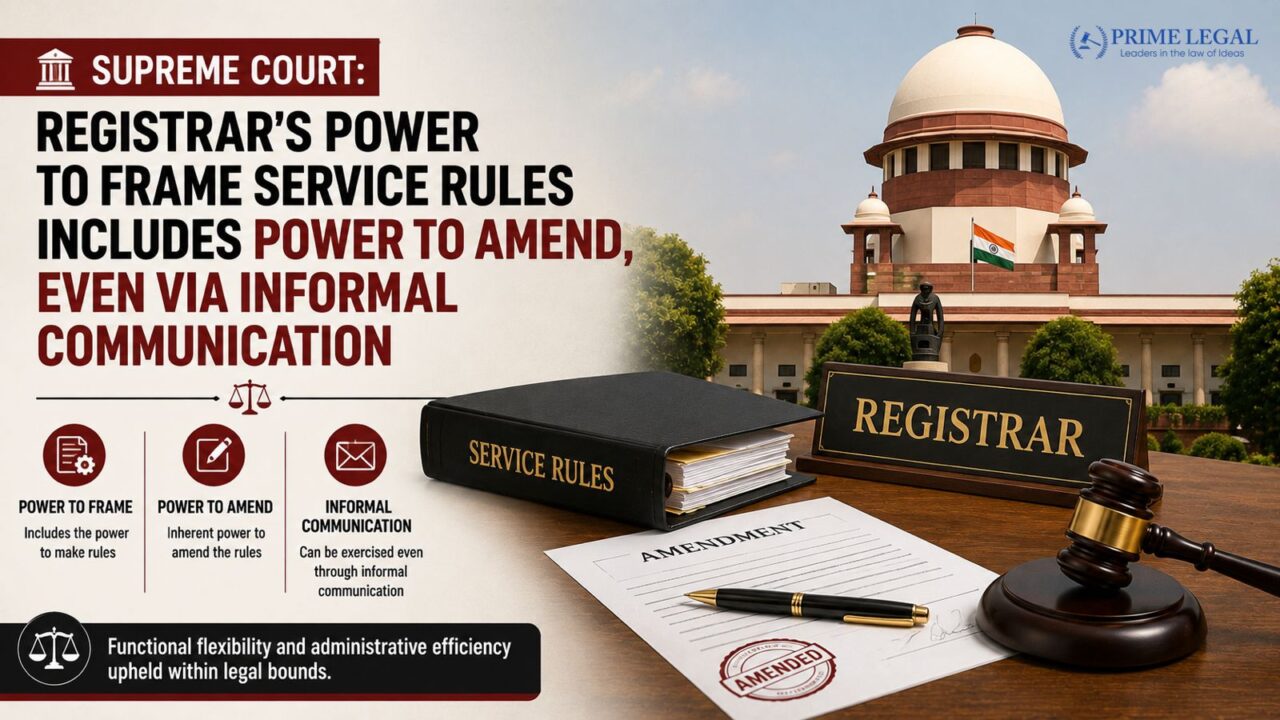
CASE NAME: S. P. Chandrakar v. State of Chhattisgarh & Ors.
CASE NUMBER: SLP (C.) No. 8726 of 2024
COURT: Supreme Court of India, Civil Appellate Jurisdiction
DATE: 30 July, 2026
QUORUM: Hon’ble Mr. Justice Sanjay Karol and Hon’ble Mr. Justice Augustine George Masih
FACTS
The appellant and respondent no. 5, Kishor Bagh, were both Class-I officers at the District Central Cooperative Bank Ltd., Raipur, governed by the 1982 Service Rules framed under Section 55 of the Chhattisgarh Cooperative Societies Act, 1960. The appellant, originally a technical appointee (Assistant Engineer), was placed above respondent no. 5 in seniority lists drawn up between 2005 and 2010 a placement respondent no. 5 resisted on the ground that Rule 5(3)(a) barred technical staff from non-technical promotions. The Registrar had, however, already deleted Rule 5(3)(a), (b) and (c) by order dated 4 July 2005, a position reiterated on 13 August 2010 through a communication from the Additional Registrar expressly stating it was “ordered by Registrar.” On this basis, the appellant was promoted to Additional Manager on 30 December 2010. Respondent no. 5’s writ challenge took thirteen years to decide; the Single Judge quashed the promotion, holding the 2010 communication could not substitute for a formal amendment order and that statutory rules cannot be altered by executive communication. The Division Bench affirmed. The appellant appealed to the Supreme Court.
ISSUES
- Whether the Registrar’s rule-making power under Section 55(1) includes the power to amend or delete rules.
- Whether an amendment communicated by the Additional Registrar, rather than the Registrar himself, is valid.
- Whether non-compliance with Section 95(3)’s laying requirement invalidates the amendment.
- Whether a thirteen-year-old promotion should have been disturbed at all.
LEGAL PROVISIONS
- Sections 55(1) and 95(3), Chhattisgarh Cooperative Societies Act, 1960
- Rule 5(3)(a)-(c), 1982 Service Rules
- Section 21, General Clauses Act, 1897
- Case Laws referred: Manbodhan Lal Srivastava (1957) 2 SCC 759;
Babu Ram Upadhya, 1960 SCC OnLine SC 5;
Bhikraj Jaipuria, 1961 SCC OnLine SC 34;
Atlas Cycle Industries (1979) 2 SCC 196;
K.T. Plantation (2011) 9 SCC 1;
Hukum Chand Mills Karamchari (1996) 7 SCC 81;
Kiran Devi (2021) 15 SCC 15;
Ben Hiraben Manilal (1983) 2 SCC 422;
Hukumchand Mills Ltd., 1964 SCC OnLine SC 89;
Punjab Water Supply & Sewerage Board (2007) 2 SCC 491;
Ashok Kumar Aggarwal (2013) 16 SCC 147.
ARGUMENTS
APPELLANT: The Registrar had already validly deleted Rule 5(3)(a)-(c) in 2005; the 2010 communication merely reiterated this and said so on its face. A power to frame rules must include a power to amend them, and neither the mode of communication nor the officer conveying it could undo a power already validly exercised. A promotion undisturbed for thirteen years should not be casually unsettled.
RESPONDENTS: Statutory, legislative rules cannot be amended by informal executive communication absent a formal order on record. The 2010 letter came from the Additional Registrar, not the Registrar, and so could not validly exercise power under Section 55(1). Executive instructions cannot override statutory rules, per Punjab Water Supply and Ashok Kumar Aggarwal.
ANALYSIS
The Court held Section 55(1), read with Section 21 of the General Clauses Act, naturally extends the rule-making power to amendment, variation, or rescission. It found no bar on the Additional Registrar communicating the amendment, especially since the letter recorded it was “ordered by Registrar” and the State never disputed this. On Section 95(3), applying the mandatory-versus-directory tests from Manbodhan Lal Srivastava, Babu Ram Upadhya, Bhikraj Jaipuria, and Atlas Cycle Industries, the Court concluded the laying requirement was directory, since no consequence attached to non-compliance and no serious inconvenience would follow. It also rejected the argument that calling the amendment a “circular” invalidated it, relying on Kiran Devi and Ben Hiraben Manilal for the principle that an informal or mistaken reference to the source of power does not undo an otherwise valid exercise of statutory authority.
JUDGMENT
The Supreme Court allowed the appeal, set aside both the Division Bench and Single Judge judgments, and upheld the appellant’s promotion of 30 December 2010. It directed his restoration to position and status, protection of seniority, all consequential promotional benefits, and 50% back wages within two months, with 6% annual interest on default. No costs were ordered.
CONCLUSION
A statutory power to frame rules inherently carries the power to amend, vary, or rescind them, and this survives being exercised through a subordinate officer or conveyed informally, so long as it traces back to the competent authority. A “shall” requirement like laying rules before the Legislature is ordinarily directory where no consequence attaches to non-compliance. The judgment also reinforces that promotions standing undisturbed for years particularly where delay owes to litigation pendency should not be lightly unsettled.
“PRIME LEGAL is a National Award-winning law firm with over two decades of experience across diverse legal sectors. We are dedicated to setting the standard for legal excellence in civil, criminal, and family law.”
WRITTEN BY: MAHFUZA FATHIMA
Read the Judgement copy below:
S. P. CHANDRAKAR VERSUS STATE OF CHHATTISGARH & ORS

