
INTRODUCTION
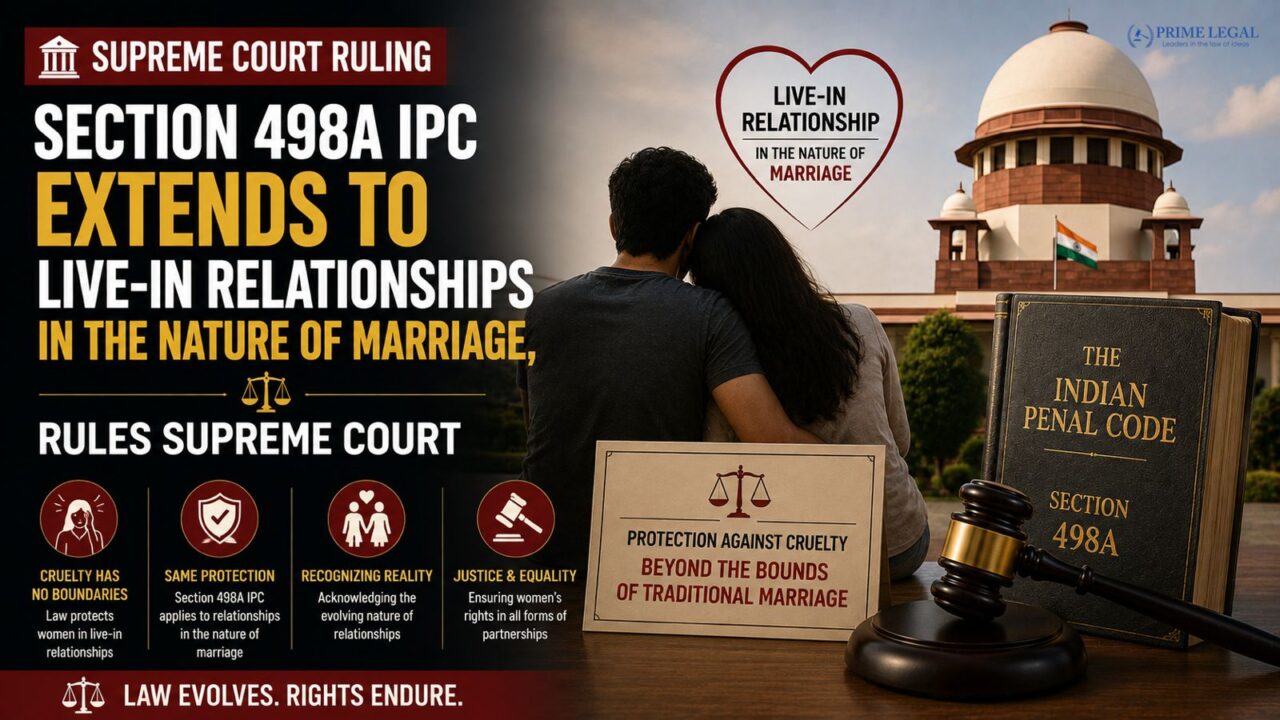
For years, one question kept surfacing in courtrooms and never quite got a clean answer: can a man in a live-in relationship be prosecuted for cruelty under Section 498A IPC, the same way a legally wedded husband can? High Courts went back and forth on this, some willing to stretch the word “husband,” others refusing to touch it. That uncertainty has now been settled. The Supreme Court has ruled that Section 498A of IPC (Section 85 of the BNS, 2023) does reach live-in relationships, but only where the relationship carries the character of marriage and an intention to marry can actually be shown.
BACKGROUND
The case arose out of a fairly familiar, and unfortunately common, fact pattern. A woman alleged that a man had presented himself to her as her husband while concealing that he was already married to someone else, and that she was later subjected to cruelty and dowry-related harassment. Two separate cases were registered, with charge sheets invoking Section 498A alongside the Dowry Prohibition Act. Before the Karnataka High Court, the accused argued that since there was no valid marriage, he could not be treated as a “husband” for the purposes of Section 498A at all. The High Court disagreed and refused to quash the proceedings, and that refusal reached the Supreme Court, where a Bench of Justices Sanjay Karol and N. Kotiswar Singh took up the question directly.
KEY POINTS
- Section 498A is a penal provision, so the accused argued it should be read strictly limited to a husband in a legally valid marriage. The Court wasn’t persuaded by that.
- Instead, it gave the word “husband” a purposive reading, one that keeps faith with why the section exists in the first place: to protect women from cruelty, not to get hung up on technical definitions.
- The provision now covers live-in relationships too, but only where two things come together the relationship has to genuinely look like a marriage, and there has to be a real intent to marry underlying it. One without the other won’t do.
- The Bench added a limit here: this isn’t a blanket rule. Casual arrangements or short-term live-ins that never had marriage as an endpoint stay outside Section 498A’s reach.
- On the argument that the Domestic Violence Act already covers live-in partners adequately, the Court disagreed. The DV Act, it noted, is mostly a civil remedy; its penal teeth only really show up if someone breaches a protection order, which isn’t the same kind of protection Section 498A offers.
- There’s a safeguard built in too: the Court made clear that arrests in these cases can’t happen reflexively. The same preliminary-inquiry checks that apply in regular matrimonial cruelty cases will apply here as well.
RECENT DEVELOPMENTS
This ruling doesn’t emerge in a vacuum. Live-in relationships have been steadily normalising in urban India, and courts have been feeling the pressure of that shift for a while now. The Kerala High Court, in fact, had gone the other way on this exact question back in 2024, holding that a live-in partner simply cannot be prosecuted as a “husband” under Section 498A, since the section’s essential ingredient presumes a marital tie. The Supreme Court’s ruling doesn’t just resolve that conflict for Karnataka, it settles the position nationally, at least for this provision. The Bench was careful to add that this expanded reading is confined to Section 498A alone and isn’t meant to spill into other statutory provisions using the word “husband” differently. It’s a narrow, deliberate expansion, not a wholesale redefinition of marital status.
CONCLUSION
What the Court has really done here is separate two questions that used to be treated as one: whether a couple is legally married, and whether a woman living with a man in a marriage-like setup deserves protection from cruelty. The answer to the second question no longer depends entirely on the answer to the first. Cruelty within a domestic relationship doesn’t stop being cruelty just because the relationship lacks a marriage certificate, and the Court’s language reflects that. Of course, this also opens up a harder practical question that trial courts will now have to grapple with case by case: how exactly does one prove “intention to marry” as a fact, rather than as an afterthought pleaded once things go wrong? That’s likely to be the next real battleground.
“PRIME LEGAL is a National Award-winning law firm with over two decades of experience across diverse legal sectors. We are dedicated to setting the standard for legal excellence in civil, criminal, and family law.”
WRITTEN BY: MAHFUZA FATHIMA

