
ABSTRACT
India’s patriarchal legal system has led the laws for the longest time. Not only does it govern marriage and other affairs of life it also governs the laws for alimony and maintenance. Statutes like the “Hindu Marriage Act of 1955 and Section 125 of the Code of Criminal Procedure (CrPC)” were enacted to safeguard wives from destitution who were financially reliant on their husbands. But, the gender-specific nature of these laws has come under increased scrutiny in the modern socioeconomic environment, where both men and women contribute to and frequently share financial responsibilities.
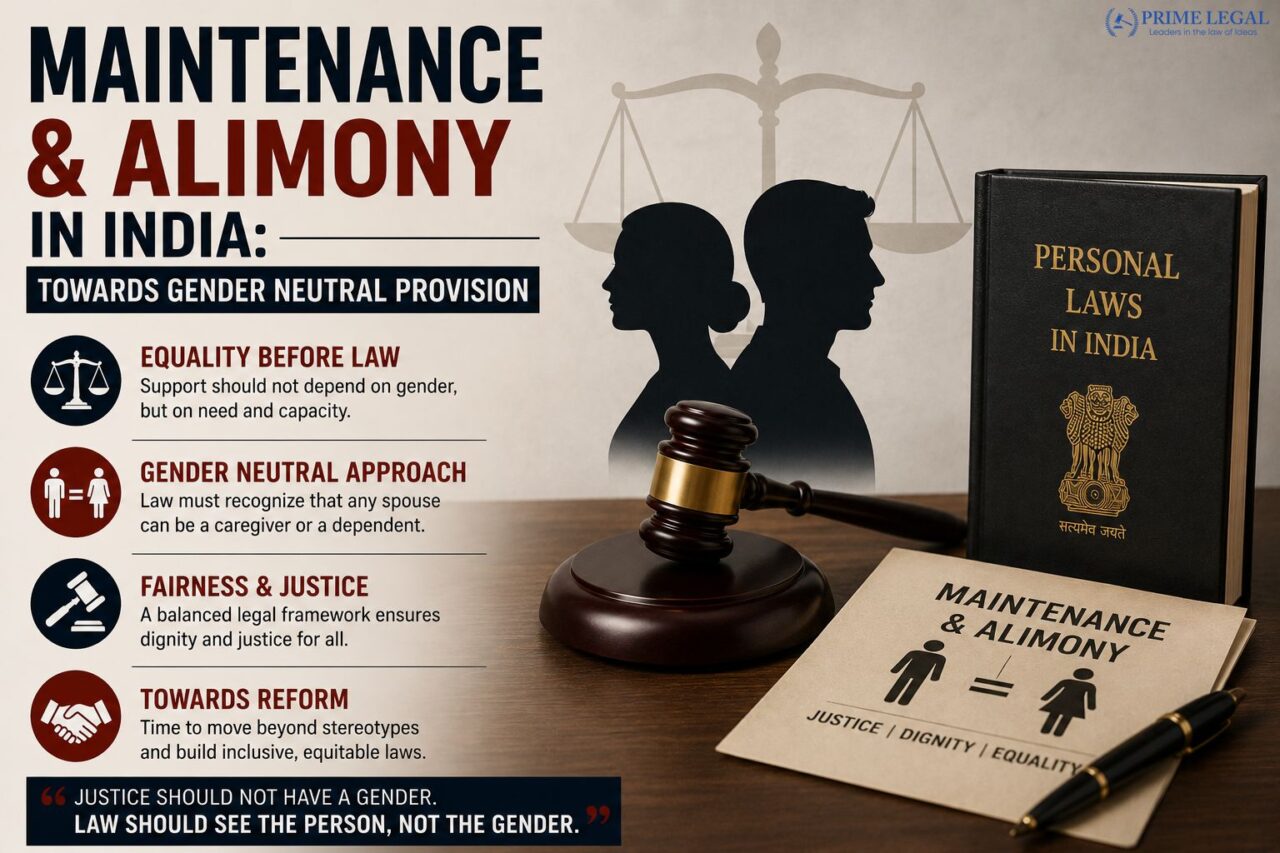
This Article examines the need for gender-neutrality and although the current laws frequently promote equality, the social stereotype that men should be the only breadwinners and women should be the eternal dependents still prevails.
INTRODUCTION
An essential part of any human’s life is companionship and cohabitation, which, in a nutshell is exactly what marriage offers. The concept of marriage has undergone a significant transformation, moving from a purely patriarchal model to one that is significantly more egalitarian. The regulations intended to oversee the separation, especially those related to maintenance and alimony, so that there is no lingering burden in the partnership.
A careful analysis of this reasoning, however, points out a paradox. Even though Article 14 and 15 of the Indian Constitution prohibits sex-based discrimination and guarantee equality, the country’s current marital support rules are fundamentally gender-specific. This has led to a system which believes for the husband to be responsible to provide, even after the separation.
THE PLIGHT OF HUSBANDS SEEKING ALIMONY
Despite these judicial improvements, the issue remains unstable and depends on a case-by-case approach to justice due to the absence of a legislative reform. The primary goal of this analysis is to break down these difficulties, evaluate the present legislation, examine the judicial trend, for India’s alimony laws to become gender-neutral and constitutionally sound. A guy who is unable to support himself is usually viewed as a failure in Indian society, which traditionally views men as providers.
Men find it extremely difficult to even consider asking the court for maintenance because of this patriarchal conditioning. Many men suffer in silence as they are afraid of social rejection, mockery and a damaged reputation. It is more common for wives who earn or have inherited some wealth to seek absurd alimony from their husbands. Due to its historical bias, the legal system may take a while to detect and correct this misuse.
It can be difficult and expensive for the husband to prove that his wife is self-sufficient and earns a living on her own. The procedure itself can become a sanction, leading to protracted court cases, monetary hardship and psychological distress. Many men decide to settle out of court to avoid the ordeal which may arise.
The predicament of husbands seeking maintenance serves as a stark reminder that true equality is not about reversing roles, but about building a legal system that is gender-neutral and simply concerned with fairness and need.
THE STATUTORY POSITION OF INDIA
India’s maintenance and alimony legal system is an intricate framework of personal and secular laws, each with its own set of regulations and prejudices. The foundation of this system is Section 125 of the Code of Criminal Procedure, 1973, a law which was created to give the spouses, children, and parents who are unable to support themselves a quick remedy.
Critics claim that considering a woman as a default beneficiary fosters an obsolete notion of female dependency and men being the perpetual providers, violating the Constitution’s equality values. The clause does not explicitly bar a husband from claiming maintenance, but in legal and social reality such claims are very rare and difficult. The Hindu Marriage Act of 1955 is more progressive, but also slightly imperfect. Both the wife and the husband can apply for maintenance pendente lite under Section 24 of the Act, while Section 25 provides permanent alimony and maintenance on the passing of a decree. Gender neutrality is directly stated in the words either the wife or the husband, as the case may be.
The application can often get warped even under this scheme. Since it is influenced by a patriarchal mindset, the judiciary tends to believe that the husband will be able to pay and the wife will not be able to sustain herself. In spite of its good intentions, the current system inadvertently fosters a cycle of dependency and unfairness, more than pushing people to stand on their own two feet economically. Legal provisions instead provide a mirror into a society in an attempt to balance constitutional ideals with conventional prejudices.
PATHWAY TO LEGISLATIVE AND SOCIAL REFORMS
The path to gender-neutral alimony and maintenance legislation in India requires a two-pronged approach i.e. strict legislative overhaul and a shift in social attitudes. The first most important step is for the legislature to modify existing law, specifically Section 125 of the CrPC, to explicitly adopt a gender-neutral stance.
A straightforward yet efficient change would be to substitute the words “wife” and “husband” with the word “spouse” or “partner,” so that the provision could be extended to anyone in need of assistance. The legislature can lay down clear guidelines for deciding the issue of maintenance, taking into account the length of the marriage, the capacity of both spouses to pay and their earning capacity, the presence of dependent children and the contributions of each spouse to the home.
Codification of these laws will also help in better applicability and interpretation of law as a whole. Beyond legal action, there needs to be a social and cultural change to achieve real gender neutrality. We need to address the deep-rooted social stigma that stops men from seeking financial help.
There is a need for cooperation between legal practitioners, social activists and members of the media to enhance consciousness and to fight patriarchal norms. We can create a more open and welcoming environment by raising public awareness of the real interpretation of these laws and showing examples of gender-neutral justice.
The legal system also needs to be sensitized to these issues. Judges and attorneys require gender-neutral training and a focus on achieving equitable results regardless of gender.
CONCLUSION
To conclude, the gender specificity of Indian laws relating to maintenance and alimony, originally intended to protect the disadvantaged women, is now outdated in a modern and equal society. Through earlier judgments the judiciary has slowly interpreted these rules to be more gender neutral and to be based on economic need rather than gender prejudices. But there’s an urgent need for legislative reform to codify these judicial victories and ensure that law is applied consistently and fairly. Gender neutrality in the maintenance provisions cannot be achieved without legal change, but also a wider societal change away from traditional patriarchal attitudes.
“PRIME LEGAL is a National Award-winning law firm with over two decades of experience across diverse legal sectors. We are dedicated to setting the standard for legal excellence in civil, criminal, and family law.”
WRITTEN BY: SHEEN.

