
ABSTRACT:
Time stops behind the bars. Once an offender becomes a victim of untold sufferings within the four walls of prison. These sufferings are far more in magnitude and inhumane in nature than any modern law contemplates to give as punishment. After days, months and years in isolation, the world outside becomes a stranger. The joy of freedom sublimes in the fear of alienation. The question that lies, “is justice served?”. Theories of retribution are bygone and the era we live in today, advocates for Reformation. However, the reality is different. With custodial violence becoming an unspoken norm, the constitutional promises seem to blur.
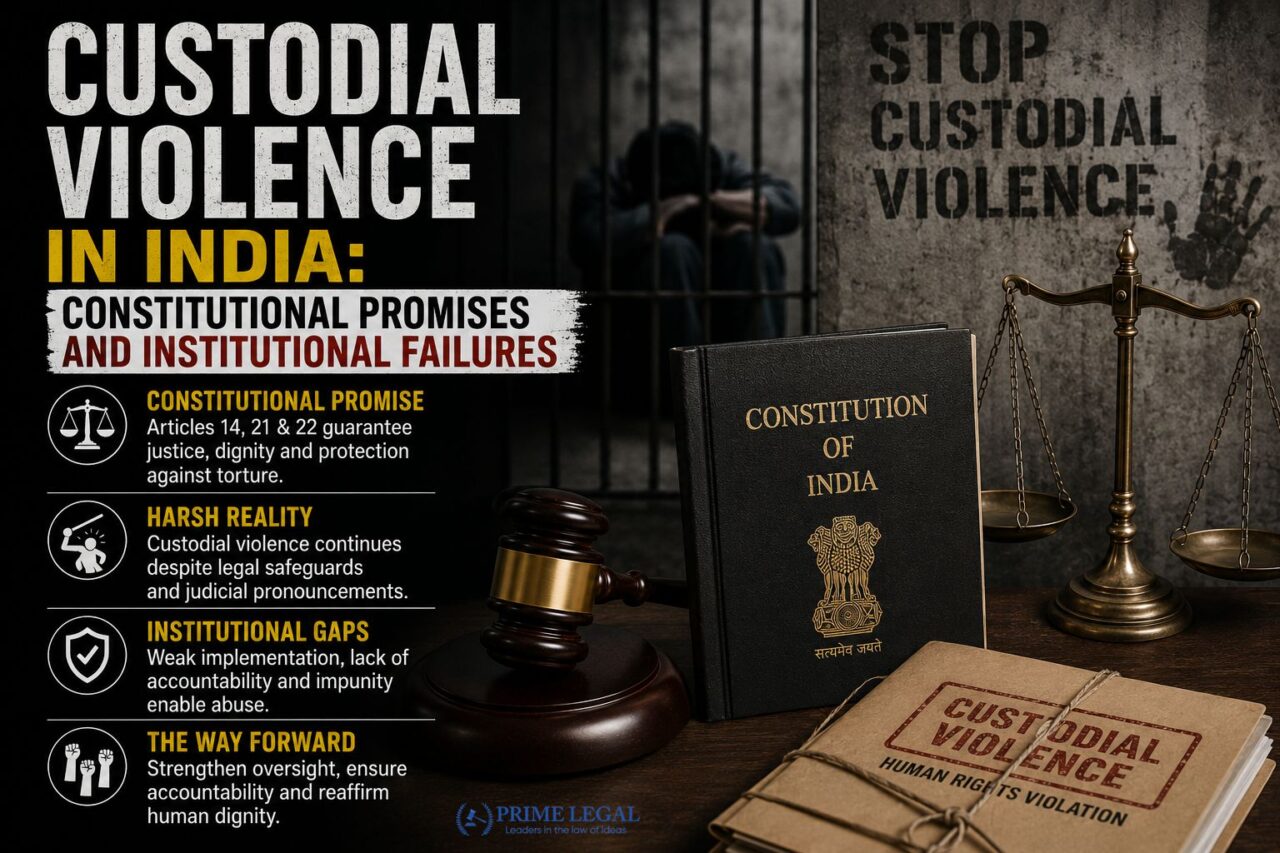
The author in this article addresses the issue of custodial violence as an institutional failure in India. Despite Constitutional provisions, legislative documentation and judicial intervention, custodial violence continues. Administrative changes and institutional reforms are required to curb custodial violence.
INTRODUCTION:
Custodial violence remains a relevant issue, with numerous cases of custody deaths and “encounter killings” reported across the country. Despite of international human rights laws, custodial torture remains systemic, and accountability mechanisms for authorities remain weak. The Supreme Court of India has many times issued directives to curb police excesses, but compliance with these guidelines has been irregular. Bail discrimination continues. This disproportionately affects the poor, as procedure disadvantages those without financial strength. The formalistic and bureaucratic nature of legal proceedings further alienates marginalized groups, making legal redress inaccessible to those who need it most (Source: Author(s): S. R. Sankaran, Economic and Political Weekly, May 29 – Jun. 4, 1999, Vol. 34, No. 22 (May 29 – Jun. 4, 1999), pp. 1316-1320).
JUDICIAL INTERVENTIONS AND EFFORTS TO CURB CUSTODIAL VIOLENCE:
Custodial Violence has been recognised by the Supreme Court, since the seventies, as an attack upon constitutional values. The case of Sunil Batra v. Delhi Administration (1980) 3 SCC 488 was one of the first cases where treatment of prisoners and their rights based on the Constitution was discussed. Sunil Batra, a condemned prisoner, had moved a writ petition for inhuman treatment and torture during custody. The Supreme Court held that prisoners have their basic rights, such as the right to dignity and humane treatment under Article 21 (Right to Life). The Court decried solitary confinement and arbitrary punishments and said that the purpose of imprisonment should be rehabilitation and not just punishment. This judgment emphasized the need for prison reforms where prisoners would be treated with dignity and offered the chance for rehabilitation.
Further in Nilabati Behera v. State of Orissa (1993) 2 SCC 746, it was held that the state is liable for custodial death in public law and not in tort and monetary compensation was awarded as a constitutional remedy under Article 32.
The Joginder Kumar v. State of Uttar Pradesh 1994 SCC (4) 260 is a seminal judgment in Indian criminal law that dealt with the abuse of police powers concerning arrest and detention. Joginder Kumar, aged 28 years and an advocate, was called by the Senior Superintendent of Police (SSP), Ghaziabad, for questioning on some undisclosed matter. Though he had promised his family that he would be let off after questioning, Joginder was arrested without a warrant or charges. His family became more worried as he was not produced before a magistrate within the prescribed 24 hours, and his whereabouts were unknown for days. This random detention led his family to present a writ petition under Article 32 of the Constitution for his release and safeguarding of his basic rights.
The Supreme Court, acknowledging the widespread abuse of the powers of arrest among police officers, held that arrests should not be arbitrary but founded on reasonable grounds and evidence. The Court underscored that the fact that there is power to arrest but that does not mean that it must be exercised; the power to arrest should only be exercised when absolutely necessary. It established procedural protections to safeguard personal liberty under Articles 21 and 22 of the Constitution. They included ensuring that the rights of the arrested individuals were made known to them, notifying a relative/friend on the arrest, filling up arrest information in the police diaries, and production before a magistrate within 24 hours.
This case has had far-reaching implications for the process of law enforcement in India by limiting the practice of making arbitrary arrests and ensuring that there is no abuse of power by those in authority through constitutional guarantees.
D.K. Basu v. State of West Bengal AIR 1997 SC 610 further developed the principles laid down in Joginder Kumar’s case by dealing with custodial violence and setting down detailed guidelines for police behaviour at the time of arrest. The background of the case can be found in the letter written by Dr. D.K. Basu to the Chief Justice of India, stating the numerous cases of torture and deaths occurring in custody in India. The Supreme Court identified custodial violence as an absolute breach of human rights and constitutional protections, resulting in the drafting of extensive procedural safeguards meant to ensure the protection of arrested or detained persons.
The Court ordered that police officers are required to introduce themselves while arresting someone, notify the arrestee of their rights, make an arrest memo noting certain details regarding the arrest, and provide for medical examinations if needed. The guidelines were created to increase transparency and accountability within law enforcement, thus decreasing occurrences of custodial torture and respect for human dignity.
Nevertheless, the implementation has been relatively poor due to certain factors, some of which overlap. Firstly, while the guidelines in D.K. Basu are obligatory, their success depends on the cooperation of the police establishment itself, and agencies responsible for monitoring such as District Legal Services Authorities and Human Rights Commissions often lack capacity and are mostly reactive instead of being proactive. Secondly, the investigation into any deaths in custody takes place by the police chain itself involved in the matter, which poses the conflict of interests that judicial inquiries can only partly solve. Thirdly, the lack of separate legislation on torture causes the prosecution to take place under the provisions of hurt or culpable homicide, which do not sufficiently reflect the aggravating circumstances of torture and thus make conviction relatively uncommon for the number of complaints. Finally, social and economic circumstances exacerbate the situation, as evidenced by cases with members of marginalized castes.
RECENT CASES AND CALL FOR INSTITUTIONAL CHANGES:
Several recent cases reveal that despite longstanding efforts, custodial violence continues to be a constant. In Khursheed Ahmad Chohan v. Union Territory of Jammu and Kashmir 2025 INSC 876, the Supreme Court dealt with the issue of inhumane custodial torture that had been carried out over several days with extreme severity and led to serious injuries to the body of the individual concerned. This judgement re-established that custodial torture amounts to human rights violations which violate Article 21 of the constitution. It highlighted the absence of special laws regarding torture despite judicial pronouncements in the past. Moreover, in Manik v. State of Maharashtra 2024 INSC 734, the court dealt with a case of custodial torture resulting in death, emphasizing the importance of circumstantial and medical evidence in proving custodial torture.
CONCLUSION:
While the constitutional prohibition on custodial violence has theoretical foundation and judicial backing stretched across decades, practical implementation and institutional practices remain insufficient. A gap that that still exists, include the lack of a comprehensive legislation on anti-torture rules that define custodial offenses clearly. Further, absence of any independent investigating agency that is free from the police system complicates the situation. Until these gaps are filled, custodial violence will continue as an institutional failure.
“PRIME LEGAL is a National Award-winning law firm with over two decades of experience across diverse legal sectors. We are dedicated to setting the standard for legal excellence in civil, criminal, and family law.”
WRITTEN BY: SOMSUTA PAUL

