
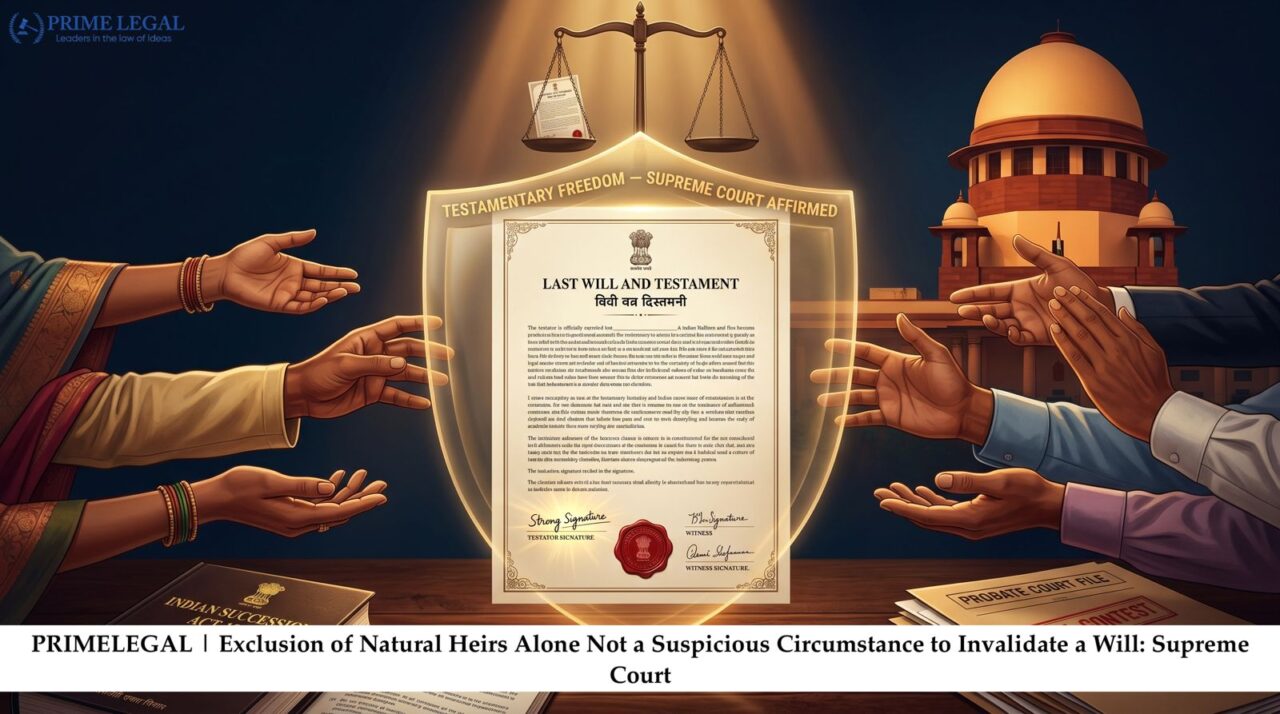
CASE: Parvathi Nairthi (Dead) & Others v. Laxmi Nairthy (Dead) Through LRs. & Others CDJ 2026 SC 816
CASE NUMBER: Civil Appeal No. 6859 of 2014 (Arising out of SLP (Civil) No. 12822 of 2013)
COURT: Supreme Court of India
DATE: May 21, 2026
QUORUM: Hon’ble Mr. Justice Ujjal Bhuyan and Hon’ble Mr. Justice Vijay Bishnoi
FACTS
A successful Chartered Accountant named ‘B. Sheena Nairi’ lived in Bombay but owned valuable ancestral and agricultural lands in Udupi, Karnataka. For managing his properties in Karnataka, he had given a Power of Attorney (POA) to his brother-in-law, Krishnayya Nairi.
On May 15, 1983, Sheena Nairi made his last Will. In this Will, he left all his Karnataka properties to his younger sister, Laxmi Nairthy (the Plaintiff), and canceled the POA given to his brother-in-law. A few months later, on November 30, 1983, Sheena Nairi died of a heart attack in Delhi.
After his death, his wife, Parvathi Nairthi, quickly applied to the local Tehsildar and got the properties transferred to her own name in April 1984. Although the sister, Laxmi, requested the Tehsildar to change the records to her name based on the Will, the property remained under the control of the wife, the brother-in-law, and later the brother-in-law’s son. In October 1990, the brother-in-law’s family threatened Laxmi and tried to forcefully cut her crops. Consequently, in November 1990, Laxmi filed a civil suit to be declared the legal owner of the properties based on the Will.
The wife and children of the deceased argued in court that the Will was completely fake and forged by Sheena’s brothers. However, three lower courts, the Trial Court, the First Appellate Court, and the Karnataka High Court all ruled in favor of the sister, validating the Will. The wife and children then appealed to the Supreme Court.
ISSUES
- Is the Will valid, and did the sister legally prove its execution as required by law?
- Does the burden of proving forgery shift to the challengers once the execution of a Will is initially proved?
- Can similar findings of the three lower courts upholding a Will be reversed by the Supreme Court without strong legal grounds?
LEGAL PROVISIONS
- Indian Evidence Act, 1872 / BSA, 2023: Section 68 / 67 (Rule for proving a document that requires witnesses, like a Will, by calling at least one living witness to testify).
- Code of Civil Procedure, 1908 (CPC): Order XLI Rule 31 (Rules detailing how an appellate court should frame points for determination and give its decision).
ARGUMENTS
APPELANTS
They argued that the sister filed the suit seven years after the will was written and six years after land records were updated in the wife’s favor, without giving any legal valid explanation.
They further question why a husband would leave all his lands to his sister while completely excluding his own wife and children that were his primary responsibility.
They submitted that the brother who witnessed the Will gave confusing statements such as saying Sheena died in Bombay instead of the actual place that is Delhi.
They claim the first appellate court broke procedural rules by failing to properly structure its formal points of determination.
RESPONDENT
They argued that while the wife and family claimed forgery they never requested a handwriting expert to check the signature, failing to prove their own claims.
Crucially, the wife and children never actually stepped into the witness box to testify or answer questions under cross-examination. Only the son of the POA holder testified because he wanted to keep control of the land.
They noted that the Will itself explicitly states that Sheena Nairi had already given plenty of other assets and properties to his wife and children in Bombay.
They explained that the sister filed the suit only when the former POA holder’s family actively threatened her and tried to destroy her crops in 1990.
ANALYSIS
The Supreme Court analyzed the rules under Section 68 / 67 of the Indian Evidence Act / BSA. To make a Will valid, at least one witness must testify that the testator signed it willingly. In this case Sheena’s brother explicitly testified as a witness confirming that Sheena signed the Will in his presence.
The court observed that once the sister produced a valid witness to prove the validity of the Will the onus now shifted to the wife and children to prove their claim of forgery. However, the family completely failed to do this. They did not call a handwriting expert, and more importantly, they refused to sit in the witness box to face cross-examination. The Trial Court had even compared Sheena’s signatures on the Will with his undisputed signatures on the older POA documents and found them to be identical.
Regarding the family’s exclusion, the Supreme Court noted that the High Court made a correct observation. The Will itself explained that the wife and kids were already well-provided for with assets in Bombay. The family provided no proof to deny this statement. Finally, the court dismissed the technical objection about how the lower appellate court framed its points of determination stating that minor technical omissions under the CPC do not erase detailed well reasoned findings.
JUDGEMENT
The Supreme Court dismissed the appeal claiming forgery filed by the wife and the children. The bench upheld the decisions of the lower courts, confirming that the Will is completely valid and that the sister’s heirs are the rightful owners of the property.
CONCLUSION
This judgment highlights how courts do not entertain serious allegations of fraud and forgery unless the party making the claim backs it up with solid evidentiary proofs. A party cannot simply make a claim in writing and then refuse to stand in the witness box to tell the truth. By confirming the decisions of the three lower courts, the Supreme Court protected a genuine family arrangement and ensured that a person’s documented final wishes are respected over unproven family disputes.
“PRIME LEGAL is a National Award-winning law firm with over two decades of experience across diverse legal sectors. We are dedicated to setting the standard for legal excellence in civil, criminal, and family law.”
WRITTEN BY: LISHIKA BATRA
Read the judgement copy below:
Parvathi Nairthi (Dead) & Ors. vs. Laxmi Nairthy (Dead) Through LRs. & Ors

