
CASE NAME: Mr. Dileep Singh vs. Smt. Girija Devi
CITATION: 2026:DHC:4568
CASE NUMBER: RFA 481/2026
COURT: High Court of Delhi at New Delhi
DATE OF JUDGMENT: 21 May 2026
QUORUM: Hon’ble Ms. Justice Neena Bansal Krishna
FACTS
In the present Regular First Appeal, Mr. Dileep Singh challenged the judgment and decree which the District Judge issued on 23 March, 2026. By this decision, the court ruled in favour of Smt. Girija Devi in her suit to recover Rs. 8,99 015 with pendent lite and future interest.
Smt. Girija Devi stated that her father-in-law, Late Sh. Prabhu Nath Singh, established multiple joint bank and post office accounts during his life. He listed himself, the plaintiff and the defendant as holders. After he died on 1 August, 2009, the defendant used the accounts and took out the money without telling the plaintiff.
To verify those actions, the plaintiff got a duplicate passbook from the Yusuf Sarai Branch of the Indian Overseas Bank. It was through this document that she found Savings Account No. 107001000001077 held Rs. 17,98 030.77 when Late Sh. Prabhu Nath Singh died.
For her legal claim, the plaintiff used a registered Will which Late Sh. Prabhu Nath Singh signed on 26 June, 2007. The document stated that the cash balance in joint accounts is to belong solely to the surviving joint holders. She claimed that she was entitled to 50% of the amount, and sued for the recovery of Rs. 8,99 015.
The Trial Court decreed the suit in favour of the plaintiff. The defendant later brought this appeal to the Delhi High Court.
ISSUES
- Whether the plaintiff was entitled to 50% share in the amount lying in the joint bank account under the Will dated 26 June 2007.
- Whether the suit instituted in 2014 was barred by limitation under Article 113 of the Limitation Act, 1963.
- Whether the Trial Court erred in treating the plaintiff’s claim as one arising from entitlement under the Will rather than a recovery suit.
LEGAL PROVISIONS
- Section 96 read with Order XLI Rule 1 of the Code of Civil Procedure, 1908.
- Section 68 of the Indian Evidence Act, 1872.
- Article 113 of the Limitation Act, 1963.
- Case Laws:
- Trojan & Co. Ltd. vs. N.N. Nagappa Chettiar
- Bachhaj Nahar vs. Nilima Mandal
- Ishwar Dass Jain vs. Sohan Lal
- Thayyullathil Kunhikannan vs. Thayyullathil Kalliani
ARGUMENTS
APPELLANT
The appellant stated that the legal action is past the time limit because the plaintiff knew about the use of the account from September 2009. By his argument the Trial Court changed the nature of the suit for money recovery to a claim for property division only to bypass the rules of limitation. To support this he stated that the Will is not a source of a specific debt and that the Trial Court gave half of the money without a process to decide the legal right of the parties.
And the appellant argued that the court did not accept the spoken evidence of DW-2, Smt. Seema Singh. If the court had acted differently, it would have examined the agreement made between the family members.
RESPONDENT
On the side of the respondent, Smt – girija Devi argued that the Will is registered and states that the money in joint accounts is for the holders who remain alive. For her the defendant did not give her the portion that the Will describes and she is therefore in a position to get her part of the money back.
ANALYSIS
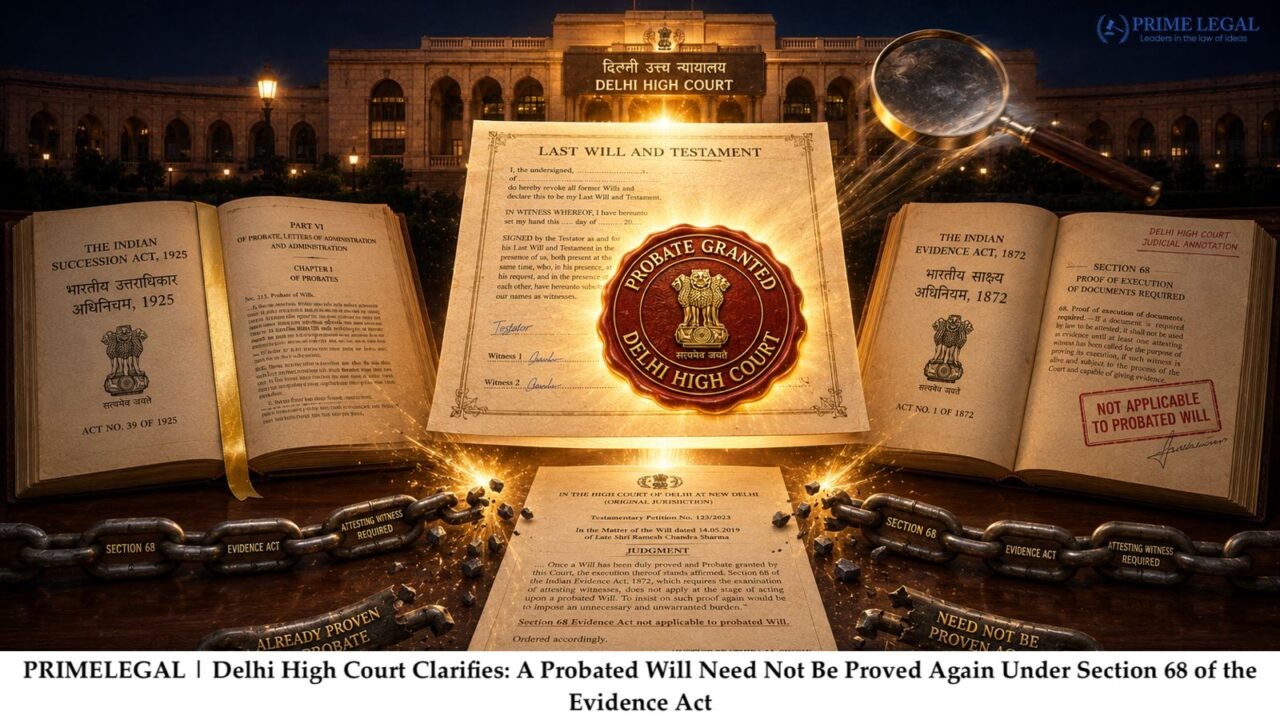
In its analysis the High Court noted that the Will from 26 June 2007 is already a proven document in Probate Case No. 120/2011. Because the court with the necessary power granted Letters of Administration, the document is a judgment in rem. Because of this status, the Will is not a document that needs more proof under Section 68 of the Indian Evidence Act.
The Court referred to the clause in the Will which stated:
“The cash balance in joint accounts opened with the Banks and/or Post Office shall go and devolve upon the respective joint holder exclusively.”
In this case the Court decided that the meaning of the person who made the will was clear. It is a fact that both the plaintiff and the defendant are the joint holders who survived. On that account both people have an equal right to the money that remains in the account. As the account held Rs. 17,98 030.77 at that time, the plaintiff has a right to half of that amount.
On the topic of limitation, the Court decided that it does not count as a refusal of the rights of the plaintiff just because she knew someone used the account in 2009. The cause of action started only when the plaintiff said she had a right to the money and the defendant did not pay her. It is the view of the Court that the plaintiff first said she had a claim in a way that produced an effect after she got the duplicate passbook in June 2013. And she said this again through the legal notice on 10 August 2013. The suit is within the time limit because she started it on 7 July 2014.
The Court rejected the plea of the appellant about a family settlement, on the ground that no proper documents were provided to establish any relinquishment of rights by the plaintiff.
JUDGEMENT
The Delhi High Court dismissed the appeal and upheld the judgment and decree passed by the Trial Court. The Court affirmed that Smt. Girija Devi was entitled to recover Rs. 8,99,015 along with interest at 6% per annum from the defendant.
CONCLUSION
The judgment reaffirms that rights flowing from a duly probated Will are binding and enforceable upon beneficiaries and co-holders. The Court clarified that limitation in such matters commences only upon denial or non-recognition of entitlement and not merely from awareness of account operations. The decision also strengthens judicial recognition of testamentary rights in jointly held financial assets.
“PRIME LEGAL is a National Award-winning law firm with over two decades of experience across diverse legal sectors. We are dedicated to setting the standard for legal excellence in civil, criminal, and family law.”
WRITTEN BY: SAMANA.
Read the judgement copy below:

