
INTRODUCTION
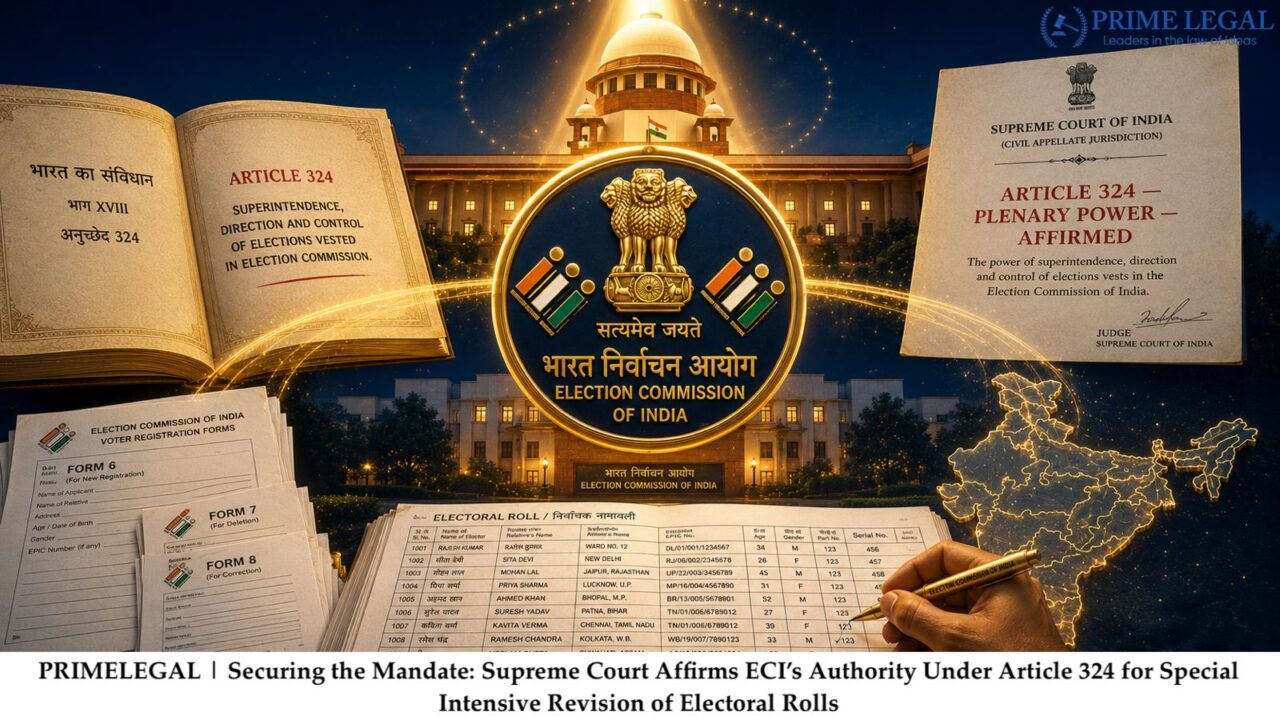
The Supreme Court of India confirmed that the Election Commission of India possesses the legal power to perform a Special Intensive Revision of electoral rolls because of Article 324 of the Constitution. In its judgment the Court stated that the basic structure of the Constitution includes elections that are conducted without bias or restriction. It is necessary to keep voter lists correct so that the government remains lawful and democratic.
For this case the dispute began when petitions questioned why the Election Commission decided to revise voter lists on a wide scale in Bihar. The Commission intended to find voters who were listed more than once, people who had died or individuals who did not meet the legal requirements to vote. By filing those petitions, the parties argued that this action might result in people losing their right to vote and that the Commission was acting beyond its legal limits, but the Court dismissed the arguments and ruled that the Election Commission stayed within the roles that the Constitution and statutes define.
BACKGROUND
As stated in Article 324 of the Constitution, the Election Commission has the power of “superintendence, direction and control” regarding elections. And this authority exists alongside Section 21(3) of the Representation of the People Act, 1950. Because of this law, the Commission is able to perform special revisions of voter lists at any time that is required.
To improve how correct and honest the voter lists are, the Election Commission started the Special Intensive Revision. When this happened, the petitioners claimed that the process for the revision did not have enough protections for voters and that it might remove individuals who have a legal right to vote. On those grounds they also claimed that the Election Commission was using powers that were beyond those granted by statute.
The Supreme Court examined whether the Special Intensive Revision exercise violated constitutional protections or exceeded the ECI’s jurisdiction.
KEY POINTS
- The Supreme Court upheld the legality and constitutional validity of the ECI’s Special Intensive Revision exercise.
- To ensure that elections are free and fair, the Court confirmed that the Election Commission possesses the powers granted by Article 324.
- In this decision, the Court stated that electoral integrity and democracy in the country depend on if officials maintain electoral rolls correctly.
- It is clarified that Section 21(3) of the Representation of the People Act, 1950 is the provision that permits officials to revise electoral rolls.
- It is necessary for judges to interfere in electoral administration only if there is evidence that actions are clearly arbitrary, show mala fide intent or are illegal.
- By this ruling, the Court emphasised that principles of fairness are required and that procedural safeguards must exist when officials conduct revision exercises.
ANALYSIS
The judgment supports the ability of the Election Commission to act independently while it remains accountable under the constitution. By stating that the Election Commission has authority, the Court noted that when there are discrepancies in voter rolls, people lose their trust in the election process and that it weakens democracy in the eyes of the public.
But the Court did not allow the Commission to have power that no one can check. In the ruling it is stated that although the Election Commission has wide powers under the constitution, it must use those powers in a way that is fair, open to view and follows legal procedures.
And the decision makes Article 324 stronger as a part of the constitution that changes to meet new problems in elections. If laws do not describe specific steps for every problem during an election, the Election Commission can use its constitutional duty to protect the honesty of the electoral process.
CONCLUSION
By this ruling the Supreme Court stated again that it is essential for the lists of voters to be clean and believable so that elections in India remain open and equitable. To protect the structure of the constitution for democratic government, the Court supported the power of the Election Commission to perform Special Intensive Revisions.
The judgment is a way to show that the right to vote relies on more than just people taking part. For this right to exist, the electoral system must also be honest, correct and lawful.
“PRIME LEGAL is a National Award-winning law firm with over two decades of experience across diverse legal sectors. We are dedicated to setting the standard for legal excellence in civil, criminal, and family law.”
WRITTEN BY: SAMANA.

