
INTRODUCTION
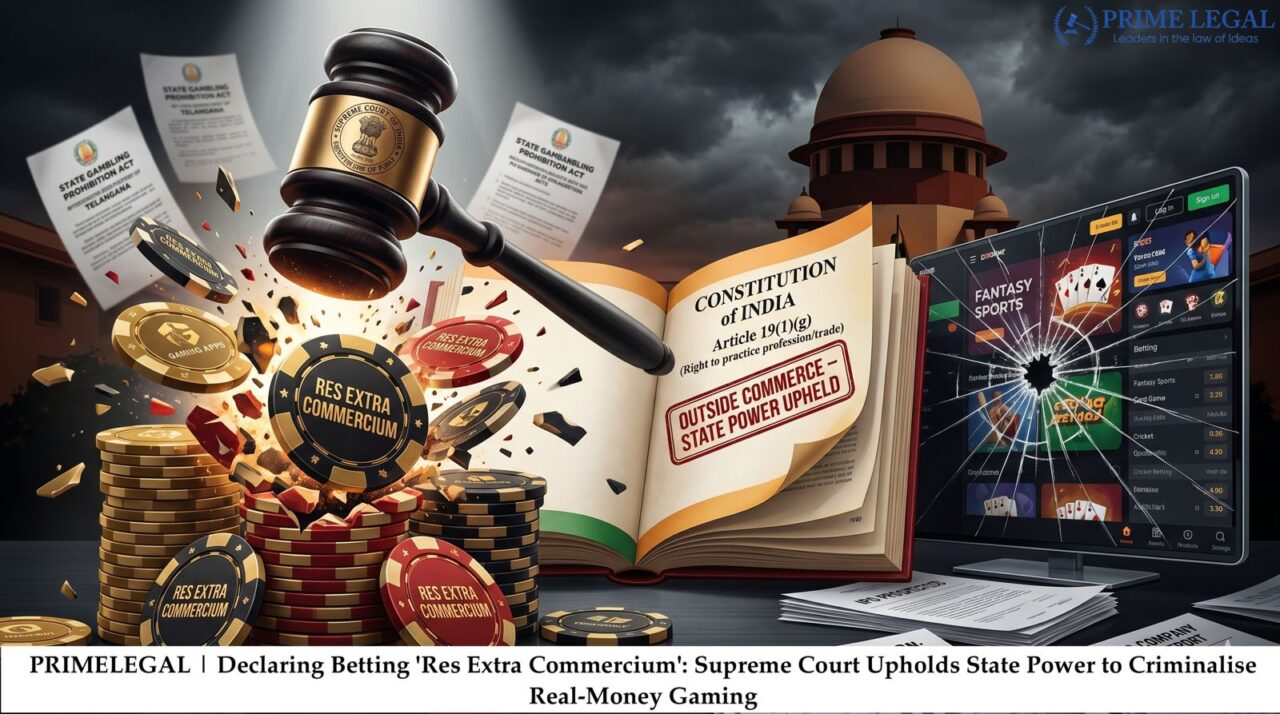
The Supreme Court has delivered a massive shock to India’s multibillion dollar gaming market. The court clarified that when real money is involved the distinction between a “game of skill” and “game of money” doesn’t matter. Under the Indian Constitution citizens have a fundamental right to carry on any business and trade under Article 19 (1) (g) however, the court clarified that betting and gambling are social evils and cannot claim any protection under this, giving power to states to completely outlaw these platforms.
BACKGROUND
Over the past few years, states like Tamil Nadu and Karnataka have passed strict amendments with regard to local gaming laws and have banned online games played for money. They did this following widespread public concern over rising user addiction, financial losses and a tragic rise in suicide among young people.
However online gaming companies challenge these amendments in court the Madras High Court and Karnataka High Court which previously ruled in favor of these companies striking down the ban of the state. The High Courts had argued that popular online gaming platforms were legally recognized as “game of skills” by precedents and therefore, a total ban on these were excessive and violated their right to carry on business under Article 19 (1) (g). The state government then appealed these decisions to the Supreme Court.
KEY POINTS
- The Supreme Court applied the doctrine of res extra commercium, stating that activities harmful for the society like gambling or trading in toxins cannot be treated as regular business and cannot thereby be protected under Article 19 (1) (g).
- The Bench highlighted that while a game itself might require intelligence and skill, the act of putting money on an uncertain future outcome is still considered as betting when money enters the picture the game essentially becomes a gambling activity.
- The court rejected the view that state governments lacked the power to regulate the games of skill. It further held that states are fully authorized under the Constitution to ban any form of wagering to protect public health and maintain public order.
- The judiciary further took a serious note of the social implication of online gaming; it agreed with the states that online betting platforms create severe addiction and emotional stress within youth causing widespread public health issues that require government intervention.
RECENT DEVELOPMENT
In the case of State of Tamil Nadu V. Jungle Games India Private Limited Civil Appeal Nos. 6124-6131 / 2023 (Arising out of SLP(C) Nos. 19981-19988 / 2021), a bench comprising Justices J.B. Pardiwala and R. Mahadevan delivered a final judgment on May 27, 2026.
The Supreme Court completely set aside the earlier orders given by Madras and Karnataka High Court declaring anti-gambling laws as fully valid. Further along with this judgment the court also gave a financial shock to the industry by giving another judgment of Directorate of Revenue Intelligence V. Gameskraft SLP(C) No. 19366-19369/2023. In this case the bench upheld governments right to levy 28% of Goods and Services Tax (GST) on the value of bets placed on these betting platforms and allowed the tax department to collect these dues retroactively.
CONCLUSION
The Supreme Court’s landmark judgment marks a historic shift on how India legally views digital gaming. By marking real money gaming as an extra commercium, the court has closed the constitutional loophole that the gaming apps were using to protect themselves. This judgment strongly places public welfare and mental health above profits. While it safeguards purely recreational games of skill it effectively gives away with the legal protection given to the real money gaming industry, giving every state in India the absolute authority to levy tax on online betting.
“PRIME LEGAL is a National Award-winning law firm with over two decades of experience across diverse legal sectors. We are dedicated to setting the standard for legal excellence in civil, criminal, and family law.”
WRITTEN BY: LISHIKA BATRA

