
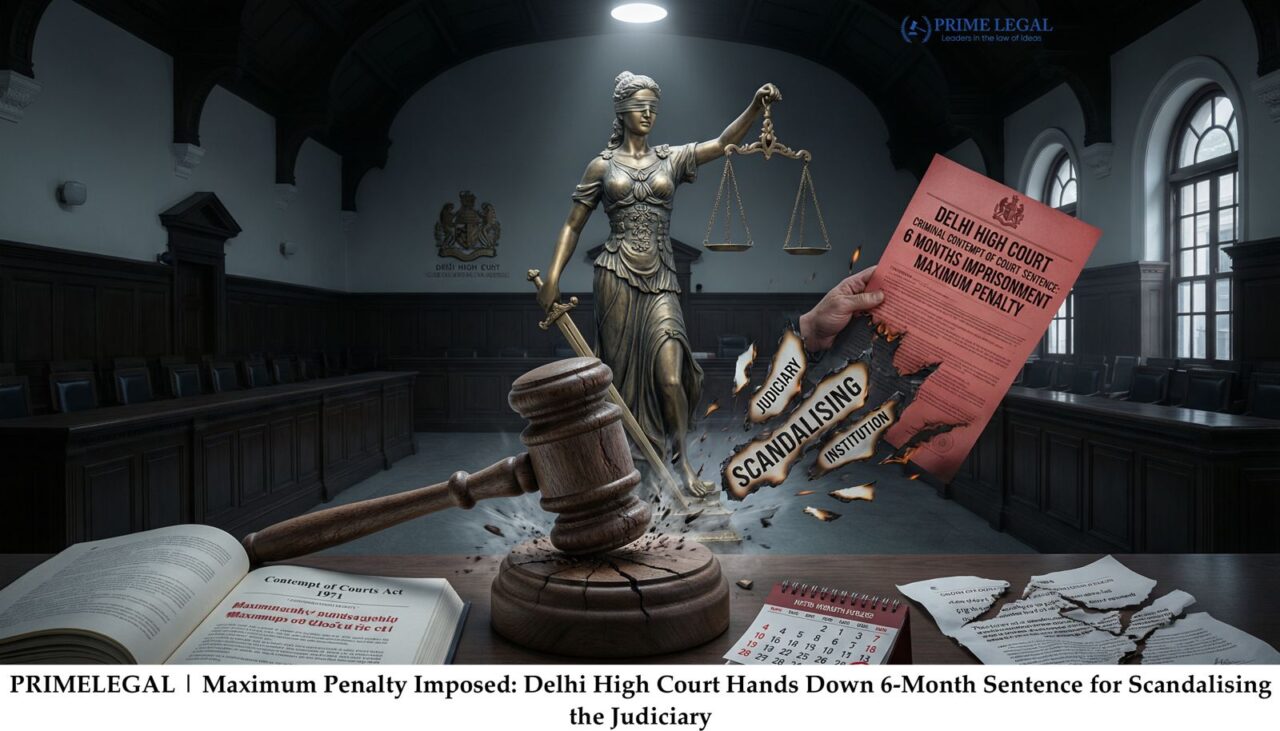
CASE: Court on Its Own Motion v. Shiv Narayan Sharma, Adv. & Ors. (In re: Gulshan Pahuja) 2026:DHC:4423-DB
CASE NUMBER: Contempt Case (Criminal) No. 3 of 2025 & Contempt Case (Criminal) No. 4 of 2025
COURT: High Court of Delhi
DATE: May 16, 2026
QUORUM: Hon’ble Mr. Justice Navin Chawla and Hon’ble Mr. Justice Ravinder Dudeja
FACTS
This case is a “criminal contempt” proceeding started by the Delhi High Court on its own (suo motu). The Court took action against an Advocate, Mr. Gulshan Pahuja (Respondent No. 2/Contemnor), for his highly improper behavior inside a courtroom. On April 21, 2026, the Delhi High Court had already heard the details of his behavior and officially found him guilty of criminal contempt
Mr. Pahuja had shouted at a sitting judge, used extremely abusive and insulting language and tried to intimidate the court to get an order in his favor. Even worse was that when the judge asked security to remove him, he aggressively threatened the judge saying that he would harm the judge’s career and physical safety outside the court. The current order dated May 16, 2026, was specifically passed to decide what punishment he should receive for his behavior.
ISSUES
- What is the appropriate punishment for an advocate who insults, shouts at, and threatens a sitting judge inside a courtroom?
- Should the court accept a standard apology from an advocate when their previous behavior shows they are not genuinely sorry?
- Can the High Court stop a lawyer from practicing law as part of a contempt punishment?
LEGAL PROVISIONS
- Contempt of Courts Act, 1971: Section 2 (c) : Defines “criminal contempt”.
- Section 12: Rules for Punishment for Contempt (maximum of 6 months of imprisonment and fine up to Rs 2,000 or both)
- Section 19(3): Gives the Court the power to pause/ suspend the imprisonment temporarily for appealing to the Supreme Court.
- Constitution of India: Article 215 (Makes High Courts as “Court of Record”).
ARGUMENTS
CONTEMNOR
Mr. Pahuja appeared in person and asked the court to be lenient. He submitted a written apology and asked the court to forgive him without sending him to jail.
He argued that if the court chose to punish him, the sentence should be paused so he could challenge both the guilty verdict and the punishment before the Supreme Court of India. He further argued that for determining the quantum of punishment, the fact that the judgement holding him guilty itself is incorrect on the basis of which the sentence should be reduced in support of which he relied on the case of Modi Telifibres Ltd. & Ors V. Sujit Kumar Chaudhary (2005) 7 SCC 40, National Fertilizers Limited V. Tuncay Alankus & Anr. (2013) 9 SCC 600 and Ankush Maruti Shinde & Ors. V. State of Maharashtra (2019) 15 SCC 470.
COURT
The lawyers assisting the court (Amicus Curiae) and the Government Prosecutor argued that the behavior was an attack on the entire justice system.
They argued that a lawyer cannot use a simple apology as a “shield” to escape punishment after making severe personal threats against a judge. They demanded a strict prison sentence to set an example for the legal community.
ANALYSIS
The High Court looked closely at Mr. Pahuja’s conduct during the hearings. The judges noticed that even after being found guilty, he showed no real regret. Instead of being genuinely regretful, he kept trying to justify his bully behavior in the court and made excuses for shouting at the Judge.
The court explained that a lawyer’s apology must be sincere, voluntary and actual and must come from a place of true regret. A fake or tactical apology offered just to escape jail cannot be accepted. The Bench emphasized that the judiciary cannot function if lawyers are allowed to bully, threaten, or abuse judges when they do not get the orders they want.
The Court highlighted that while lawyers have a true duty to fight hard for their clients, they must always maintain basic manners and respect for the Court. Because Mr. Pahuja crossed all lines of professionalism and threatened a Judge’s safety, the court ruled that a simple fine would be too light and imprisonment was absolutely necessary to protect the dignity of the Court.
JUDGEMENT
The High Court sentenced Mr. Gulshan Pahuja to simple imprisonment for a period of 6 months (the maximum allowed under the law) and ordered him to pay a fine of Rs. 2,000. If he fails to pay the fine, he will have to spend an extra 15 days of imprisonment.
Furthermore, the Court used its constitutional powers to bar him from entering, appearing, or practicing law in the Delhi High Court and all District Courts in Delhi for a period of one year.
However, as Mr. Pahuja stated that he wants to file an appeal for this decision. The Court used Section 19(3) of the Contempt of Courts Act to pause his jail sentence for sixty days. If the Supreme Court does not extend this pause within 60 days, he must surrender to the Registrar General of the High Court immediately.
CONCLUSION
This judgement is a reminder that the law will not tolerate misbehavior from its own officers. While courts generally respect the independence of lawyers, they will act strictly against anyone who tries to scare or insult Judges. By handing down the maximum possible prison sentence and a one-year practice ban, the Delhi High Court made it clear that preserving public trust in the justice system is far more important than protecting a misbehaving lawyer.
“PRIME LEGAL is a National Award-winning law firm with over two decades of experience across diverse legal sectors. We are dedicated to setting the standard for legal excellence in civil, criminal, and family law.”
WRITTEN BY: LISHIKA BATRA
Read the judgement copy below:
COURT ON ITS OWN MOTION Vs SHIV NARAYAN SHARMA ADV. AND ANR.

