
CASE NAME: Mr. Riyaz Ahmed v. Karnataka State by North Traffic P.S., Mangalore
CASE NUMBER: Criminal Revision Petition No. 486 of 2018
COURT: High Court of Karnataka at Bengaluru
DATE: 28 April 2026
QUORUM: Hon’ble Mr. Justice V. Srishananda
FACTS
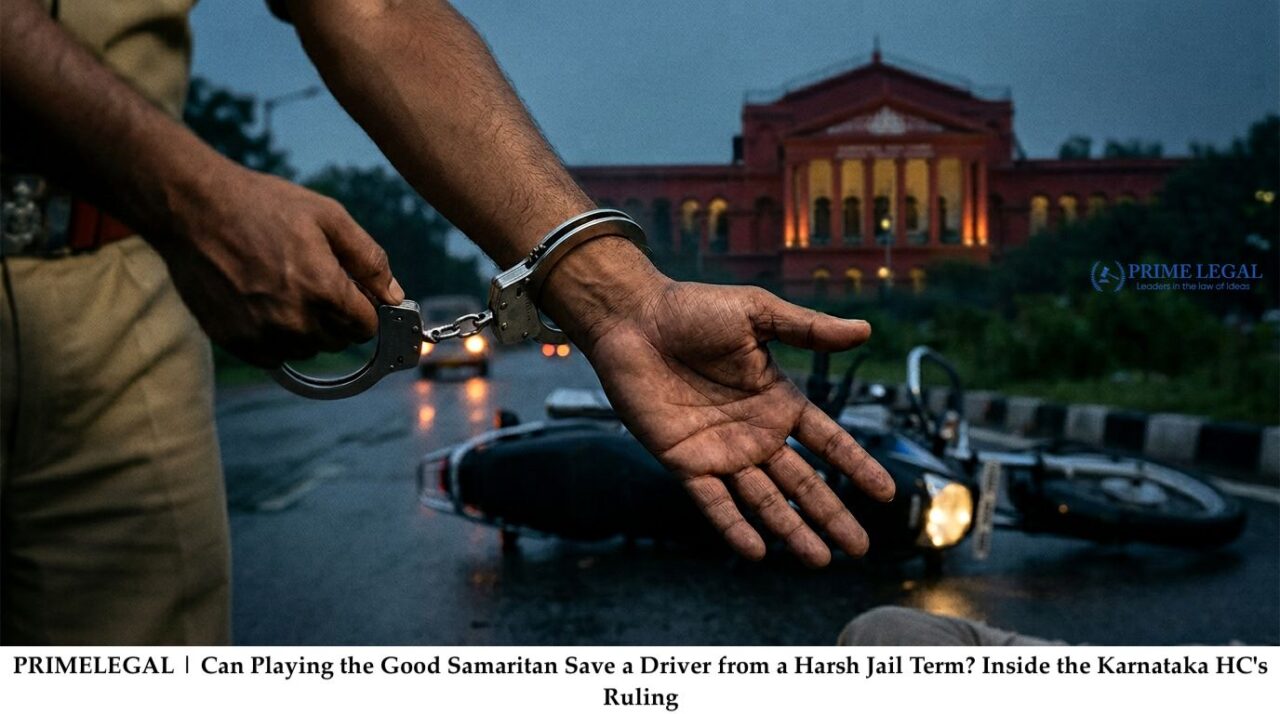
In the present case, a road accident occurred on 15 July 2015 at approximately 6:30 p.m. When the event took place, the petitioner, Mr. Riyaz Ahmed, was the person who operated the car. As a result of the collision, Anand Shetty died.
Officials registered a criminal case against the petitioner under Sections 279 and 304A of the Indian Penal Code for rash and reckless driving resulting in death of the victim. In C.C. No. 3531 of 2015. The Trial Court held that the petitioner was guilty and ordered that the petitioner stay in prison for a year and pay a fine of ₹5 000.
In Criminal Appeal No. 151 of 2017, the Principal Sessions Judge, D.K. Mangalore upheld the judgment. The petitioner later filed a Criminal Revision Petition with the High Court of Karnataka and requested a modification of the sentence.
ISSUES
- Whether the conviction of the petitioner under Sections 279 and 304A IPC required interference.
- Whether the sentence imposed by the lower courts should be modified considering the circumstances of the case.
LEGAL PROVISIONS
- Section 279 of the Indian Penal Code – Rash driving on a public way.
- Section 304A of the Indian Penal Code – Causing death by negligence.
- Sections 397 and 401 of the Code of Criminal Procedure – Revisional jurisdiction of the High Court.
ARGUMENTS
PETITIONER
The petitioner stated that he stayed at the location after the accident occurred. Instead of leaving, he stopped the vehicle and moved the person who was hurt to the hospital in his own car. For those reasons, he argued that the court should consider his actions as a reason to lower the punishment.
If the court removes the requirement for prison, the petitioner is willing to pay more money to the family of the person who died, but the petitioner also stated that he experienced injuries during a different accident. On his right leg there is a medical device that doctors implanted. Because of his physical state, he is no longer able to work as a driver. At this time he is a person who performs small tasks to earn money.
RESPONDENT
The State argued that the record contains enough evidence for the court to keep the conviction. By the State’s account, the petitioner drove in a way that lacked care and this act caused a person to die, but the State also suggested that the court could change the sentence if the petitioner pays more money to the family of the dead person.
ANALYSIS
When the High Court looked at the records, it saw that the accident caused Anand Shetty to die. As the evidence on the record is enough, the court kept the conviction of the petitioner under Sections 279 and 304A IPC, although some witnesses did not support the initial claims. At the same time the Court looked at how the petitioner acted after the accident.
It is a fact that the petitioner stayed at the location and helped the injured person moving him to a hospital. With those details, the Court also noted that the petitioner is willing to pay more money to the family members who relied on the dead person.
Due to his health problems and his lack of money, the Court considered the factors as well. In the view of the Court, it is better for the legal outcome to make the time in prison shorter and to make the payment to the family larger.
JUDGEMENT
On 28 April 2026, the High Court of Karnataka partly allowed the Criminal Revision Petition.
The Court upheld the conviction of the petitioner under Sections 279 and 304A IPC. However, it modified the sentence imposed by the lower courts. Instead of one year’s simple imprisonment, the petitioner was directed to undergo imprisonment for the day till the rising of the Court. The Court also enhanced the fine amount to ₹1,00,000.
The fine amount was directed to be paid in two equal installments. Out of the total amount, ₹50,000 each was ordered to be paid as compensation to the wife and son of the deceased.
The Court further clarified that failure to pay the enhanced fine amount would automatically restore the original sentence imposed by the Trial Court.
CONCLUSION
While the High Court maintained the conviction for causing death by negligent driving, it recognised the petitioner’s responsible conduct after the accident and his willingness to compensate the victim’s family.
The decision reflects a reformative approach in sentencing, where compensation to victims and genuine remorse of the accused were given significant weight. It also reinforces that courts may reduce imprisonment in appropriate cases where justice can be achieved through meaningful compensation and mitigating circumstances.
“PRIME LEGAL is a National Award-winning law firm with over two decades of experience across diverse legal sectors. We are dedicated to setting the standard for legal excellence in civil, criminal, and family law.”
WRITTEN BY: SAMANA
Read the judgement copy below:
Mr. Riyaz Ahmed v. Karnataka State By North Traffic P.S., Mangalore

