
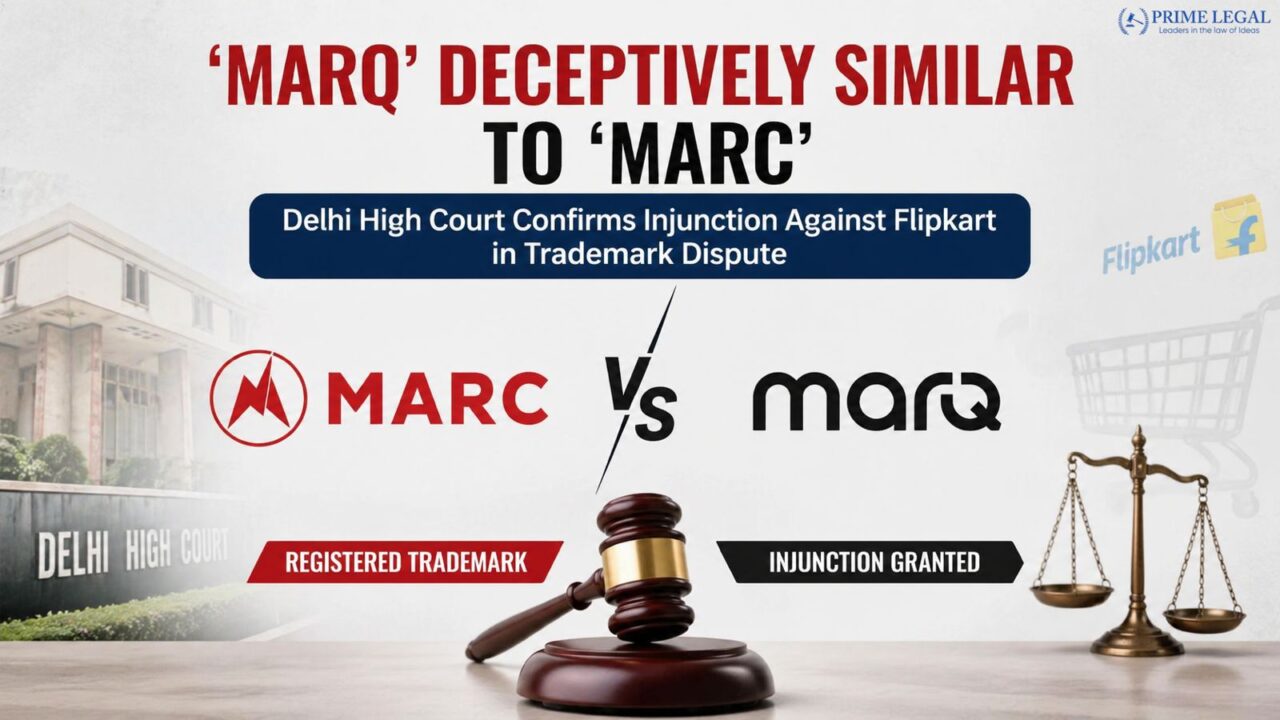
CASE NAME: M/S Flipkart India Private Limited vs. M/S Marc Enterprises Pvt. Ltd.
CASE NUMBER: FAO-IPD 46/2021 (along with CM APPL. 46817/2018 & CM APPL. 54484/2018)
COURT: High Court of Delhi
DATE: 29 April, 2026
CORAM: Hon’ble Mr. Justice Tejas Karia (Single Judge Bench)
FACTS
The company Marc Enterprises Pvt. Ltd. started its operations in 1981 when it began to produce and distribute electrical accessories and appliances and instruments which it built under the brand name “MARC”. The company started to register its trademark for this brand in 1984 and received multiple registrations until 1984 which protected its brand under Classes 9 and 11. Flipkart India Private Limited (Appellant) introduced its private label brand of large home appliances which includes TVs and ACs and Washing Machines and Microwave Ovens through its e-commerce platform in July 2017 under the brand names “MARQ” and “marQ by Flipkart”. The name was created by combining the first three letters of “mark” with “Q” which represents “quality” according to its definition. Marc Enterprises filed a suit before the Additional District Judge, Patiala House Courts, New Delhi seeking a permanent injunction for trademark infringement, passing off, and dilution. The Trial Court issued an ad-interim injunction on 18.01.2018 which prohibited Flipkart from using the “MARQ” trademarks. The Impugned Order of 27.10.2018 denied Flipkart’s request to vacate the injunction. Flipkart then filed an appeal at the Delhi High Court.
ISSUES
1. Whether the marks “MARC” and “MARQ/marQ” are deceptively similar so as to cause consumer confusion?
2. Whether Flipkart’s use of “MARQ” constitutes infringement of Marc Enterprises’ registered trademark?
3. Whether the use of the house mark “Flipkart” alongside “MARQ” is sufficient to distinguish the two brands?
LEGAL PROVISIONS
– Trade Marks Act, 1999 — Infringement and passing off.
– Order XXXIX Rules 1 & 2, CPC — Temporary injunction
– Order XXXIX Rule 4, CPC — Vacation of injunction
– Order 43(1)(R), CPC — Appeal against interlocutory orders
– Order XLI Rule 27, CPC — Admission of additional evidence in appeal
ARGUMENTS
APPELLANT (FLIPKART)
The name “MARQ” originated through an independent creation process which used the base word “mar” from “mark” and the letter “Q” to represent quality. The two words “MARC” and “MARQ” maintain their distinct identity through different conceptual elements and visual characteristics and phonetic patterns. People say “marQ” as “Mar-Queue” which creates a different sound from “Marc” thus establishing phonetic distinction between the two marks. The main brand “FLIPKART” appeared together with “MARQ” at all times which removed any doubt about the product source. The Respondent’s products (geysers, fans, irons) and the Appellant’s products (TVs, ACs, washing machines) are entirely different goods targeting different markets. The word “Marc/Mark/Mar” is extensively used by multiple third parties, so the Respondent cannot claim monopoly over it. The Trial Court violated natural justice by issuing the injunction without simultaneously providing reasons, when no urgency existed. The Trial Court violated judicial propriety by conducting an independent internet search to verify pronunciation which resulted in the court becoming a witness.
RESPONDENT (MARC ENTERPRISES)
The respondent has operated under the name “MARC” since 1981 because they registered their first trademark in 1984 which established the name as their prior trademark. “MARC” functions as a trademark because it represents a unique term which does not exist as an ordinary English word. The marks “MARC” and “MARQ” exhibit pronunciation and structural resemblance and visual similarity which create consumer confusion because of their imperfect memory of the two brands. Both parties sell their electrical and electronic products which belong to related product categories through the same sales channel that operates on Flipkart’s platform. The house mark “Flipkart” creates confusion because “Flipkart” was not shown with “MARQ” in some cases which occurred without the house mark. The Appellant obtained trademark registrations for “Flipkart MarQ” after the Impugned Order but multiple applications remain under opposition from the Respondent. The appellate courts should only intervene when the trial court issues an order that shows clear unreasonable judgment which does not apply in this case.
ANALYSIS
- Deceptive Similarity of the Marks
The Court established that “MARC” and “MARQ” have identical phonetic and structural elements. Both names follow the same four-letter pattern which average users pronounce in the same way. The Court used a recognized rule which states that phonetic similarity can lead to infringement even when visual elements differ from each other. Changing “C” to “Q” failed to establish enough difference between the two items.
- Irrelevance of Flipkart’s House Mark
The Court rejected Flipkart’s claim which stated that using “Flipkart” with “MARQ” eliminated any possibility of confusion. The Court showed that the house mark often appeared in very small text or was completely missing during various situations. The presence of a house mark as a prefix or suffix does not create a distinction for goods because the trademarked item remains unduly similar to the registered mark.
- Allied and Cognate Goods & Common Trade Channels
The Court rejected Flipkart’s claim of dissimilarity in goods. The two parties both sell electrical appliances together with their accompanying accessories which belong to the same product category. The two products obtain distribution through Flipkart.com which creates shared retail outlets that serve the same customer base and thereby heightens confusion risks.
- Common to Register ≠ Common to Trade
The statement “Common to Register” does not match with “Common to Trade” because Registering Commonality requires different criteria than the Commonality of Trades. The third-party users of “MARC/MARK/MAR” which the Respondent claimed as exclusive rights raised his rights to exclusive use down to his actual rights. The Court rejected this claim because multiple registered marks and pending Trade Marks Registry applications do not establish actual business operations. The argument for common usage fails because it needs proof that third parties use the market extensively.
- Scope of Appellate Interference
The Court restated the established legal standard from Wander Ltd. v. Antox India Pvt. Ltd. 1991 PTC 1 SC which gives appellate courts authority to overturn trial court injunction rulings when the trial court decision shows clear irrational errors. The Trial Court order received validation through its logical reasoning which demonstrated correct application of three essential elements required for establishing prima facie case and irreparable harm and balance of convenience. The investigation showed that no elements of irrationality existed in the situation.
JUDGMENT
Flipkart appealed the case but the court decided to maintain the temporary order which the Trial Court had issued. The Court determined that Flipkart’s arguments lacked validity and the newly acquired trademarks by Flipkart for “Flipkart MarQ” (in Class 7 and 42) which they obtained after the Impugned Order did not include the disputed marks, therefore, they did not change the case results. The stay on the Trial Court’s injunction which had operated during the pendency of the appeal was vacated. The Court gave Flipkart until May 15 2026 to follow the interim injunction because Flipkart requested more time to sell its current inventory. The court made no decision regarding cost responsibilities.
CONCLUSION
The judgment here provides a major victory to established trademark owners who operate small businesses against large e-commerce companies. The court ruling shows that phonetic similarity between two trademarks serves as sufficient proof for establishing trademark infringement. The court ruling establishes that well-known house marks do not provide automatic protection against deceptive sub-brand names. The court system gives significant legal power to both previous trademark use and trademark registration.
“PRIME LEGAL is a National Award-winning law firm with over two decades of experience across diverse legal sectors. We are dedicated to setting the standard for legal excellence in civil, criminal, and family law.”
WRITTEN BY: PRANAVI KOLLU
Read the judgement copy here:
Ms Flipkart India Private Limited Vs. Ms Marc Enterprises Pvt Ltd

