
INTRODUCTION
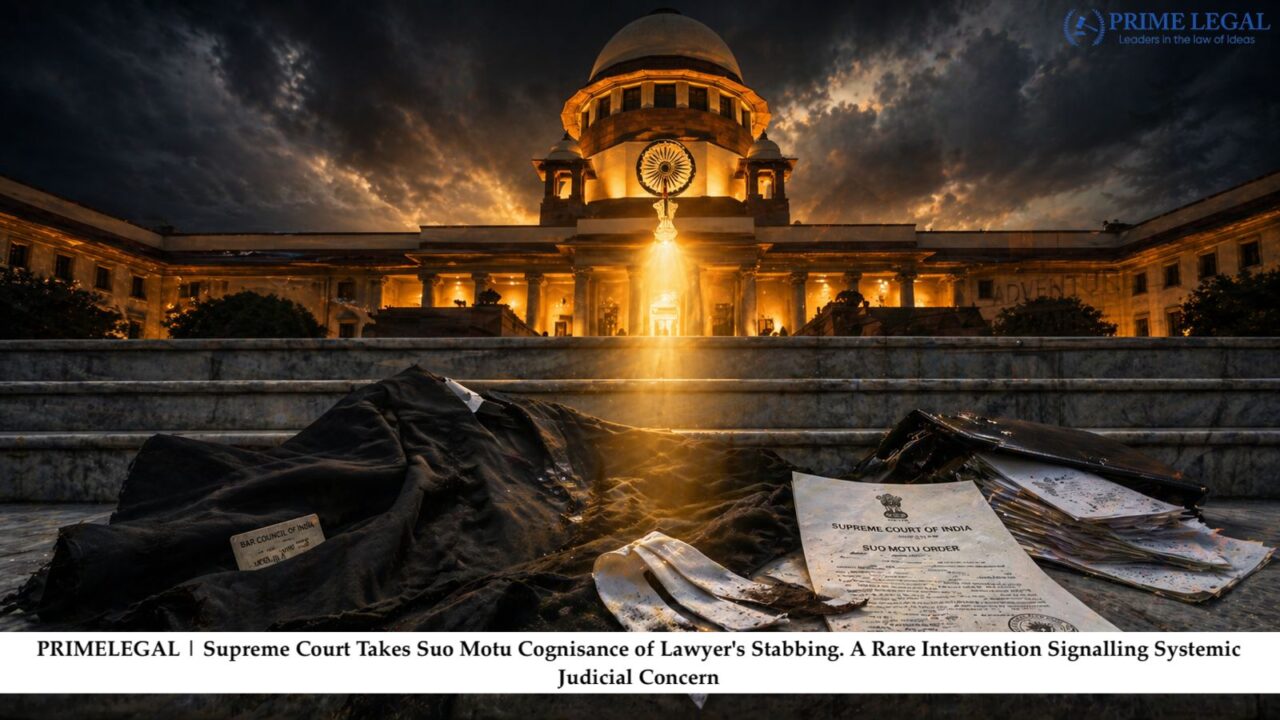
On April 27, 2026, the Supreme Court of India on its own initiative, took a suo motu cognizance of the shocking event were a advocate from Delhi. Madhu Rajput, was stabbed to death by her husband in an office building.A bench led by Chief Justice of India Surya Kant and Justice Joymalya Bagchi registered the case as SMW(C) 4/2026 and commenced proceedings without waiting for any formal petition to be filed. The case has drawn national attention not merely on account of the violence involved, but also because of the multiple institutional failures it has laid bare, including the conduct of hospitals that allegedly refused emergency treatment to the injured advocate.
BACKGROUND
Advocate Madhu Rajput was attacked inside the office of her husband, sustaining serious stab wounds that affected vital organs, as noted in photographs placed before the Court. After the attack, she managed to make PCR calls seeking emergency assistance. She was subsequently taken to three hospitals, GTB, RK, and Kailash, all of which allegedly refused to admit her. She eventually received treatment at the AIIMS Trauma Centre and was later shifted to a private hospital. The couple have three minor daughters aged 12 years, 4 years, and 1 year. At the time the Court took up the matter, the children had been abandoned by their father and were in the care of their maternal grandparents. The man was arrested and an FIR entered against him for violating Section 109(1) of the Indian Penal Code. The in-laws were also accused, but they are reportedly on the lam.
KEY POINTS
The Supreme Court has taken a suo moto (on its own) cognisance of the matter, i.e., it has looked into this matter by itself without any petition having been filed before it, which indicates the seriousness with which the Bench looked at both the actual assault and the circumstances surrounding it. The Advocate for the victim, Ms Sneha Kalita, has told the Court about what happened to her client, the attack, and how three hospitals have refused to give the victim emergency medical treatment.
The Court has asked for an investigation to be conducted of the refusal to provide treatment. Under Indian law, no hospital can refuse emergency treatment to an injured person. The Court’s direction to the three hospitals to be investigated shows that the Court wishes that there be accountability for what would otherwise be gross negligence on the part of the hospitals.
The Bench has directed the National Legal Services Authority (NALSA) to provide funds to the victim for her medical care, and for the care of her children, immediately. The Court has stated that the amount should be deposited the next day to show the seriousness with which it has taken this matter.
With regard to the three minor daughters, the Court noted that they had been abandoned by their father. It directed the police to trace the whereabouts of the children and ordered that the custody arrangement with the maternal grandparents continue, with the eldest daughter specifically to remain with the maternal grandparents.
Additional Solicitor General Aishwarya Bhati appeared for the State and confirmed to the Court that the accused husband had been arrested and that an FIR had been duly registered. She further informed the bench that the victim had been discharged from AIIMS and was receiving treatment at a private hospital at the time of the hearing.
RECENT DEVELOPMENTS
In this case involving the violent assault on a member of the legal community, and the urgent need for judicial intervention, it shows the Supreme Court willingness to act directly on matters that extend through multiple systems at one time. The three issues involved with this case are as follows: First, the individual suffered domestic abuse; Second, the emergency room did not respond and provide enough emergency medical attention to suit the standards of care that exist within the law; and Thirdly, as a result of this incident, there are three minor children now abandoned by the legal profession. The case has been formally escalated through an active judicial review process. and has been referred to the Supreme Court.
CONCLUSION
The Supreme Court has decided to take suo motu cognisance of the stabbing of Advocate Madhu Rajput, making it a clear example of how the judiciary acts as a constitutional guardian and does not simply wait for injustices to make their way to the courts in traditional ways when a situation requires prompt action. The matter raises concerns that extend well beyond a single act of domestic violence. It questions whether medical institutions understand and honour their legal obligations in emergencies, whether law enforcement mechanisms respond adequately when members of the legal fraternity are themselves victims, and whether the welfare of vulnerable children caught in such situations receives the urgent attention it deserves. The Court’s swift and comprehensive directions on each of these fronts signal an institutional concern that goes far beyond the immediate facts of the case.
“PRIME LEGAL is a National Award-winning law firm with over two decades of experience across diverse legal sectors. We are dedicated to setting the standard for legal excellence in civil, criminal, and family law.”
WRITTEN BY: KISLAY RAJ

