
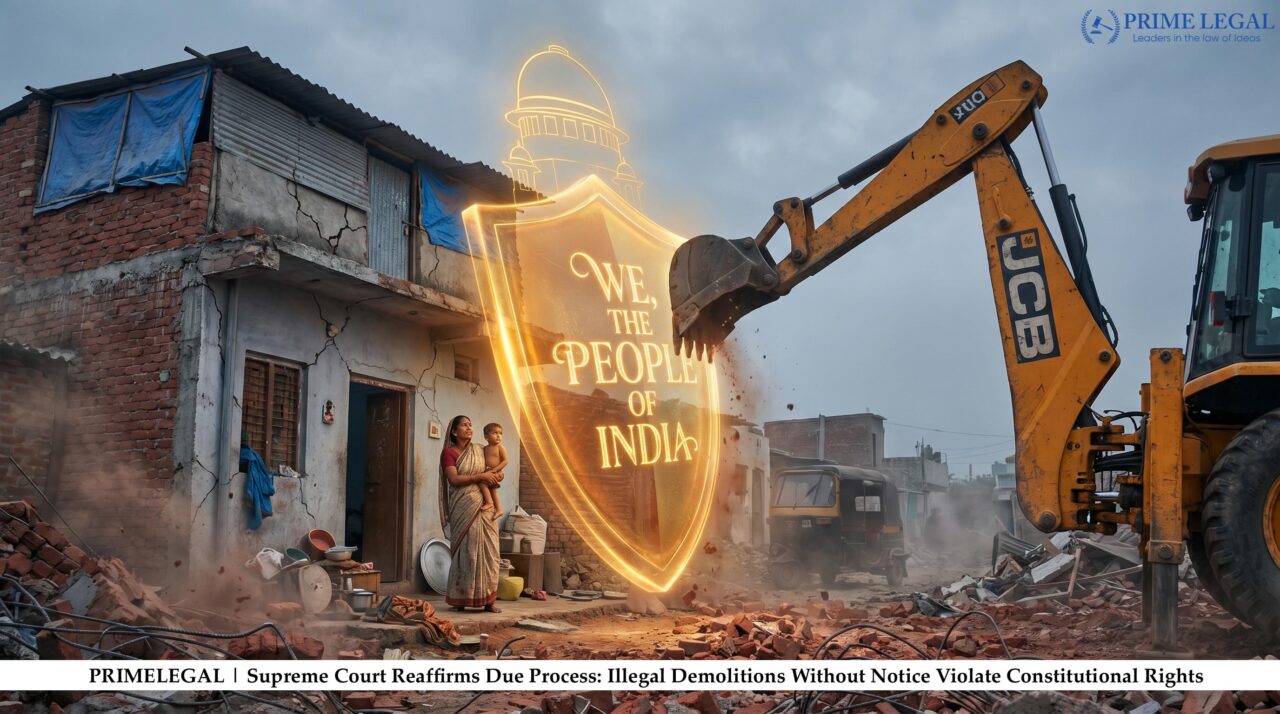
ABSTRACT
The article analyzes the Supreme Court’s landmark decision which calls “bulldozer justice” unconstitutional and shows its impact on regular citizens. The judgment strongly upholds the principles of natural justice which separate powers between different branches of government and establish the rule of law. The Court issued clear and binding directives to ensure that demolitions are carried out only within constitutional limits and that no arbitrary executive action goes unchecked. The article presents the legal arguments used to reach the judgment together with the cited case law and its effects on property rights and executive responsibility and respect for human rights.
KEYWORDS: Bulldozer Justice, Due Process, Natural Justice, Article 21, Demolition, Rule of Law, Separation of Powers, Fundamental Rights, Executive Accountability, Constitutional Rights
INTRODUCTION
The term “bulldozer justice” has developed into a widely used expression which people in India now use during their public discussions. It defines the practice of destroying buildings which belong to people who face criminal accusations without having gone through a legal trial. The states of Uttar Pradesh and Madhya Pradesh and Rajasthan have become the main areas where these destruction activities take place. The authorities use illegal construction and encroachment as their main reason to conduct these destruction activities. The critics hold that the demolitions proceed through illegal methods which target particular communities for punishment because they have not been found guilty of any crimes.
The Supreme Court of India stepped in to address this growing concern and restore constitutional order. The government agencies needed to follow established legal processes because the executive branch lacked the authority to execute criminal punishment without evidence.
The Supreme Court’s Landmark Ruling
The Justices B.R. Gavai and K.V. Viswanathan issued a 95-page ruling on 13 November, 2024 which declared that the “bulldozer culture” which exists throughout India must be stopped.
- The required notice period demands another 15 days of written notice which must contain details about the alleged unauthorized construction work.
- The affected parties need to receive their opportunity to speak before any demolition decision reaches its final stage.
- The final orders must provide their reasons for permission to demolish only after all other possible solutions have been tried.
- Every demolition operation requires complete video recording to ensure operational transparency.
- Every G20 official who commits a violation will face both contempt charges and required restitution and criminal prosecution.
The Court excluded two types of land use violations from its established rules about public space encroachments which people illegally occupy and court-mandated removal operations. The ruling derives its constitutional foundation from Article 21 which grants citizens the right to housing and basic necessities while Article 14 protects against unfair treatment by the government.
The practice of conducting demolitions based on specific criteria or discriminatory methods creates an infringement on the right to equal treatment under the law.
Article 300A states that no person shall lose their property rights except through legal authorization. The political parties conduct their demolitions without following legal procedures which creates a violation of this law.
The Supreme Court used its special constitutional authority under Article 142 to make binding orders which filled empty spaces in legal procedures to achieve complete justice.
Important Case Law Referenced
The judgment drew strength from several important previous rulings of the Supreme Court which include the following cases Maneka Gandhi v. Union of India AIR 1978 SC 597 The landmark case established that any state action must fulfill the requirements of “just” and “fair” and “reasonable” because it expanded Article 21 The standard which demolitions must attain fails to exist because valid procedures were not followed during demolition work.
Olga Tellis v. Bombay Municipal Corporation AIR 1986 SUPREME COURT 180 – The Court found that all people possess a right to their life which includes both their right to work and their right to live in a place of their choosing. The act of removing people from their homes without following proper procedures and providing them with alternate housing options breaks the fundamental principles of Article 21.
S.R. Bommai v. Union of India AIR 1994 SC 1918 – The judgment established that the Indian Constitution’s basic structure depends on constitutional law which requires state actions to comply with its established framework.
Violation of Natural Justice
The judgment raised its most serious issue when it denied natural justice to the defendant. Natural justice requires that no person shall face punishment until they receive the opportunity to defend themselves. Demolitions which occur without warning and without giving affected individuals a chance to respond violate fundamental principles of justice. The sudden evacuation of their homes results in families facing homelessness because they lack both time to pursue legal protection and to collect their personal belongings. The Court established that constitutional democracy does not permit such actions to occur.
The Problem of Collective Punishment
The Supreme Court specifically condemned the practice of demolishing the homes of entire families because one member of that family is accused of a crime. The practice punishes people who have no connection to the alleged crime. The Court described such actions as “anarchy” and a direct breach of the rule of law. One family member must not face punishment because of accusations against another family member who has not yet been found guilty by any court.
Communal Concerns and Selective Targeting
The Court received multiple petitions which explained how officials used demolitions to target minority communities while falsely claiming to remove unlawful constructions. When state authorities exercise their power in a discriminatory manner, they breach the constitutional requirement of equality, which leads to doubts regarding their political power abuse. The state must conduct its operations in a way that ensures both neutrality and fairness, which should be governed by existing legal frameworks according to the court decision.
Economic and Human Impact
The human toll of uncontrolled destruction operations exceeds all legal arguments in this matter. A home shows the result of multiple years spent working and saving money and building emotional ties to the property. The sudden demolition of a building results in complete destruction of the physical structure and the associated work and educational opportunities and the mental well-being of the people. Families become completely impoverished because they receive no financial assistance or help during their time of need. The Court’s guidelines require all necessary procedures to follow proper procedures before any severe actions take place to protect against permanent damage.
CONCLUSION
The Supreme Court’s ruling against “bulldozer justice” demonstrates that all citizens including the government must obey the Constitution in a democracy which follows the rule of law. The executive branch should not perform judicial functions which include both judging and executing. Justice does not exist when officials destroy a person’s house as punishment because they failed to provide proper notification and judicial examination and explanation of their decision. The Court’s directives function as legal principles which establish judicial standards for handling cases. The Constitution protects dignity and equality and fairness as well as safeguarding every citizen particularly those who are most defenseless. Implementation of this judgment represents its actual evaluation. The use of bulldozers as tools for intimidation requires political will together with strong operational controls and genuine dedication to constitutional principles in order to establish lawful governance. Justice delayed may be justice denied – but justice delivered by a bulldozer is no justice at all.
“PRIME LEGAL is a National Award-winning law firm with over two decades of experience across diverse legal sectors. We are dedicated to setting the standard for legal excellence in civil, criminal, and family law.”
WRITTEN BY: PRANAVI KOLLU

