
CASE NAME: Crocodile International Pte. Ltd. v. La Chemise Lacoste & Anr.
CASE NUMBER: RFA(OS)(COMM) 18/2024 & CM APPL. 56314/2024
COURT: The High Court of Delhi
DATE: 9 March 2026
QUORUM: Hon’ble Mr. Justice C. Hari Shankar and Hon’ble Mr. Justice Om Prakash Shukla
FACTS
The appeals arose from a judgment of a Single Judge go Delhi Court on 14.08.2024, which was an Intellectual Property dispute, particularly of trademark and copyright over crocodile device marks. La Chemise Lacoste (Plaintiff No.1) is a French Company owning the globally known brand “LACOSTE” and crocodile device marks. Plaintiff No.2 is an Indian Company serving as licensee of Plaintiff No.1 under a 1994 user agreement. Crocodile International Pte. Ltd. (Defendant No.1) is a Singaporean Company and Crocodile Products Pvt. Ltd. (Defendant No.2) is an Indian Company serving as Indian associate of Defendant No.1, who started with registered composite “CROCODILE + device” marks (first Indian registration in 1952 and then in 1990), and around 1998 began using a standalone device (impinged device) in India without the word “CROCODILE”.
Lacoste holds Indian registrations for its crocodile device and claims extensive use and promotion in India since 1993, asserting that the defendants’ standalone crocodile, which is not registered, is deceptively similar to Lacoste’s registered device mark. Defendants relied on a 1983 and 1985 agreement for coexistence to show that it had consent to use its marks, including the impugned standalone crocodile in India. Plaintiffs argued that these instruments did neither extend to India nor cover the impugned device. The Single Judge of Delhi High Court partly decreed the suit in favour of plaintiffs and against the defendants vide judgment dated 14.08.2024. It is against this judgment that the parties have filed the present cross-appeals.
ISSUES
- Whether the use of the impugned mark by Crocodile International amounts to infringement of the copyright of Lacoste?
- Whether the Agreements dated 17.06.1983 and 22.08.1985 between Lacoste and Crocodile International extend to India? Whether the aforesaid Agreements entitle Crocodile International. to use the impugned mark in India?
- Whether the use of the impugned mark by Crocodile International in India amounts to infringement of trademark rights of Lacoste?
- Whether the use of the impugned mark by Crocodile International in India amounts to passing off?
- Whether the suit suffers from acquiescence on behalf of Lacoste?
- Whether the learned Single Judge erred in granting rendition of accounts to Lacoste?
- Whether the learned Single Judge erred in awarding costs to Lacoste?
LEGAL PROVISIONS
The Copyright Act, 1957
- Section 13 – works in which copyright subsists
- Section 14(c) – exclusive rights in artistic works
- Section 17 – author as first owner of copyright
- Sections 51 and 55 – what amounts to infringement, and civil remedies
The Trade Marks Act, 1999
- Section 28 – exclusive rights of registered proprietor
- Section 29 – what constitutes infringement
- Section 135 – reliefs for infringement and passing off
ARGUMENTS
APPELLANT (Crocodile International):
Crocodile’s core case was that it was a bona fide, honest and prior international user of crocodile marks, with Indian device registrations dating back to 1952 and long‑standing use in Asia, and that its standalone crocodile flowed from that history. It heavily relied on the 1983 co‑existence agreement and the 1985 letter as extending and permitting use to India, arguing that Lacoste had accepted a series of consent communications and benefitted by securing registrations without opposition. It alleged that the Single Judge’s Judgement was flawed in Fact and Law. It complained that the court set too high a standard of proof and downplayed acquiescence despite Crocodile’s open use since the late 1990s.
RESPONDENTS (Lacoste):
Lacoste argued that it is the original creator and proprietor of the iconic crocodile artwork, which was first published in 1927, holding a copyright registration, and of the Indian crocodile device registrations from 1983, used commercially in India since 1993. It argued that the 1983 agreement was confined to South‑East Asian markets and not to India, and that the 1985 letter was merely a vague unilateral communication that never became a binding contract for India. It stressed on the nearly identical crocodile device marks, contending that similarity is sufficient for trademark infringement. The claims were supported by submitting a copy of copyright, and that Crocodile’s late entry into India with the standalone device was neither honest nor protected by any co‑existence arrangement.
ANALYSIS
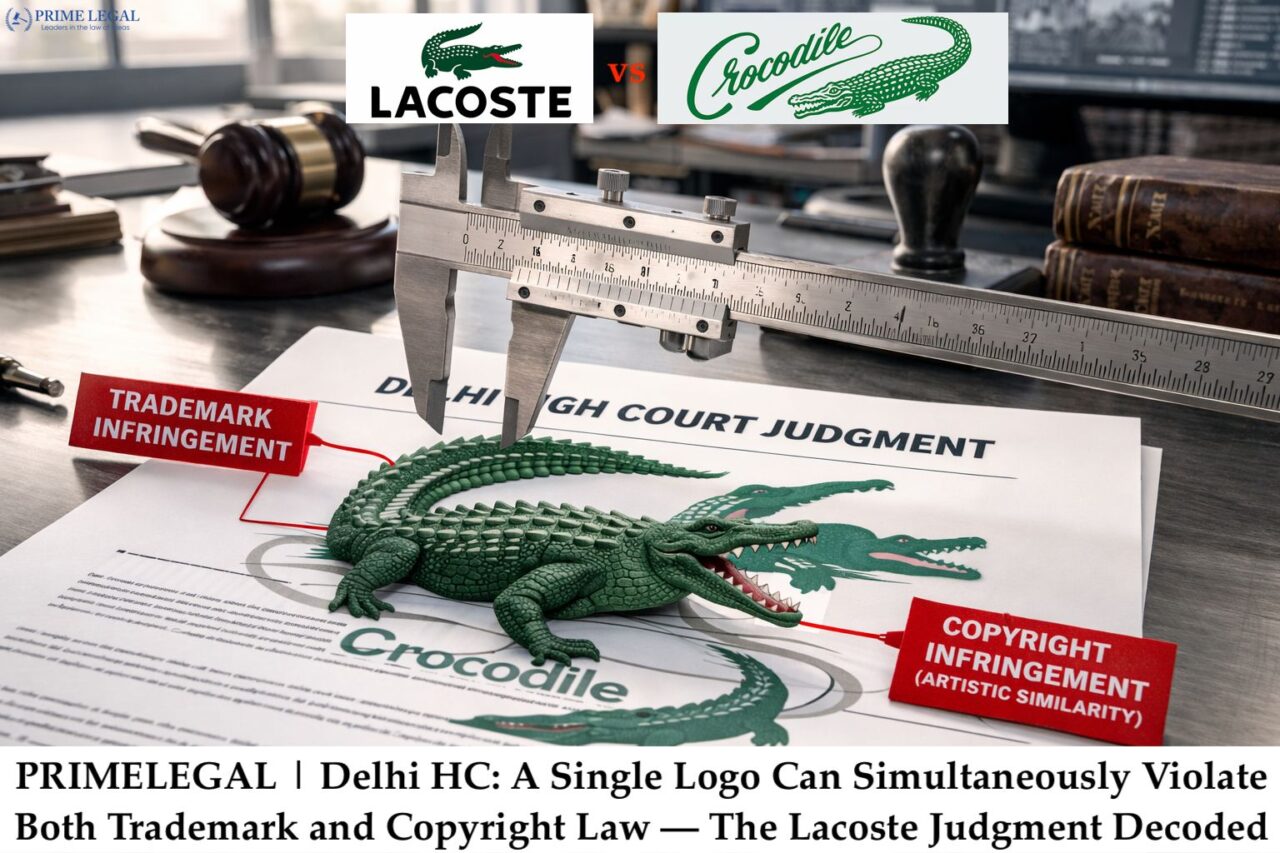
The Division Bench approached the appeal as a ‘full appeal’, recasting the points for determination and examining evidence afresh. On similarity, it endorsed the Single Judge’s visual comparison: that once Crocodile’s left‑facing crocodile was mentally reversed, the two devices shared highly specific and unusual features in posture, body curve, limb position and overall “look and feel”, far beyond the mere idea of a crocodile. The court accepted the notion of “initial interest confusion” in trademark law, noting that even if tags later disclose the manufacturer, the front‑facing device alone can mislead an average consumer into associating the goods with Lacoste.
On copyright, the Bench parted with the Single Judge’s view, rejecting that the impugned device was an independent expression within limited artistic choices. It held that Crocodile itself had historically used several different crocodile depictions and was not constrained to the particular configuration that so closely tracks Lacoste’s artwork. Given access, timing and the striking conceptual identity of the devices, the court found that independent creation was “untenable” and that substantial copying of protectable expression had occurred, thus making out copyright infringement as well.
Turning to the contractual framework, the judges treated the 1983 and 1985 instruments to be governed by Indian contract law. The 1983 agreement was read strictly by territory, India was not among the co‑existence markets, and prior arbitral findings and foreign decisions were noted as consistent with that territorial confinement. The 1985 letter was characterised as vague, lacking clear acceptance, mutual consent and specificity about which marks and rights in India were being dealt with. It could not be elevated into a binding licence for the impugned standalone device in India. On that analysis, Crocodile’s plea of consent, honest concurrent use and acquiescence was rejected, with the court also noting the absence of concrete prejudice from the asserted delay.
JUDGMENT
The Bench substantially affirmed and, on key points, strengthened the relief in favour of Lacoste. It held that:
- Lacoste owns valid copyright in its crocodile artwork and that Crocodile’s impugned device amounts to copyright infringement;
- India is outside the territorial scope of the 1983 co‑existence agreement; and
- The 1985 letter does not confer any enforceable right on Crocodile to use the impugned standalone crocodile in India.
- The impugned device was found deceptively similar to Lacoste’s registered crocodile device, amounting to trademark infringement.
Consequently, the injunction against Crocodile from using the impugned standalone crocodile mark in India was maintained and supported by both in trademark and copyright. The court also upheld the direction for rendition of accounts, invoking Section 135 of the Trade Marks Act and clarifying that no fiduciary relationship is required once infringement is established, and found no ground to interfere with the award of costs in favour of Lacoste under the Commercial Courts and Delhi High Court Rules framework.
CONCLUSION
The judgment of Delhi High Court upholds territorial limits on co‑existence agreements and looks past the long foreign use when an impugned device in India converges too closely on an earlier local registration and artwork. For brand owners, it underscores that stylized animal devices can attract overlapping protection under both trademark and copyright, and that “initial interest confusion” around a logo is enough to trigger infringement, even in a sophisticated apparel segment. At the same time, the decision signals that consent‑based and acquiescence defences in cross‑border IP disputes will be tested against strict contractual principles and hard evidence, not just a general history of co‑existence abroad.
“PRIME LEGAL is a National Award-winning law firm with over two decades of experience across diverse legal sectors. We are dedicated to setting the standard for legal excellence in civil, criminal, and family law.”
WRITTEN BY: ABIA MOHAMMED KABEER
Click here to view the original copy: Crocodile International Pte. Ltd. v. La Chemise Lacoste & Anr.

