
INTRODUCTION
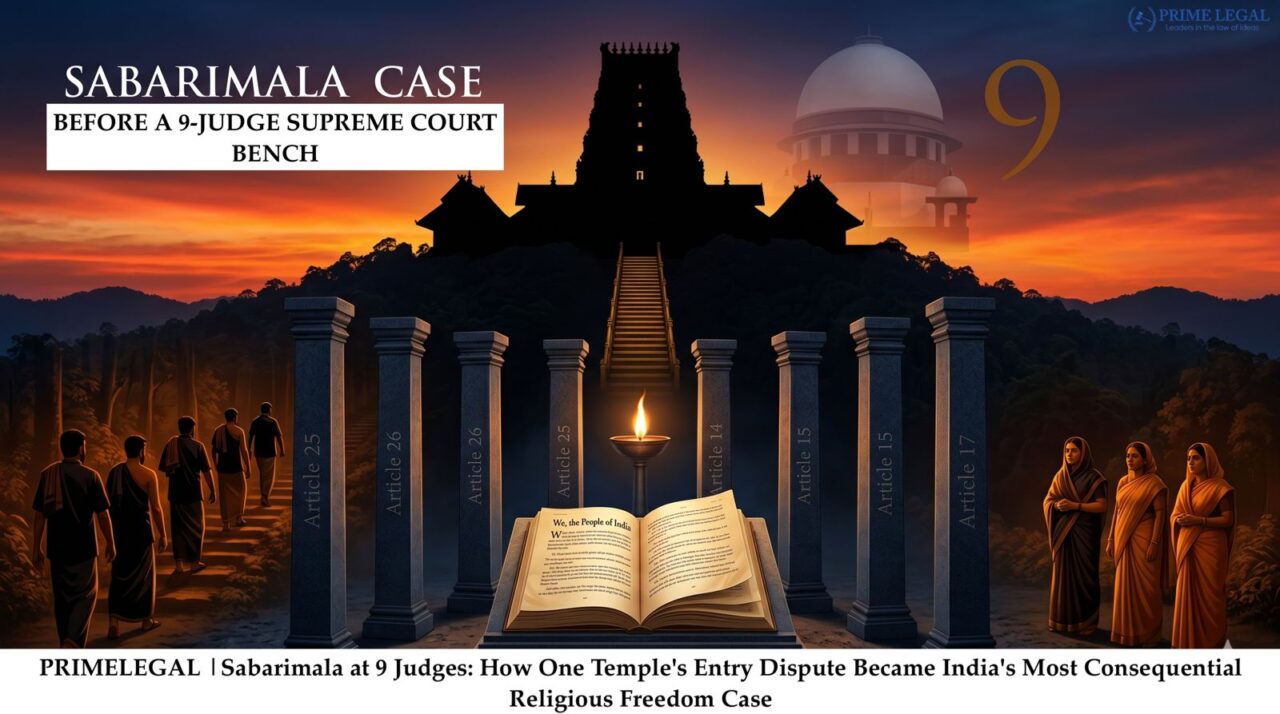
This dispute started with the question of whether menstruating women should be allowed to enter a hill shrine in Kerala. The Sabarimala case has reached the Supreme Court’s nine-judge Constitution Bench because it now involves multiple temples and various communities. The case examines which principle should prevail when faith and equality come into conflict because both principles are essential to India’s constitutional identity.
BACKGROUND
In 2018, the decision which a five-judge bench made during Indian Young Lawyers Association v. State of Kerala AIRONLINE 2019 SC 1450 declared Sabarimala temple’s rule which prevented women between 10 and 50 from entering the temple as unconstitutional. The majority used Articles 14 and 15 and 25 to establish that excluding people based on their physical traits entered into a space that violated their right to dignity and equal treatment. The court decision created intense public discussion which spread across both religious sites and public spaces and legal environments. Multiple review petitions emerged to investigate a fundamental issue which questioned whether courts should decide which practices a religion considers fundamental to its operations. The Supreme Court needed to investigate mosque entry conflicts and Parsi fire temple access rights because these issues showed identical tensions that existed between different religions.
KEY CONSTITUTIONAL QUESTIONS
- The Essential Religious Practices (ERP) Doctrine
The ERP doctrine functions at the core of this reference material as a judicial test which developed through time from the Shirur Mutt decision in 1954 (1954 AIR 282) to establish criteria for assessing whether a religious practice should receive constitutional protection because it represents an essential element of that faith. The nine-judge bench must now decide whether this doctrine is workable at all. Should judges be interpreting theology? The authority to establish religious requirements belongs to believers and religious texts and the Constitution. The answer will reshape decades of precedent and determine how courts engage with religious claims going forward. The most emotionally charged question before the bench is whether faith-based exclusion of women automatically constitutes unconstitutional discrimination. The first side of the argument supports the Constitution which presents a transformative vision that seeks to eliminate all social inequalities which include discrimination based on religious beliefs. The second side of the argument supports denominational autonomy because it enables religious groups to operate their practices without any government involvement. The bench must determine whether individual rights must always prevail over community religious identity, or whether some space must be preserved for doctrinal distinctiveness.
- The Interplay of Articles 14, 15, 25 and 26
The most difficult legal matter to resolve involves determining how equality rights interact with religious freedom rights. Three possible models emerge: the Equality-First Model, under which Article 25 is always subject to Article 14, making any exclusionary practice constitutionally suspect; the Group-Rights Model, which protects denominational autonomy under Article 26; and the Harmonisation Model, under which courts intervene only when a practice violates dignity in a civil and verifiable sense. The choice of which model to implement will determine India’s future approach to secularism throughout upcoming decades.
- Constitutional Morality versus Religious Morality
All of these issues stem from a battle between two philosophical systems. Can constitutional morality and the values embedded in the text of the Constitution override the internal moral framework of a religious tradition? The two systems need to have space for their respective operations according to the principles of pluralism. The bench’s decision about the Constitution’s role will determine whether it functions as a social reformer or as an impartial judge between different societal ideals.
CONCLUSION
The Sabarimala reference has expanded beyond the temple steps which served as its starting point. The case now stands with the Basic Structure doctrine and the Right to Privacy judgment and the decriminalisation of homosexuality as a legal precedent which can completely transform Indian constitutional law. The ruling will establish judicial authority boundaries for belief matters and will define equality standards in religiously diverse societies and will determine how far the Constitution can reach into faith community internal affairs. The nine judges will make their decision which will establish temple entry rights. The outcome will establish India’s complete comprehension of freedom.
“PRIME LEGAL is a National Award-winning law firm with over two decades of experience across diverse legal sectors. We are dedicated to setting the standard for legal excellence in civil, criminal, and family law.”
WRITTEN BY: PRANAVI KOLLU

