
CASE NAME: Union of India v. Radha Yadav
CASE NUMBER: M.A. Nos. 741–742 of 2019 in C.A. Nos. 1265–1266 of 2019; with M.A. Nos. 743–744 of 2019 in C.A. Nos. 1267–1268 of 2019
COURT: Supreme Court of India
DATE: 17 February 2026
QUORUM: Hon’ble Mr. Justice Ahsanuddin Amanullah and Hon’ble Mr. Justice R. Mahadevan
FACTS
These miscellaneous applications arise out of the impugned final judgment dated 29 January 2019 in C.A. Nos. 1265–1286 of 2019, wherein the Supreme Court had dealt with compensation and safety obligations of the Railways in passenger accident case of Dasarath Yadav. On 02.10.2003, while travelling in a local train from Burdwan to Howrah, one Dasarath Yadav peeped his head out of the compartment door, collided with a trackside post and died on the spot.
The Railway Claims Tribunal, Kolkata, held him to be a bona fide passenger and the occurrence an “untoward incident” under Section 123 of the Railways Act, 1989, yet denied compensation on the ground that he was the victim of his own act. His widow, Radha Yadav, challenged the dismissal before the Calcutta High Court (FMA No. 858 of 2012). The High Court applied Section 124‑A and the principle of strict liability, set aside the Tribunal’s view, and awarded Rs. 8,00,000 with 9% interest per annum, with review later dismissed. The Union of India approached the Supreme Court in 2018, after Union of India v. Rina Devi, 2018 SCC OnLine SC 507, which had clarified the basis for computing compensation and interest in railway accident claims.
The present matter deals with passenger safety measures, budgeting and implementation by the Railways, wherein the Chief Commissioner of Railway Safety, Mr. Janak Kumar Garg, aided the Court. Mr. Garg proposed fencing of railway tracks to deal with oblivious movement of people and animals over railway lines, stating that cost of fencing is reasonable and over 15,000 km of tracks are already fenced and full fencing is targeted in 3–4 years. Further, construction of foot over-bridges as key steps to reduce accidents caused by crossing over railway tracks to reach desired platforms, lifts for senior citizens and ramps for differently abled persons was also proposed.
ISSUES
- Whether the Railways’ budgeting and prioritization of expenditure adequately reflect a constitutionally compliant focus on safety and welfare of the general traveling public.
- Whether the discriminatory availability of accident insurance only for online ticket purchasers, but not for passengers buying tickets over the counter, is legally sustainable.
LEGAL PROVISIONS
- Article 14 of the Indian Constitution – prohibition of arbitrary and unreasonable classification
- Article 21 of the Indian Constitution – right to life with dignity
- Directive Principles and Public Trust Obligations guiding allocation of public funds for welfare and safety of the public at large.
ARGUMENTS
APPELLANT:
Union of India represented by the learned Additional Solicitor General (ASG), submitted that suggestions of Mr. Garg would have to be conveyed to the authorities and would also be communicated by the Officers of the Railways. On the issue related to budget allocation and prioritization of expenditure, the ASG sought “one last opportunity” to file a detailed and comprehensive affidavit with a comparative chart of fund allocation, utilisation and a “Remarks” column explaining why particular features are prioritised over others. On the issue of discrimination in granting insurance, the ASG argued that absence of reliable identity data of over‑the‑counter passengers is limiting the insurance scheme to online ticket bookings, it if further submitted that the Railways was “working out the modalities” to identify over‑the‑counter passengers in a way that would prevent misuse and false claims.
RESPONDENTS / AMICUS:
The learned Amicus Curiae, Mr. Shikhil Suri, highlighted that there was no satisfactory response to the “duality” in coverage, whereby passengers booking online tickets could avail an accident insurance scheme at a nominal extra cost, but those who purchase physical tickets over the counter were excluded from this benefit, questioning the fairness and rationality of this discrimination.
ANALYSIS
The Court examined the Union’s affidavit on fund allocation, expressed difficulty in understanding the figures, and recorded displeasure at the manner in which the Railways are conducting the case and briefing the Additional Solicitor General (ASG). The SC reiterated that it is for the ultimate benefit of the common man and not for the privilege of few people, who will be using the facilities of the Railways, which has not been maintained by Railway’s budget allocation.
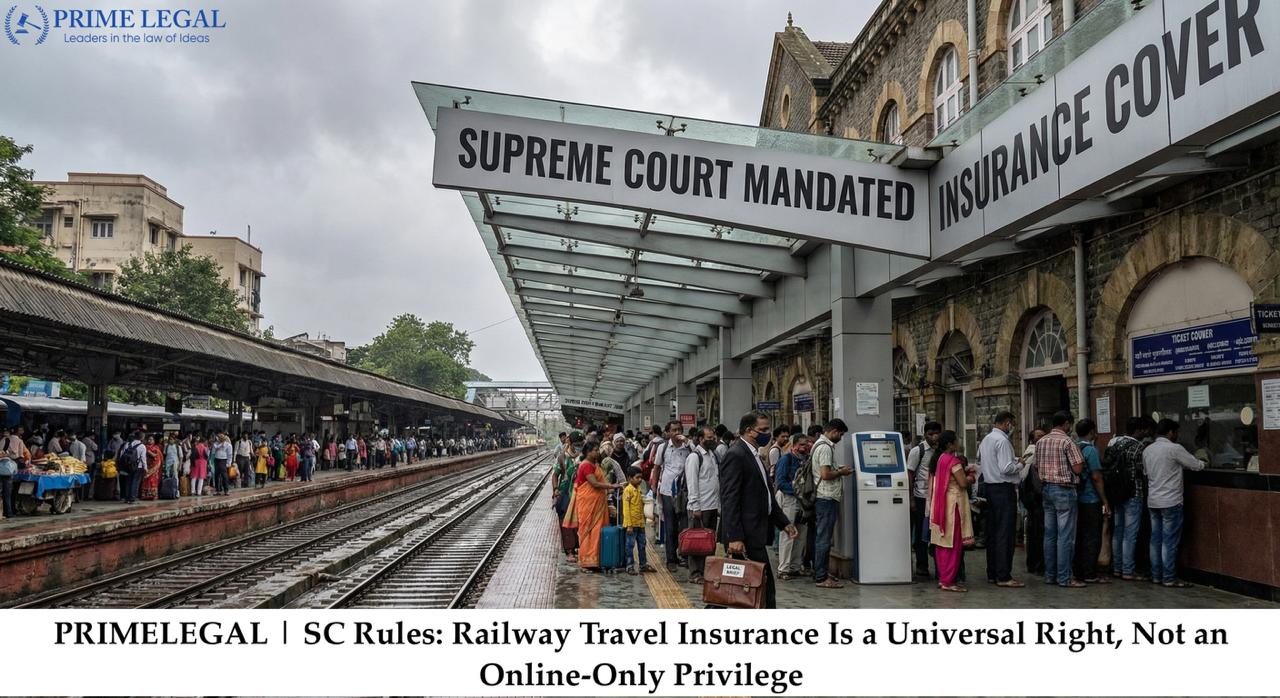
A further concern was the “duality” in providing accident insurance only to passengers booking online, excluding those purchasing tickets over the counter, which the Railways sought to justify on practical and misuse-related grounds. This created an arbitrary discrimination between two classes of bona fide passengers solely on the basis of mode of ticket purchase, although both categories contribute equally to the revenue and are equally exposed to risk.
ORDER
The Court held that there cannot be a distinction between online and over‑counter ticket purchasers in access to accident insurance, and indicated that Railways must employ modern technology to identify over‑the‑counter passengers instead of depriving them of insurance on the ground of possible misuse. On the request of the ASG, the matter was listed for further hearing on 01.04.2026 at 2:00 p.m.
CONCLUSION
The Supreme Court’s order that insurance benefits cannot be limited only to online ticket purchasers is a direct application of Article 14’s mandate against arbitrary classification. The mode of purchase of Railway ticket is not a rational nexus or a reasonable classification to grant the Railway Travel Insurance, the bench opined that such differentiation is impermissible discrimination. It emphasized that administrative inconvenience or fear of misuse cannot justify excluding a large, often less‑privileged segment from protective coverage.
“PRIME LEGAL is a National Award-winning law firm with over two decades of experience across diverse legal sectors. We are dedicated to setting the standard for legal excellence in civil, criminal, and family law.”
WRITTEN BY: ABIA MOHAMMED KABEER
Read the judegement copy here.

