
INTRODUCTION
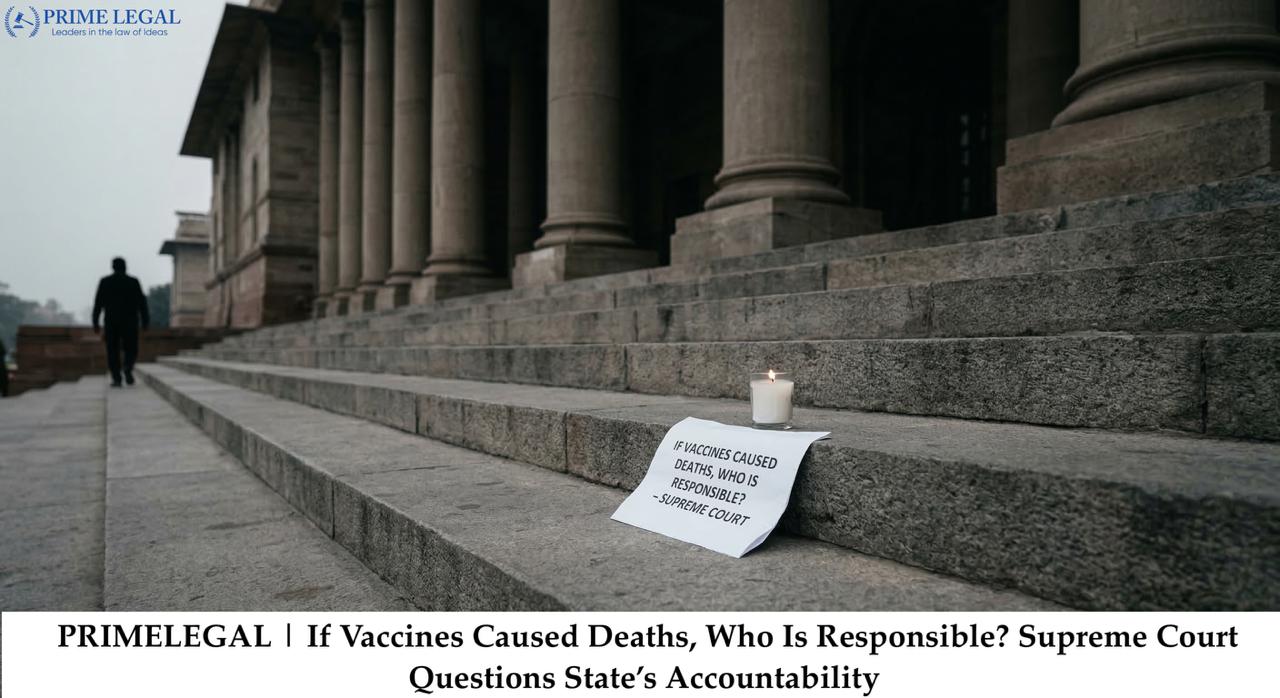
On 10 March 2026, the Supreme Court of India did something that a lot of COVID-19 vaccine-affected families had been waiting years for. It directed the Union Government to frame a ‘no-fault compensation policy’ for individuals who suffered serious adverse effects following COVID-19 vaccination. A bench of Justice Vikram Nath and Justice Sandeep Mehta, while disposing of a batch of writ petitions, made it clear that the State cannot simply walk away from people who were harmed during a government-led vaccination drive, even if the vaccine itself was not defective. The case is titled Rachana Gangu & Anr. v. Union of India & Ors 2026 INSC 218.
BACKGROUND
The matter started with a writ petition filed by the parents of two young women who allegedly died after receiving their first dose of the Covishield vaccine in 2021. The petitioners claimed that their daughters developed severe medical complications, including conditions like thrombotic thrombocytopenia syndrome, intracranial bleeding, and autoimmune encephalitis shortly after vaccination, which eventually led to their deaths. They sought the constitution of an independent expert medical board to investigate such deaths, greater transparency in reporting Adverse Events Following Immunisation (AEFI), and, most importantly, compensation for affected families.
Several connected matters from the Kerala High Court were also transferred to the Supreme Court for adjudication. The Kerala High Court had, in an earlier order, directed the National Disaster Management Authority to frame guidelines for identifying and compensating families of people who died following vaccination. The Central Government challenged this order in the Supreme Court, claiming that the only declared disaster due to COVID-19 was the disease itself and not any deaths that occurred as a result of administering a vaccine to someone who received a vaccination for COVID-19. They also claimed that because getting vaccinated is a voluntary act and the person getting vaccinated has given their consent to the vaccine, the government is therefore not accountable for any deaths arising out of this act.
KEY POINTS
The Court made it clear at the outset that it was not examining vaccine efficacy or questioning the regulatory approval process. The constitutional question before it was narrower, i.e. whether the absence of a structured redress mechanism for persons harmed during a state driven vaccination programme violated their right to life under Article 21. The Court answered this in the affirmative.
The bench observed that India, as of today, does not have any uniform or structured policy mechanism to provide redress to individuals who suffer adverse effects following vaccination. The Court noted that this gap cannot be lightly overlooked, especially when vaccination was carried out as a public health measure under the authority of the State itself. It also referred to similar no-fault compensation mechanisms already in place in countries like the United Kingdom, Australia, and Japan.
The Court rejected the government’s argument that vaccination being voluntary shields it from responsibility. It was analysed that the link between an individual and the State cannot be considered solely on the basis of fault. Families affected by vaccine-related deaths would have the impossible burden of having to prove that the vaccine caused the death in each case; this could lead to a lot of variation in whether families are successful in their cases, depending on which court they brought their case in. However, the bench declined to constitute a separate court-appointed expert medical panel to investigate individual deaths. It held that the existing National and State AEFI Committees are adequate for this purpose, and in the absence of material suggesting these committees are non-functional, the Court would not set up a parallel body. The existing AEFI surveillance mechanism will continue to function, and relevant data on adverse events must be periodically placed in the public domain, in line with the directions given in the earlier case of Dr Jacob Puliyel v. Union of India 2022 SCC OnLine SC 533.
Additionally, the Court made clear that requiring the government to create a no-fault compensation plan in connection with the COVID-19 vaccine is not an acknowledgement or admission of the Union Government’s accountability or culpability. The Court noted that those impacted by the COVID-19 vaccine may also pursue their own separate legal remedies via the appropriate legal options.
RECENT DEVELOPMENTS
With the final order now pronounced, the Supreme Court has directed the Ministry of Health and Family Welfare to frame and publish the no-fault compensation policy for serious adverse events following COVID-19 vaccination. The writ petition and all connected matters have been disposed of. The Court has also instructed that AEFI-related data be made publicly available on a periodic basis, bringing in an element of transparency that was a key demand of the petitioners from the very beginning. While the order does not set a specific deadline for framing the policy, it places a clear constitutional obligation on the Centre to act. The matter had been reserved for judgment in November 2025 before being pronounced on 10 March 2026.
CONCLUSION
This ruling is a significant step in recognising that when the State runs a mass vaccination programme, it carries a responsibility towards those who are, even rarely, harmed by it. The Supreme Court has drawn a line between admitting fault and accepting welfare responsibility and in doing so, it has pushed for a system where affected families are not left to fight long and expensive legal battles to prove something as difficult as causation in a medical context. The no-fault framework, once implemented, could set an important precedent for how India handles the intersection of public health policy and individual rights. For now, the ball is firmly in the government’s court.
“PRIME LEGAL is a National Award-winning law firm with over two decades of experience across diverse legal sectors. We are dedicated to setting the standard for legal excellence in civil, criminal, and family law.”
WRITTEN BY: KISLAY RAJ
Read the judgment copy here
13157_2019_11_21_68564_Order_17-Feb-2026

