
INTRODUCTION
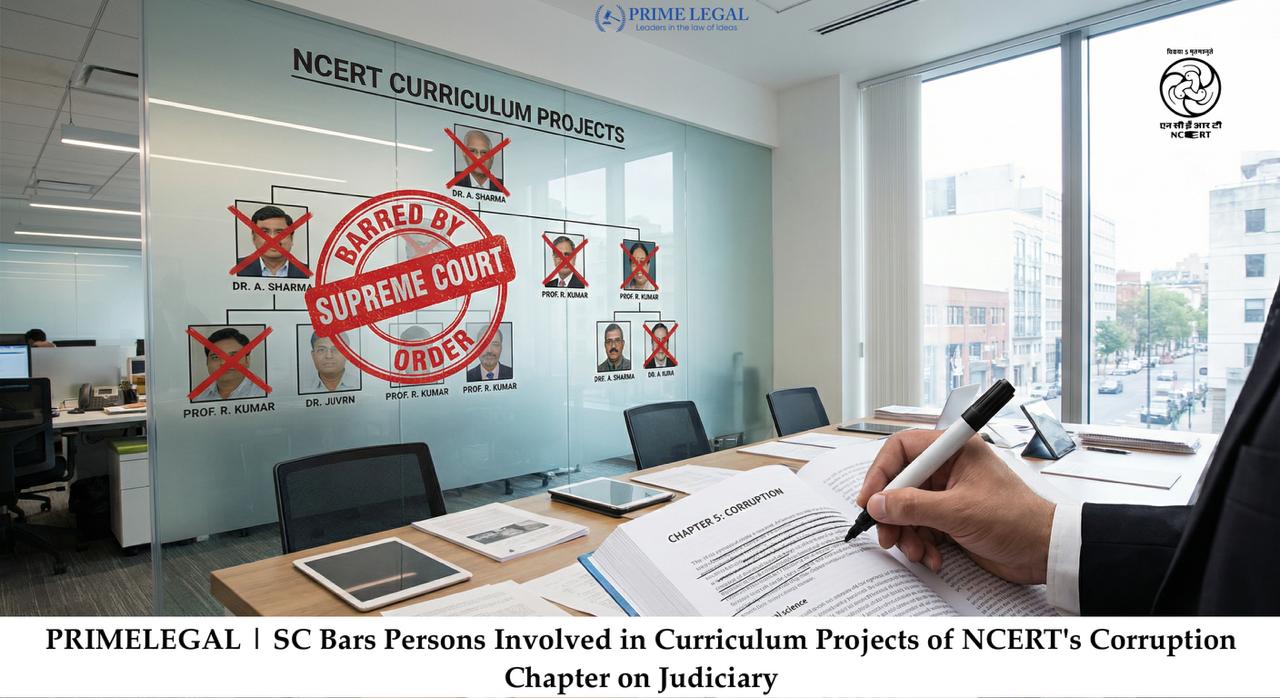
The Supreme Court of India has barred three experts, who were associated with a controversial Class VIII NCERT Social Science chapter on “Corruption in the Judiciary” from participating in any future curriculum development or publicly funded textbook preparation. The SC was hearing the Sun Moutu Case In Re: Social Science Textbook for Grade‑8 (Part 2) published by NCERT and ancillary issues (SMW (C) No. 1 of 2026), wherein in a 3 Judge Bench comprising Chief Justice of India Surya Kant, Justice Joymalya Bagchi and Justice Vipul M. Pancholi, remarked it was “disturbed” by NCERT’s stand that the controversial chapter had merely been “rewritten” and proposed to be introduced from the 2026‑27 academic year.
BACKGROUND
The controversy arose from NCERT’s Class VIII Social Science textbook “Exploring Society: India and Beyond” (Vol II), specifically Chapter IV, “The Role of the Judiciary in our Society”, which contained a sub‑section on “Corruption in the Judiciary” and linked allegations of corruption, massive case backlogs, shortage of judges and infrastructure deficits to public confidence in courts. Media reports highlighting the contents of the Chapter and complaints about the judiciary urged the Senior Advocates to bring the issue before the CJI, who highlighted that many judges were “perturbed” and that the Court would not allow the institution’s integrity to be tainted.
On 26th February 2026, the SC took Suo Motu cognizance and passed an order in In Re: Social Science Textbook for Grade‑8 (Part 2) published by NCERT and ancillary issues (2026 SCC OnLine SC 318), imposing a “complete blanket ban” on any further publication, reprinting or digital dissemination of the book and directing immediate seizure and removal of all copies. Show‑cause notices were issued to the Secretary, Department of School Education and Literacy, and the NCERT Director to explain why action, including proceedings for criminal contempt under Section 2(c) of the Contempt of Courts Act 1971, should not be initiated.
KEY POINTS
- Three experts barred from curriculum work: The Bench comprising CJI Surya Kant and Justices Joymalya Bagchi and Vipul M. Pancholi identified visiting professor Michel Danino, educator Suparna Diwakar and legal researcher Alok Prasanna Kumar as the experts under whose supervision the controversial chapter was drafted. Holding that they either lacked reasonable knowledge of the Indian judiciary or had deliberately misrepresented facts to project a negative image of the institution before the young minds of students of Class VIII, the Court directed the Union, all States/UTs, universities and publicly funded bodies to “disassociate” from them and not assign any responsibility involving public funds.
- Concern over NCERT’s “rewriting” of Chapter IV: In a subsequent affidavit, NCERT informed the Court that Chapter IV had been “duly rewritten” and would be incorporated into textbooks from the academic session 2026‑27. The judges questioned who had rewritten the chapter, whether any domain experts had vetted the revised content, and why details of the approving authorities were missing, describing the affidavit as “laconic” and the process as “casual”.
- High‑level committee mandated before any republication: In response, the Court directed the Union government to constitute a committee of domain experts, preferably including a former judge, an academician and a senior practitioner of law, to review any proposed revision. It ordered that even if Chapter IV has been rewritten, it shall not be published unless approved by this committee, and suggested that NCERT take assistance from institutions such as the National Judicial Academy to ensure factual accuracy and balance.
- NCERT apology and withdrawal of the book: Parallel to the court proceedings, NCERT issued a press release acknowledging that “inappropriate textual material” and an “error of judgement” had been unintentionally added to Chapter IV, and also tendered an “unconditional and unqualified apology” for the chapter. The Council confirmed that the entire textbook has been withdrawn and that distribution has been halted, with around 82,000 copies reportedly pulled back nationwide.
- Judiciary open to “healthy criticism”, not scandalization: While taking a hard line on the textbook and related social‑media commentary, the Bench clarified that its interim directions were not intended to prevent “healthy and legitimate criticism” of judicial functioning. It drew a distinction between good‑faith expert analysis of institutional deficiencies, which could be welcomed, and material that, in the Court’s prima facie view, carried an agenda to undermine judicial authority and could amount to criminal contempt.
RECENT DEVELOPMENTS
In its most recent order, the Supreme Court has combined institutional self‑protection with systemic course‑correction, by:
- sustaining the blanket ban on the impugned textbook
- keeping the contempt notices alive, and
- restructuring the process by which any revised chapter on the judiciary can enter the school curriculum.
The Court has also asked the Union government to revisit the composition and functioning of the National Syllabus and Teaching‑Learning Material Committee, noting that the controversial chapter appears not to have been placed before the full body, but only circulated digitally to a few members. Further, NCERT’s rewritten content on the judiciary will remain in abeyance until it passes scrutiny by an expert committee, even as the three disqualified authors retain the option of approaching the Supreme Court for modification of the adverse directions.
CONCLUSION
The Supreme Court’s intervention in the matter by barring three experts, ordering textbook withdrawal, and mandating a high-level review is to safeguard institutional integrity of the Judiciary against potentially defamatory educational content. The case, which has triggered a wider debate on how school textbooks should describe constitutional institutions and their shortcomings, is listed for further hearing, with the Court signaling that both curricular autonomy and freedom of criticism must operate within constitutional and contempt limits when the judiciary itself is the subject.
“PRIME LEGAL is a National Award-winning law firm with over two decades of experience across diverse legal sectors. We are dedicated to setting the standard for legal excellence in civil, criminal, and family law.”
WRITTEN BY: ABIA MOHAMMED KABEER
read the judgement here.

