
ABSTRACT:
As digital transactions have helped a lot in the day-to-day functioning with its growth. It has made the tasks easier to perform. The rapid expansion of the UPI by the National Payments Corporation of India has transformed the way financial transactions are conducted. But everything has a backdrop; with the fast and accessible mode of payments arises certain new legal challenges that are currently circulating not in the country but in the entire world. One such issue arises when individuals receive funds in their bank account from unknown sources resulting in their accounts getting frozen by the authorities. The law enforcement agencies have granted the power to freeze the bank accounts in suspicion to the authorities to prevent the illicit transfer of the funds and to help in aiding the prevention of the cybercrimes.
This article talks about the issue being faced by the innocent account holders whose account is getting freeze due to the transfer of the money from an unknown source. It highlights the challenges that are being faced by the individuals dealing with the UPI transactions. The study ultimately emphasizes the need for establishing the guidelines to curb down the unnecessary freezing and to bring fairness in the digital payment ecosystem.
KEYWORDS:
Freeze, UPI, Cybercrime, Money laundering, safeguards,
INTRODUCTION:
With the rapid growth and development in the country; various developments took place. One such development being the digitalization of the transactions that made the day-to-day tasks of an individual way easier. The NPCI’s UPI system has been one such development which has made the transaction on a daily basis much more accessible. However, this creation has created certain concerning problems as well. The rapid growth of the digital transactions has created ways for advanced cyber-crimes that are currently happening. One such crime being the freezing of the individual’s bank accounts due to suspicious receiving of money from unknown sources or UPI IDs. The sudden freezing of the account of an individual is creating problems as day-today transactions has become a daily routine in today’s era. The account of the person getting freeze doesn’t even have the knowledge of the transaction or its illegal origin, yet their access is being restricted. This raises questions about the stability, fairness and the protection of the innocent account holders as millions of people receive and transfer money daily through mobile applications such as PhonePe, Google Pay etc. This also raises a question regarding the excess reach in the cybercrime in today’s time. The innocent individuals are facing difficulties due to this freezing of the bank accounts.
THE RISE OF THE CYBERCRIMES:
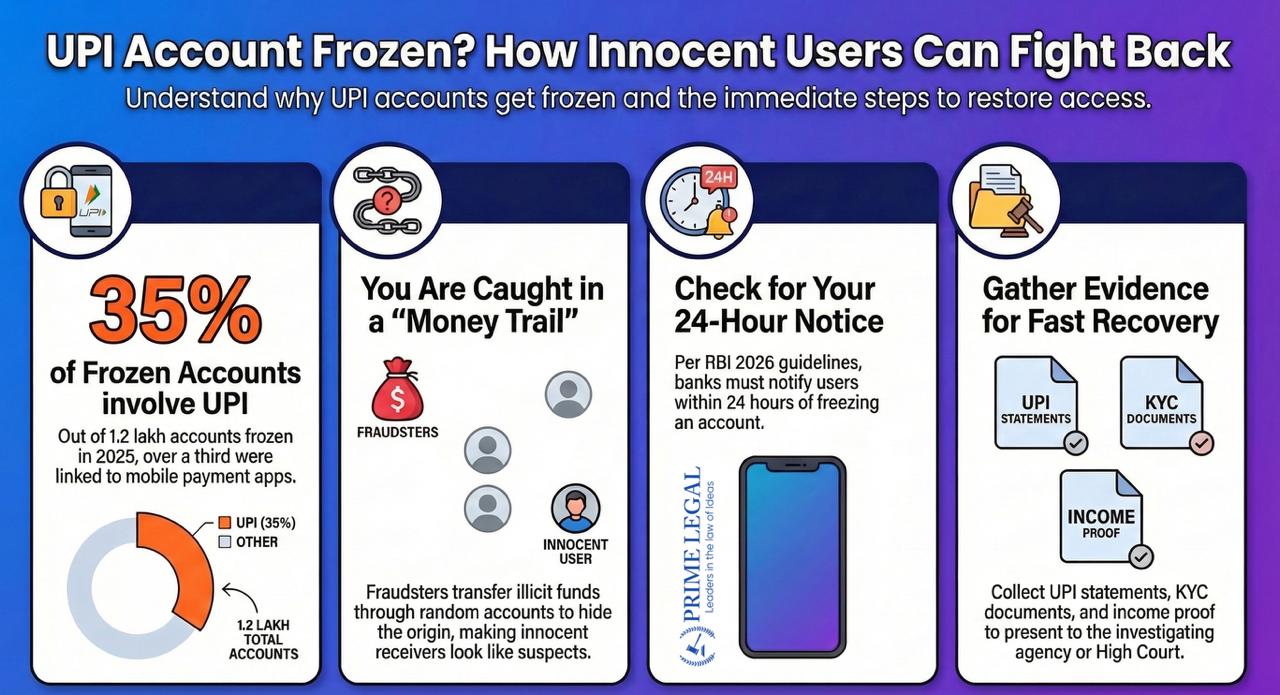
Online frauds have increased significantly with the increase in the digital payment systems. Fraudsters often move their illegally obtained money through multiple bank accounts to keep a trail of their funds. And in this process the innocent account holders get targeted, and they unknowingly become a part of this chain. They without any knowledge gets trapped and their account gets freeze consequently. They receive money in their account from an unknown source or ID and as a result gets tracked as a suspicious amount being credited to the owner of the account and hence the authority freezes the account to curb the illicit transfer or withdrawal of the funds from various accounts.
LEGAL POWERS TO FREEZE BANK ACCOUNTS:
The authorities have the power to block or freeze the account of the individual if they detect any suspicious activity. The authorities have the power under section 106 of the BNSS. This provision allows the banking authorities, Enforcement Directorate (ED), CBI to freeze the account whose activities are suspicious. Bank authorities can freeze the digital funds and the bank account of the individual. However, this power must be exercised carefully and with proper justification to avoid harming the innocent individuals. Other powers include section 17 of the Prevention of Money Laundering Act (PMLA) for suspected money.
Banks generally comply with the freezing orders issued by the law enforcement agencies to freeze the bank accounts of the individuals. The banks are required to follow the regulations or the guidelines which are being laid down by the Reserve Bank of India regarding the suspicious transactions, anti-money laundering measures and fraud prevention. The financial institutions monitor the suspicious or the unusual activity and give an order to freeze the account temporarily to investigate further and to curb the crime down. The institutions monitor the activity and give instructions to stop the illicit flow or the withdrawal of the funds obtained illegally.
PROBLEMS FACED BY THE INNOCENT ACCOUNT HOLDERS:
Freezing the bank account can cause various hardships to the individuals who depend on the digital transactions for their daily expenses. Sudden failure in the digital transaction of an individual causes a lot of problems as the person does not even know that his account got freeze by the authorities due to a suspected transaction.
- The inability to withdraw or to pay the bills.
- Not able to transfer the amount at all due to the freeze account.
- Being unaware regarding the reason for the freeze.
- It takes days and weeks to restore the account back to normal.
For the individuals who receive the amount or money unknowingly to their bank account do not even know that their account is being treated as a suspect rather than a victim which leads to a financial and psychological stress to the individual.
RBI data talks about the 1.2 lakh accounts getting freeze in 2025%, out of which 35% are UPI related.
LEGAL REMEDIES AVAILABLE:
The authorities did not leave the innocent account holders who got targeted without any remedies. Some remedies are provided to the innocent account holders to reclaim their account and to be free from the account freeze.
- Approach the investigating authority or the agency and provide explanation regarding the transaction or the account freeze.
- Gather the evidence such as the UPI statements, KYC docs., income proofs etc.
- The victim can also go to the PMLA Appellate Tribunal
- Or can also go to the High Court under the article 226 which talks about the personal remedies.
Courts have emphasized that freezing power should be used carefully to prevent the innocent accounts from getting freezed and should follow a proper legal procedure. RBI’s 2026 guidelines mandated that the banks should notify the users within 24 hours of freezing; offering some relief.
CONCLUSION:
The freezing of the accounts due to suspicious UPI transactions represents a serious issue to both- the individual and the bank. It is suggested that the authorities should take strong action to prevent cyber fraud and money laundering. A balanced approach to the safeguards and the investigation is required to build the trust or the public confidence in digital payments and to protect the rights of the private account holders.
“PRIME LEGAL is a National Award-winning law firm with over two decades of experience across diverse legal sectors. We are dedicated to setting the standard for legal excellence in civil, criminal, and family law.”
WRITTEN BY: MEENAKSHI DANGI.

