
CASE NAME: Israr Ahmad Khan v. Amarnath Prasad & Ors.
CASE NUMBER: Contempt Petition (Civil) No. 5/2026 in C.A. No. 7023/2025
COURT: Supreme Court of India
DATE: 24.02.2026
QUORUM: Hon’ble Justice Mr Ahsanuddin Amanullah and Hon’ble Justice Mr R. Mahadevan, JJ.
FACTS
The present contempt proceedings arose out of an earlier order passed by the Supreme Court on 20 May 2025 in Civil Appeals No. 7023/2025 and 7024/2025. In that order, the Court had directed the concerned authorities to take certain steps and comply with the directions within three months, that is, on or before 20 August 2025.
However, when the matter came before the Court again, it appeared that the directions had still not been complied with. A civil contempt petition was filed, and in response, Respondent No. 4, who was one of the alleged contemnors, filed an affidavit explaining the delay.
Meanwhile, a Review Petition challenging the order dated 20 May 2025 was filed in October 2025, although the defects pointed out in November 2025 had not yet been rectified. The Court immediately initiated the contempt proceedings against them because the order had still not been carried out even after the deadline had passed.
Following this, the accused parties asked for 15 days to comply with the order of the court. The Court accepted the prayer and gave them one last chance, setting the matter for March 24, 2026.
ISSUES
- Whether the Respondents’ failure to comply with the order dated 20.05.2025, while taking the defence of administrative hurdles and pendency of a defective Review Petition, constitutes wilful disobedience and contempt of court.
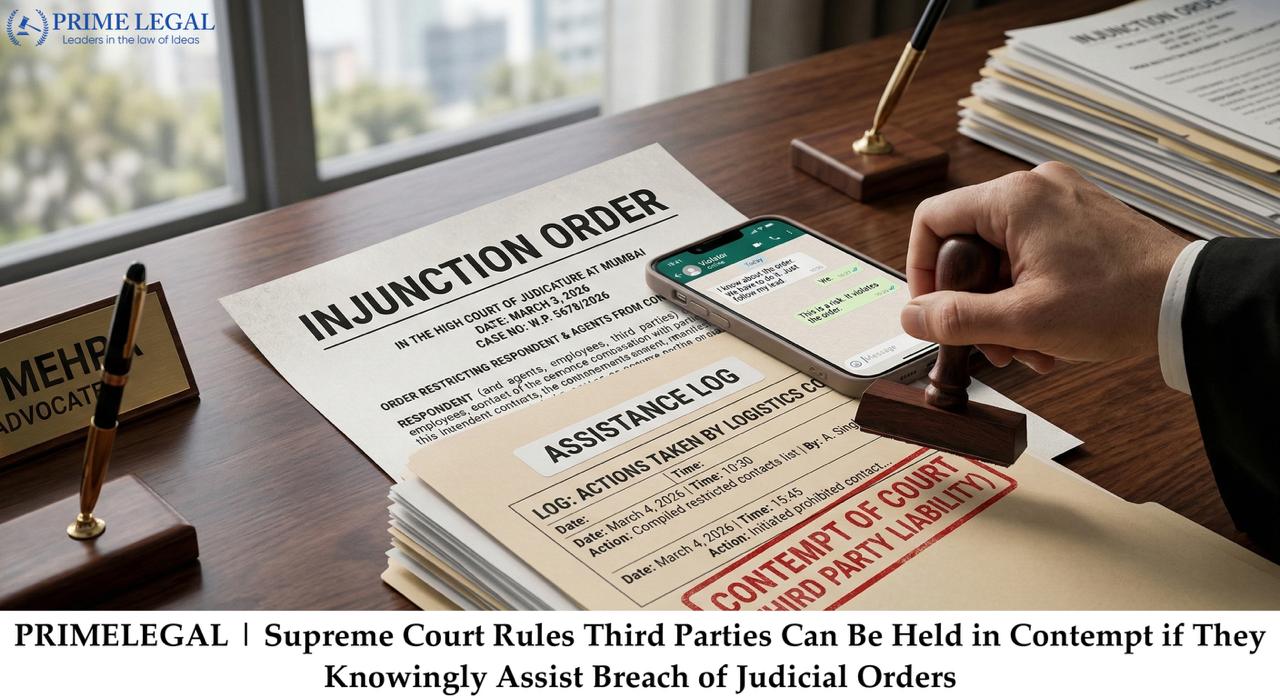
- Whether third parties & non-parties of the original suit who are part of the chain of implementation can be held liable for contempt.
LEGAL PROVISIONS
- Article 129 of the Constitution of India: The Supreme Court is a Court of Record and gives it the power to punish people who disrespect it.
- Section 2(b) of The Contempt of Courts Act, 1971: Defines civil contempt as wilfully ignoring any court’s judgment, decree, etc.
- Section 12 of the Contempt of Courts Act, 1971: Provides for punishment for contempt of court, which may include imprisonment, fine, or both.
ARGUMENTS
APPELLANT (Not expressly reproduced in the judgment)
The petitioners contended that the respondents had wilfully disobeyed the order passed by the Supreme Court on 20 May 2025, which required compliance within three months (by 20 August 2025). Even after the expiry of the given time, no steps were taken by the authority to implement the directions of the Court.
They argued that the authorities remained inactive for a long period and only began internal correspondence much later. The petitioners further pointed out that the Managing Director wrote to the Government seeking guidance only on 22 July 2025, when most of the compliance period had already elapsed.
RESPONDENTS
The accused parties said they had tried to follow the Supreme Court’s order from May 20, 2025, but the process was slowed down because of administrative and practical problems. They said that on July 22, 2025, the Managing Director of the Chhattisgarh State Minor Forest Produce Federation wrote to the Additional Chief Secretary to ask for advice on how to carry out the order.
They say that the government later asked for some documents, which were given. On September 26, 2025, a reminder was sent, and on October 3, 2025, the government replied, asking if all legal options had been used up. The respondents also told the Court that a Review Petition had been filed against the order in October 2025. They added that in the event that the review petition was denied, preparations were underway to draft a proposal for the establishment of a supernumerary position of Godown Keeper. They asked the Court to give them one last chance, for fifteen days, to fully follow the instructions.
ANALYSIS
The Supreme Court made it clear that the explanation offered by the alleged contemnors was not satisfactory. According to the Court, the affidavit filed by the respondent largely contained excuses rather than genuine reasons for non-compliance.
The Court noted that the order had to be complied with by 20 August 2025, but the actions taken by the authorities, such as the reminder letters and communications with the Government, occurred well after the deadline had already passed. This, in the Court’s view, clearly showed a lack of seriousness in implementing the Court’s directions.
The Court also noted that the authorities could have contacted the Court sooner by submitting a suitable application asking for guidance or clarification if they were actually having trouble carrying out the order. Rather, they decided to submit a review petition, which was flawed in and of itself and had not even been properly pursued.
Another important observation made by the Court was that a mere filing of a review petition does not dissolve the obligation to comply with the order of the court. Since several government officials and authorities who were not initially parties to the civil appeals had to take action in order to implement the Court’s previous order dated May 20, 2025, the Court also considered whether third parties or non-parties could be prosecuted for contempt. The Supreme Court cited its previous ruling of Sita Ram v. Balbir (2014) 13 SCC 489, in which it held that even a person who was not originally a party to the case can be held liable for contempt if they knowingly help in violating or obstructing the implementation of a court’s order to illustrate how contempt liability can apply to individuals who were not initially involved in the case.
JUDGMENT
The Court finally came to the conclusion that a prima facie case of contempt was clearly established after considering all these factors. The action of the officials was an outright disregard for the order of the Court and an utter contempt for the judiciary.
However, the Court decided to give the accused contemnors one last chance to abide by the order before proceeding with the contempt proceedings in consideration of their request.
The Court also stated that while it was not the responsibility of the accused contemnors to begin with, it was the responsibility of any individual or authority that was part of the chain that was responsible for carrying out the order.
CONCLUSION
The Supreme Court in this case also emphasised that the order has to be complied with within the specified time frame and that it should not be ignored in the name of the review petitions that are still pending or the administrative delays that may be occurring. Moreover, the Supreme Court also clarified that the responsibility of complying with the order does not lie solely on the parties to the original case, as the other officials in the chain of responsibility to implement the order may also face contempt if they do not act on it. Despite the fact that the Supreme Court found that there was a case of non-compliance, the respondents were given one last opportunity to comply with the previous order.
“PRIME LEGAL is a National Award-winning law firm with over two decades of experience across diverse legal sectors. We are dedicated to setting the standard for legal excellence in civil, criminal, and family law.”
WRITTEN BY: KISLAY RAJ
Click here to read the judgment.

