
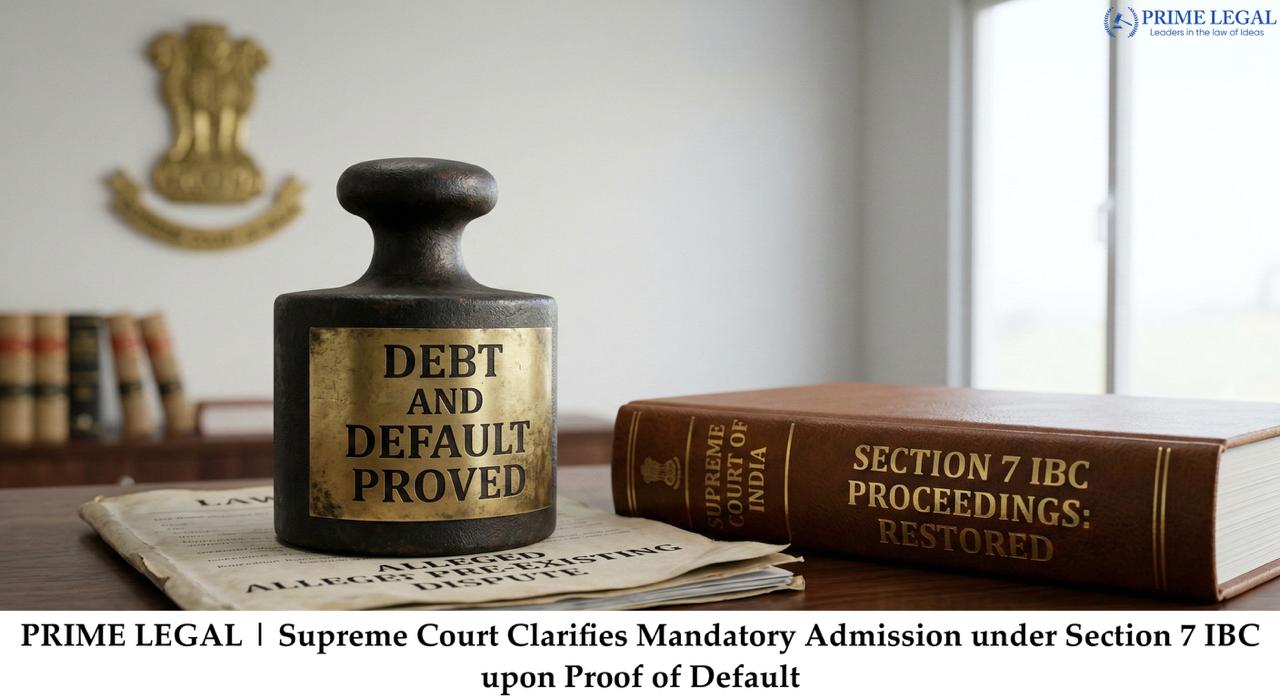
CASE NAME: Catalyst Trusteeship Ltd, v Ecstasy Realty Pvt Ltd (1997)
CASE Number: Civil Appeal No. 7424 of 2025
COURT: Supreme Court of India
DATE: 24 February 2026
QUORUM: Justice Sanjay Kumar & Justice K Vinod Chandran
FACTS
The Respondent company had proposed the development of a residential cum retail project at Mumbai in accordance with a board resolution dated 20.03.2018, the company had passed a board resolution for issue of 850 secured, redeemable, non-convertible debentures in two series, i.e., Series A (₹600 crore) and Series B (₹250 crore) debentures. Catalyst Trusteeship Ltd. was appointed to be the Debenture Trustee and a Debenture Trust Deed (DTD) was executed on 27.03.2018.
Series A debentures were fully subscribed and disbursement of amounting to Rs 600 crore to Respondent was made. Series B debentures never were issued. Subsequently, through communication of 16.03.2022, the Respondent applied for restructuring of repayment obligations by proposing a moratorium for the repayment of principal and interest payments for 18 months. However no formal amendment of the DTD was actually consummated pursuant to the contractual modification clauses contained in the DTD.
Upon default by the Appellant in maintaining the interest payment reserve and the repayment obligations, a notice of recall dated 21st July 2022 for an amount of Rs. 1203.55 Crore was issued. Thereafter, a petition was made under Section 7 of the Insolvency and Bankruptcy Code, 2016 before the NCLT, Mumbai in CP (IB) No. 922/MB/C-I/2022.
The NCLT dismissed the petition on 03.02.2023 holding that discussions about restructuring pointed towards a moratorium. The NCLAT affirmed the said finding on 16th April 2025. Aggrieved, the Appellant filed an approach to the Supreme Court under Section 62 IBC.
ISSUES:
- If the restructuring of the discussion was not accompanied by any formal change to the Debenture Trust Deed, did it constitute a binding moratorium?
- Whether financial debt and default pursuant to Section 7 IBC was determined.
- Whether the concomitant results of NCLT-NCLAT were perverse for NCLT to interfere with the posture of NCLAT.
LEGAL PROVISIONS:
- Section 7, Insolvency and Bankruptcy Code, 2016 was invoked by the Appellant in order to commence the CIRP on the ground that financial debt and default were clearly established. The Appellant argued that once these ingredients are fulfilled admission would be mandatory.
- Section 62, Insolvency and Bankruptcy Code, 2016 was used to challenge the NCLAT’s decision in front of the Supreme Court.
The Appellant had relied on the Debenture Trust Deed dated 27.03.2018 which was used to establish that where restructuring was needed, formal amendment should strictly be made in accordance with the terms of the contract. The Respondent’s case was based on argument from correspondence and negotiations that there is an implied arrangement to restructure.
ARGUMENTS:
PETITIONER / APPELLANTS:
The Appellant claimed that the Respondent had admittedly failed to make default on repayment obligations and to maintain the required reserve of interest payments as provided under the Debenture Trust Deed. It was argued that although there had been discussions on restructuring it had not been formally amended to the DTD through its modification clauses. Therefore, no legally binding moratorium was born. The Appellant further contended that the NCLT and NCLAT erred by considering informal discussions to be concluded restructuring. Once the financial debt and default was established, then the Adjudicating Authority was bound to admit the Section 7 petition.’
RESPONDENTS:
The Respondent’s contention was that restructuring negotiations and communications between parties reflected a consensual understanding on the issue of moratorium on payments. It was advocated that huge repayment of amounts amounting to a sum of Rs. 508.48 crores already made out of the amount of Rs. 600 crore which was disbursed. The Respondent further submitted that insolvency proceedings were being used as a mechanism of recovery and that the conduct of the Trustee indicated acceptance of restructuring discussions.
ANALYSIS:
The Supreme Court considered whether any legally-enforceable restructuring had occurred. The Court held that discussions or correspondence alone shall not amount to amendment of the Debenture Trust Deed. The contractual mechanism to modify was not followed and hence no binding moratorium came into existence.
The Court held that the findings of NCLT and NCLAT were based on assumptions and not strict contractual interpretation and documentary evidence. Such findings were described as perverse.
Reiterating the settled position under Section 7 IBC, the Court emphasized, once financial debt and default is established then admission of the application is mandatory. The Adjudicating Authority cannot, by rewriting terms of contracts, import equitable considerations which are inconsistent with the statutory framework.
JUDGMENT:
Civil Appeal was admitted before the Supreme Court on 24th Feb 2026, where the orders passed by NCLT on 03rd Feb 2023 and passed by NCLAT on 16th Apr 2025 were set aside. The Court held that both forums have been wrongly started on the basis of the existence of a moratorium that would be obligatory both for the Parties despite no formal amendment in the waiver of moratorium included in the Debenture Trust Deed of 27.03.2018. It made clear that discussions or correspondence relating to restructuring cannot supersede contractual requirements. Since the financial debt and default was readily established, the Court determined that the admission under Section 7 of the Insolvency and Bankruptcy Code, 2016 was mandatory in nature. Accordingly, CP (IB) No. 922/The suitability for appeal was directed to be admitted as per law and the appeal was allowed.
CONCLUSION:
The judgment is a correct application of the principle that the sanctity of contracts governs insolvency proceedings and, moreover, that informal restructuring discussions should not trump formally binding contractual agreements. It supports the idea that admission under Section 7 IBC is mandatory upon proof of debt and default and defines the power of the Supreme Court to interfere in cases where the concurrent findings are perverse. The decision goes a long way in trying to strengthen creditors protection in the ambit of Insolvency and Bankruptcy Code, 2016.
“PRIME LEGAL is a full-service law firm that has won a National Award and has more than 20 years of experience in an array of sectors and practice areas. Prime legal falls into the category of best law firm, best lawyer, best family lawyer, best divorce lawyer, best divorce law firm, best criminal lawyer, best criminal law firm, best consumer lawyer, best civil lawyer.”
WRITTEN BY: TANUSH RAJ
Click here to read the judgment

