
ABSTRACT
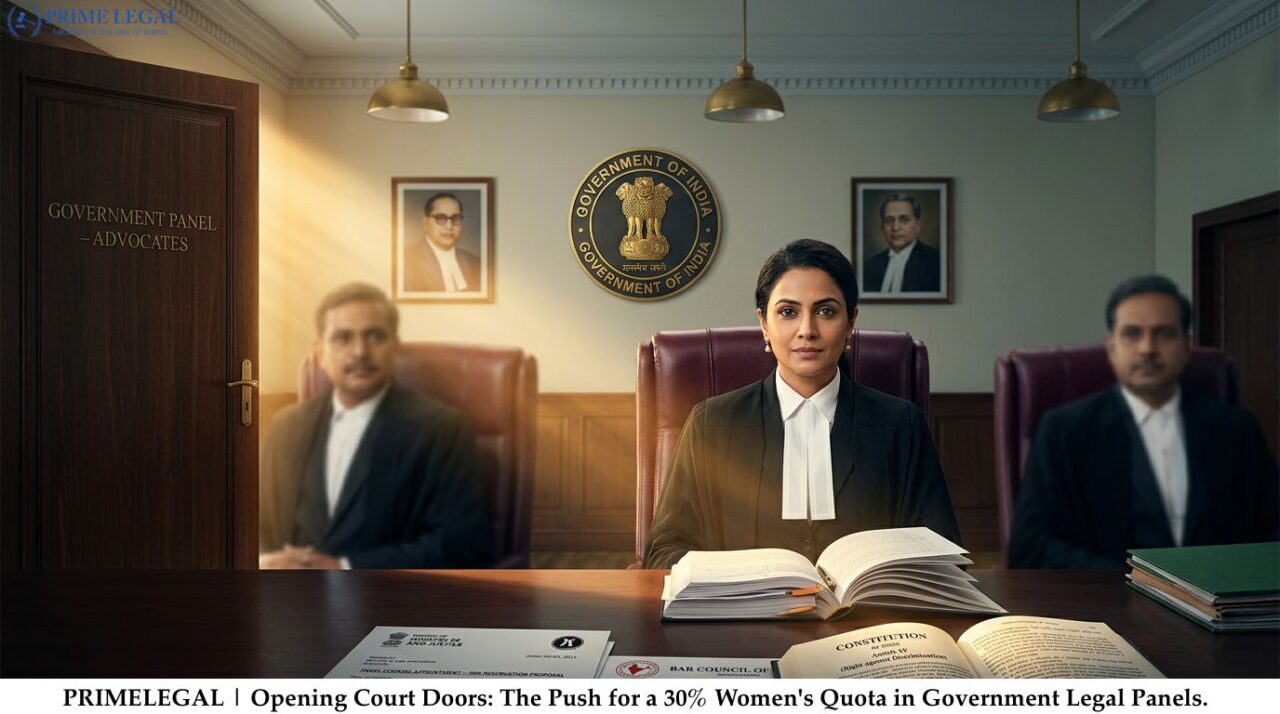
The legal profession in India has grown significantly, with thousands of young women graduating from law schools every year. However, a sharp gender imbalance remains at the senior levels of practice and state representation. In a major development on May 20, 2026, the Supreme Court of India issued notices to the Central Government and all states regarding a Public Interest Litigation (PIL) filed by the Ladli Foundation Trust, the petition demanded a minimum 30% horizontal reservation for women advocates across all government legal panels, public sector undertakings that is PSU’s and law officer positions. This article analyzes the systematic barriers that women law officers face including the phenomenon of “pyramidal exclusion” it also examines the constitutional validity of gender quotas under Article 14 and Article 15(3) and highlights why government panels serve as the ultimate stepping stone for judicial elevation for women.
KEYWORDS
Women Reservation, Supreme Court 2026, Government Legal Panels, Pyramidal Exclusion, Ladli Foundation Trust, Law Officers, Constitutional Law India, Article 15(3).
INTRODUCTION
When we walk into any modern Indian law school, the classrooms are filled with bright, ambitious young women. Yet, if we step into the highest constitutional courts of the country, the picture changes completely. The front rows, where senior state counsels and top law officers stand, remain overwhelmingly male. This sharp contrast shows a deeper institutional issue within India’s legal ecosystem. On May 20, 2026 a bench comprising Chief Justice of India Surya Kant, Justice JoyMalya Bagchi and Justice Vipul M. Pancholi took a historic step by entertaining a petition that could completely transform this landscape with regard to the 30% reservation of women advocates in government councils. The lawsuit seeks to mandate a 30% quota for female lawyers in state empanelments it forces the country to address a stark historical inequality that was there for over 75 years in independent India that is it had never seen a single female attorney journal or solicitor general
THE REALITY OF PYRAMIDAL EXCLUSION IN THE LEGAL PROFESSION
The petition filed by the Ladli Foundation Trust highlights a social issue known as “pyramidal exclusion”. This term describes a system where a woman enters a profession in large numbers at the starting level but gradually they start disappearing in number as we move up towards the position of authority. According to the statistical data presented before the Supreme Court, out of approximately 1.54 million enrolled advocates across India, only about 284,507 are women. This means women make up just about 15.31% of the total active legal workforce. The drop becomes even more severe when looking at state representation. The India Justice Report reveals a nationwide pattern of institutional exclusion, showing that 13 out of 17 large states have less than 30% women as panel lawyers. States like Odisha and Uttar Pradesh report staggeringly low numbers, hovering around 14%.
THE “EMPTY BRIEF” PROBLEM: BEYOND MERE NAMES ON A PANE
During the Supreme Court hearing, Senior Advocate Vikas Singh, representing the petitioner, brought up a crucial issue that goes beyond just counting heads. He pointed out that even when women advocates manage to get their names listed on government panels, they are frequently victims of the “empty brief” practice. This means their names exist on the official government list to show diversity, but the actual, high-profile court cases are rarely assigned to them. Chief Justice Surya Kant acknowledged this reality, noting that while some states offer stipends to empanelled women advocates, there are times when not a single case is marked to them for an entire month. Therefore, the 2026 push is not just about securing a 30% quota on paper; it is about creating a strict institutional tracking mechanism to ensure that female lawyers are actively allotted cases to argue in open court.
THE CONSTITUTIONAL FOUNDATION FOR AFFIRMATIVE ACTION
Opponents of reservation in professional spaces often argue that quotas compromise merit. However, the petition filed by the Ladli Foundation firmly states that the demand for 30% quotas is within the text of the Constitution of India. It argues that the current system violates the right to equality within Article 14 and right to practice a profession within Article 19(1) (g) by keeping structural barriers intact. More importantly Article 15 (3) of the Constitution explicitly highlights that state to make special provisions for women and children. The Supreme Court has repeatedly held that true equality cannot be achieved by treating unequal people equally since women advocates face unique social biases and challenges such as lack of old boy networking circles and domestic obligations; a targeted horizontal reservation is a valid constitutional tool to level the playing field. The recent Nari Shakti Adhiniyam which mandated 33% reservation for women in legislative bodies approved of a clear national commitment to gender exclusive governance.
GOVERNMENT PANELS AS INSTITUTIONAL POOLS FOR THE JUDICIARY
The lack of women on government legal panels has a direct, damaging effect on the diversity of the judiciary itself. In India, government panels function as the primary platform where lawyers gain institutional visibility, argue complex constitutional matters, and build professional reputations. When judges are selected for elevation to the High Courts and the Supreme Court from the Bar, the selection committee naturally looks at the pool of successful government counsels and senior advocates. Because women are systematically excluded from these state panels, they are automatically shut out from the primary “feeder pool” for judgeship. Currently, women constitute only about 5.88% of judges in the Supreme Court and roughly 13.76% in the High Courts. By opening the doors of government panels to women, the legal system will naturally create a diverse pool of highly qualified female advocates ready to be elevated to the bench.
CONCLUSION
The Supreme Court’s decision to examine the 30% reservation plea in Ladli Foundation Trust v. Union of India Writ Petition (Civil) No. 471 of 2026 marks a defining movement for the legal fraternity, especially the women- advocates in 2026. For decades the structural exclusion of women from state legal representation was treated as an indivisible, individual struggle. By transforming this issue into a formal constitutional debate, the judiciary has signaled that inclusivity is essential to justice. True merit cannot thrive in an environment where structural hurdles prevent a large section of talent from even entering the courtroom. While the responses from the Centre and the States are awaited, the conversation itself has broken a long-standing silence. Ensuring that women have a definitive seat at the state’s legal table is no longer a matter of charity; it is a constitutional necessity that will make India’s justice system fairer, more balanced, and truly democratic.
“PRIME LEGAL is a National Award-winning law firm with over two decades of experience across diverse legal sectors. We are dedicated to setting the standard for legal excellence in civil, criminal, and family law.”
WRITTEN BY: LISHIKA BATRA

