
CASE NAME: Vinodkumar Chellappan Pillai v. State of Maharashtra & Ors.
CITATION: 2026:BHC-KOL:3781-DB
CASE NUMBER: Writ Petition No. 280 of 2026
COURT: High Court of Judicature at Bombay, Circuit Bench at Kolhapur
DATE: 04 May 2026
CORAM: Hon’ble Mr. Justice Madhav J. Jamdar and Hon’ble Mr. Justice Pravin S. Patil
FACTS
The petitioner Vinodkumar Chellappan Pillai, received a conviction under Section 138 of the Negotiable Instruments Act, 1881. As a result he is in a situation where he must stay in prison for one year. To resolve his debt, he is also under an order to pay Rs. 24 lakh to the complainant. If he does not pay this amount, he is required to stay in prison for an additional six months.
On 03 May 2025, the petitioner went to the prison authorities and stayed at Kolhapur Central Prison. After this event on 23 March 2026, he tried to submit an application for regular parole under the Maharashtra Prisons (Furlough & Parole) Rules, 2024.
But the prison authorities did not accept the application – for their reason, they stated that Rule 14 of the 2024 Rules is a requirement that a prisoner stays in prison for one full year before he is eligible for regular parole.
Because of this denial, the petitioner filed a case in the Bombay High Court under Article 226 of the Constitution of India. In this legal action, he asks the court to direct the authorities to look at his parole application. And he also argues that Rule 14 of the Maharashtra Prisons (Furlough & Parole) Rules, 2024 is not valid under the constitution.
ISSUES
- Whether Rule 14 of the Maharashtra Prisons (Furlough and Parole) Rules, 2024 violates Articles 14 and 21 of the Constitution of India.
- Whether the one year restriction bears any rational nexus with the objectives and grounds for grant of parole.
- Whether parole is merely a concession granted by the State or a limited legal right available to prisoners.
LEGAL PROVISIONS
- Article 14 of the Constitution of India – Guarantees equality before law and prohibits arbitrary State action.
- Article 21 of the Constitution of India – Protects the right to life and personal liberty, including the right to live with dignity.
- Article 226 of the Constitution of India – Empowers High Courts to issue writs for enforcement of fundamental and legal rights.
- Rule 12 of the Maharashtra Prisons (Furlough and Parole) Rules, 2024 – Specifies the grounds on which parole may be granted.
- Rule 13 of the Maharashtra Prisons (Furlough and Parole) Rules, 2024 – Classifies parole into regular parole and emergency parole.
- Rule 14 of the Maharashtra Prisons (Furlough and Parole) Rules, 2024 – Prescribes eligibility conditions for parole, including the requirement of one year of actual imprisonment for regular parole.
- Section 138 of the Negotiable Instruments Act, 1881 – Penalises dishonour of cheques for insufficiency of funds.
- Case Laws:
- Kantilal Nadlal Jaiswal v. Divisional Commissioner.
- Asfaq v. State of Rajasthan.
- Navtej Singh Johar v. Union of India.
- Balaji Abhaji Puyad v. State of Maharashtra.
- Nadeem v. State (Govt. of NCT of Delhi).
ANALYSIS
In the Maharashtra Prisons (Furlough & Parole) Rules, 2024, the Court reviewed the structure and the goals of the parole system. It is stated that a prisoner can receive parole if a spouse or a blood relative is very ill, if a child is born, if a child or sibling gets married or if a natural disaster harms the family of the prisoner.
The Bench noted that the events are not predictable and can occur at any time while a person is in prison. As a result, the rule that prevents a prisoner from asking for parole before one year passes does not have a logical connection to the reasons why authorities grant parole.
To support this the Court used the judgment from a larger group of judges in Kantilal Nadlal Jaiswal v. Divisional Commissioner. In that case, a similar restriction had been struck down because it violated Article 14 & Article 21 of the Constitution. They decided that parole is a legal right with specific limits rather than just an administrative concession.
The Bench also referred to the Supreme Court’s judgment in Asfaq v. State of Rajasthan, which said that parole and furlough exist because of a humanistic approach to help prisoners maintain ties to their families and society.
For the final part of the discussion, the Court looked at the idea of manifest arbitrariness under Article 14, citing Navtej Singh Johar v. Union of India. It is required that the people who manage prisons and the steps for parole must act in a way that is fair and follows consistent logic.
JUDGEMENT
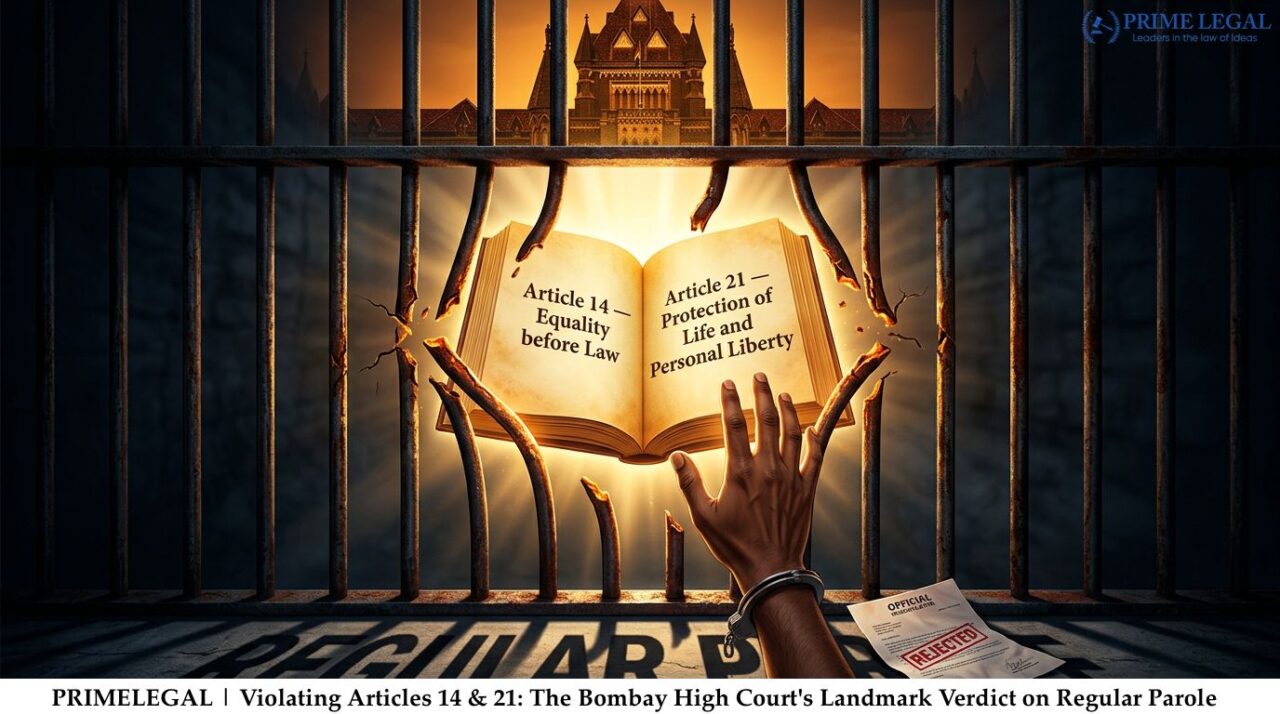
The Bombay High Court held that the phrase “on completion of one year of actual imprisonment” appearing in Rule 14(1) of the Maharashtra Prisons (Furlough and Parole) Rules, 2024 was manifestly arbitrary and unconstitutional.
Accordingly, the Court struck down the said portion of Rule 14(1) as violative of Articles 14 and 21 of the Constitution of India.
The Court further directed the Deputy Inspector General of Prisons (West), Yerwada, Pune, to decide the petitioner’s parole application in accordance with law on or before 15 May 2026.
CONCLUSION
The Court struck down the one year waiting period for parole eligibility and said that prisoners do not lose their constitutional rights merely because of incarceration. The Bombay High Court recognised that parole serves an important rehabilitative and humanitarian purpose.
The ruling further clarifies that prison administration must function in a fair, reasonable and non-arbitrary manner, particularly where prisoners seek temporary release to deal with genuine family emergencies and personal crises.
“PRIME LEGAL is a National Award-winning law firm with over two decades of experience across diverse legal sectors. We are dedicated to setting the standard for legal excellence in civil, criminal, and family law.”
WRITTEN BY: SAMANA.
Read the judgement copy below:

