
CASE NAME: Jalim Singh v. Nand Kishore & Ors.
CASE NUMBER: Civil Appeal No. of 2026 @ Special Leave Petition (C.) No. 20915 of 2024.
COURT: Supreme Court of India
DATE: 17 March, 2026
QUORUM: Justice Vikram Nath and Justice Sandeep Mehta
FACTS
The appellant was appointed as Cooperative Supervisor in the year 1971. He was suspended in 1977 and later reinstated to service in 1991. While in suspension the appellant had filed a suit seeking full salary and other benefits during his suspension period. The High Court allowed the same in the year 2006 and held that the appellant is entitled to full salary and emoluments. The respondent Bank’s Special Leave Petition was dismissed thus the judgement attaining finality.
On 31st October 2009 the appellant retired, and the Bank failed to release the retirement benefits, leading to a series of writ petitions and when the Bank failed to comply with contempt of court proceedings. In 2019 the High Court directed the Bank to release post retirement benefits, salary arrears and emoluments. When the Bank further failed to comply with the Court orders the appellant filed a contempt of court petition.
The High Court however dismissed the contempt petition in 2024, aggrieved, and the appellant approached the Supreme Court.
ISSUES
- Whether the High Court, while exercising contempt jurisdiction, can reopen and re-examine issues already settled by a final judgment?
- Whether non-compliance with clear judicial directions can be justified by raising new grounds in contempt proceedings?
LEGAL PROVISIONS
- Contempt of Courts Act, 1971
- Article 129 & 142, Constitution of India
- Principles governing contempt jurisdiction
- Doctrine of finality of judgments
ARGUMENTS:
PETITIONER
The petitioner contended the High Court exceeded its jurisdiction by reexamining issues that were already settled in the previous judgement.
He argued that the 2019 order had already directed for the disbursement of salary arrears and retiral benefits and that the court only needed to adjudicate on the matter of compliance of the contempt proceeding and not the readjudication on the matter.
He further held that the Respondent Bank is deliberately avoiding compliance and unnecessarily prolonging the litigation to deny him his benefits.
RESPONDENT
The respondent bank argued that the appellant is not entitled to certain benefits due to lack of qualification and he was also not formally absorbed into Class-III post. Due to such deficiencies no legal liability arose thus, benefits like gratuity are not payable.
ANALYSIS
The SC emphasised that once a judgment reached finality its correctness cannot be questioned again in contempt proceedings. The 2019 High Court order had clearly and unequivocally issued directions to the respondent bank to pay arrears of salary and other retiral benefits and that order was never challenged by either of the parties thus becoming final between them.
The High Court went beyond its jurisdiction by reopening questions of qualification, entitlement and absorption; this was held legally impermissible by the Supreme Court.
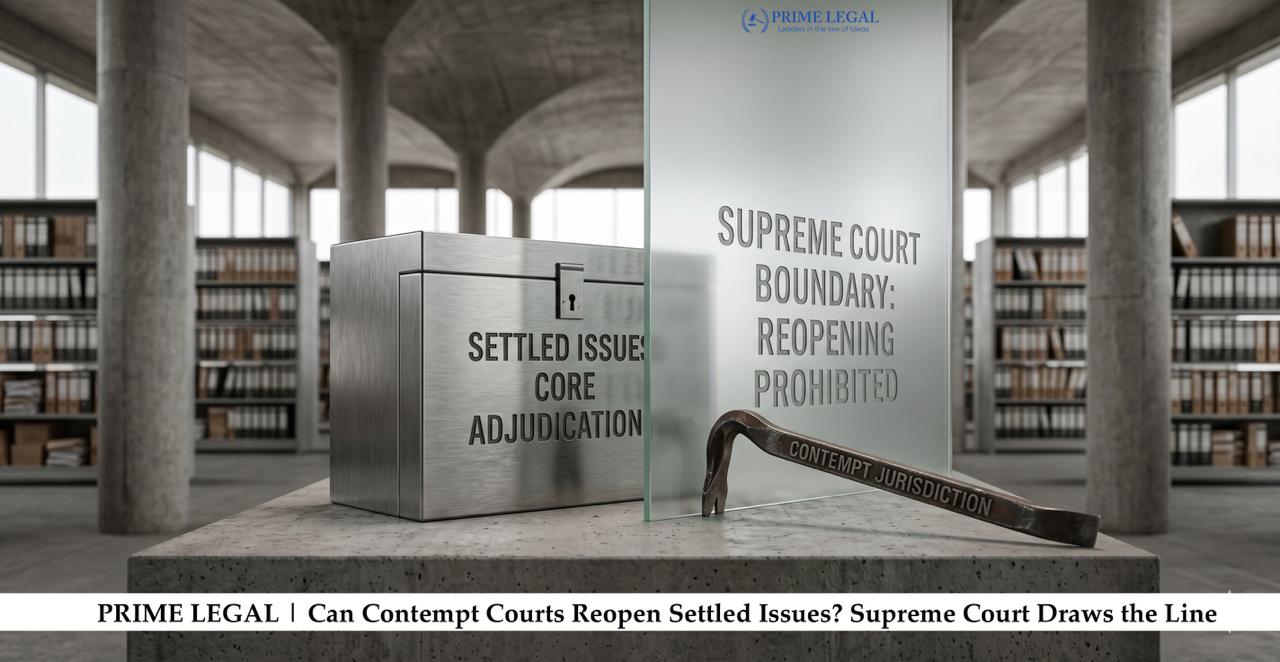
The Court thus clarified that contempt jurisdiction is for enforcement and not to readjudicate.
The Court heavily criticised the respondent bank saying that they had unnecessarily prolonged the litigation and deprived the appellant of his benefits which were granted to him decades ago to which he had statutory right on.
JUDGEMENT
The Supreme Court held that
- The impugned judgement of 7th May 2024 was set aside
- The High Court had gravely erred by dismissing the contempt proceedings and reexamining the questions that had already attained finality
- The appeal was allowed
The Court also directed the respondent bank to
- Pay 2,28,000/- as gratuity and 8% p.a interest from 1st November 2009
- In case of default interest to increase to 18% p.a
- Pay additional compensation of 1,00,000/- for prolonged litigation
- Make all the payments within two months
CONCLUSION
The judgement is a landmark decision in contempt jurisdiction where it drew a clear boundary stating that contempt courts cannot function like appellate courts. After a matter is settled and directions are issued the only question that is left to adjudicate on is its compliance and nothing more. The Court also imposed monetary consequences for causing institutional delays and litigation abuse holding that prolonged non compliance with judicial orders will not be tolerated.
PRIME LEGAL is a National Award-winning law firm with over two decades of experience across diverse legal sectors. We are dedicated to setting the standard for legal excellence in civil, criminal, and family law.
WRITTEN BY: AARSHITHA UNNIKRISHNAN
read the judegment copy here

