
INTRODUCTION
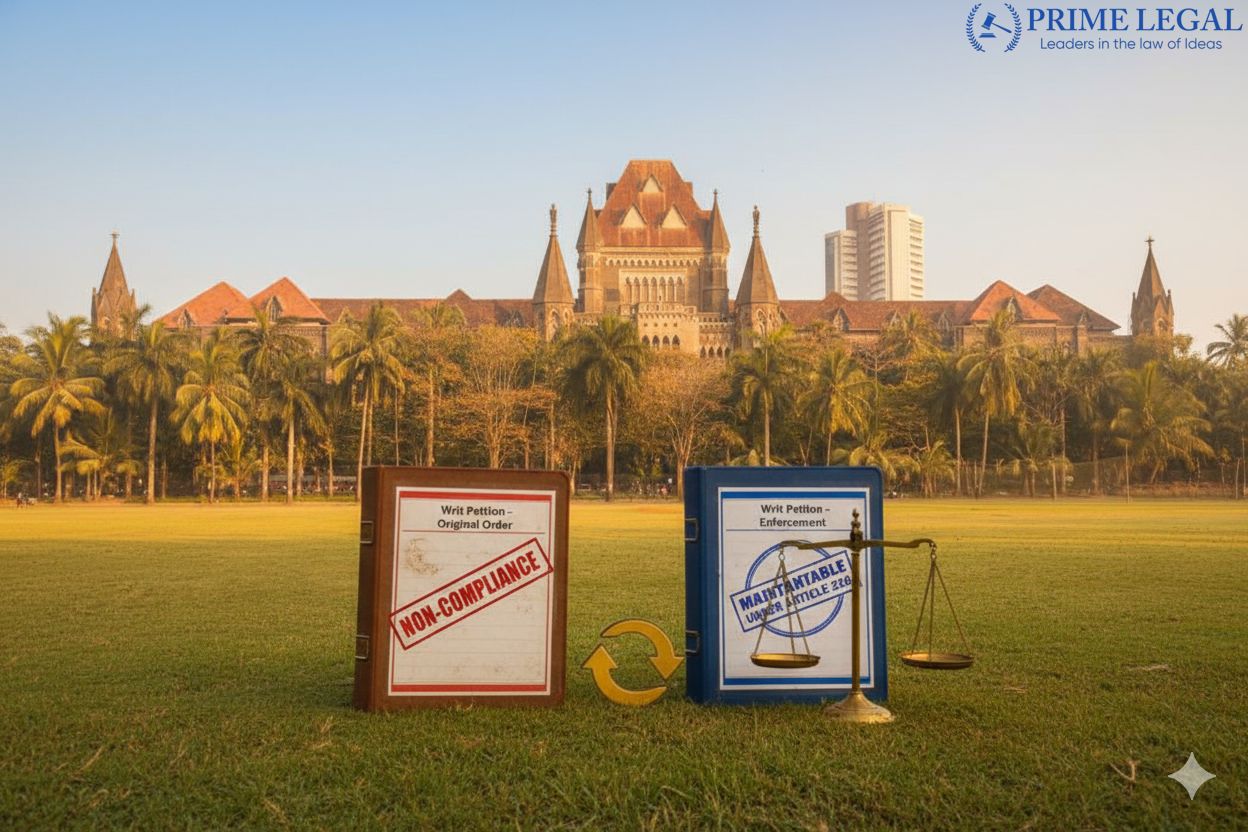
The Bombay High Court has clarified an important procedural question in writ jurisdiction that is whether a second writ petition under Article 226 can be filed solely to enforce an earlier writ order that has not been complied with. The Court answered in the affirmative, stressing that writ jurisdiction does not end with the delivery of a judgment, it further continues until the Court’s directions are fully implemented. This ruling reinforces the supervisory and corrective role of High Courts when administrative authorities attempt to bypass or dilute earlier judicial orders.
BACKGROUND
The dispute arose after the petitions had successfully challenges certain orders and an inspection report relied upon by the Employee’s State Insurance Corporation (ESIC). The Bombay High Court had earlier quashed those proceedings. Despite this, the ESIC went on to issue fresh show – cause notices based on the very same quashed inspection report. Faced with what appeared to be an incident revival of cancelled material, the petitioners through second writ petition approached the Court again stating not to reopen the original case but to enforce the Court’s previous judgement. ESIC objected contending that the second petition was not maintainable, but the Court rejected this contention.
KEY POINTS
- The High Court held that the second writ petition is perfectly maintainable when its object is to ensure compliance with an earlier writ order. The Court observed that if an authority does not follow the earlier directions or attempts to revive quashed proceedings, the aggrieved party cannot be left remediless. Therefore, second writ petition becomes a legitimate tool to protect the sanctity of judicial orders.
- The Court declined to entertain objections raised about which Bench should hear the second writ or whether the matter should fall within another roster category. It held that procedural refinement cannot be used as a shield to avoid compliance. The Court has inherent authority to enforce its own judgments, and administrative roster classifications cannot restrict that power.
- The Bench reiterated that Article 226 empowers the High Court to remedy injustice whenever it occurs. The jurisdiction of the Court is not exhausted after issuing am order. If the order is disregarded or neglected, the Court must step in again to ensure its implementation and to prevent administrative overreach.
- Issuing fresh notices based on a previously quashed inspection report amounted to a clear violation of the earlier judgment. The Court found that such conduct directly undermines judicial jurisdiction. Therefore, any attempt either direct or indirect to rely on quashed material is treated as non – compliance warranting intervention.
RECENT DEVELOPMENTS
The Court’s ruling in earlier decisions such as Bibekananda Mondal v. State of West Bengal [W.P. 15205 (W) of 2003], where the Calcutta High Court upheld the maintainability of a second writ for enforcing the primary one. Moreover, the Bombay High Court’s ruling in Found ever CRM India Pvt. Ltd. v. ESIC [WP (L) No. 36732 of 2025] further cements the principle that enforcement of judicial orders takes precedence when public authorities disregard earlier rulings. The Supreme Court at the same time has often warned against routine bypassing of alternate remedies, but it has also acknowledged that where enforcement of judicial directions is at stake, writ Courts hold exceptional authority. The current ruling thus harmonizes existing jurisprudence by distinguishing between reopening a dispute and enforcing compliance.
CONCLUSION
This decision given by Bombay High Court provides clarity and strengthens the enforceability of writ judgments under Article 226 of the Constitution of India. By affirming that a second writ petition is maintainable when authorities fail to honour earlier directions, the Court has reinforced the principle that judicial orders cannot be circumvented through fresh proceedings built on quashed material. The ruling not only safeguards the integrity of judicial decisions but also ensures that litigants have an effective remedy when administrative bodies attempt to disregard or dilute High Court judgments.
“PRIME LEGAL is a full-service law firm that has won a National Award and has more than 20 years of experience in an array of sectors and practice areas. Prime legal falls into the category of best law firm, best lawyer, best family lawyer, best divorce lawyer, best divorce law firm, best criminal lawyer, best criminal law firm, best consumer lawyer, best civil lawyer.”
WRITTEN BY – SUSMITA ROYCHOWDHURY

