
Introduction
Bilkis Bano Case is one of the most important examples of the failure of the criminal justice system in the 2002 Gujarat riots. The case poses crucial questions about the dignity of women, protection of victims, accountability of the constitution and criminal justice. Almost two decades after the convictions of the accused, the case has once again come into focus in the national limelight due to the Supreme Court order of 28 October 2026 that suspended the life sentences of two of the convicts, Bipinchand Kanaiyalal Joshi and Pradip Ramanlal Modhiya, and granted them bail. The controversial order was made without informing the survivor and giving her an opportunity to object to the same. Though suspension of sentence pending appeal is a judicial power, the exercise of such power in cases of such grave nature requires a proper consideration of the facts of the case, the interest of justice and the rights of the victim. The controversy thus is not just about granting bail but the issue of whether criminal procedures are sufficient to safeguard the rights of participation of a survivor in decisions affecting her safety and justice.
Background to the Case
The case arose from communal violence that broke out in Gujarat in February 2002 after the Godhra train fire. On 3 March 2002, while Bilkis Bano was pregnant at the time, she was gang-raped by a mob in a village called Randhikpur in the district of Dahod. Some members of Bano’s family, including her three-year-old daughter, were murdered ruthlessly. At the time, there was a lot of worry regarding police corruption as well as suppression of evidence. For this reason, the Supreme Court transferred the investigation and trial to Maharashtra from Gujarat for a fair trial in 2004. In 2008, Bilkis’ rapists were convicted by a Special CBI Court in Mumbai of charges such as rape, murder, and rioting in a sentence of imprisonment for life. In 2017, these convictions were upheld by the Bombay High Court. Nevertheless, in August 2022, the Gujarat Government released the 11 convicted men early through remission. In January 2024, the Supreme Court overturned the remission orders on the grounds that the Gujarat Government did not have the jurisdiction to grant remission in that case and the whole procedure was marred with fraud. The 11 convicts were ordered to surrender. Later, two of the convicts moved the Supreme Court for suspension of their sentences and bail, leading to the October 2026 ruling.
Key points:
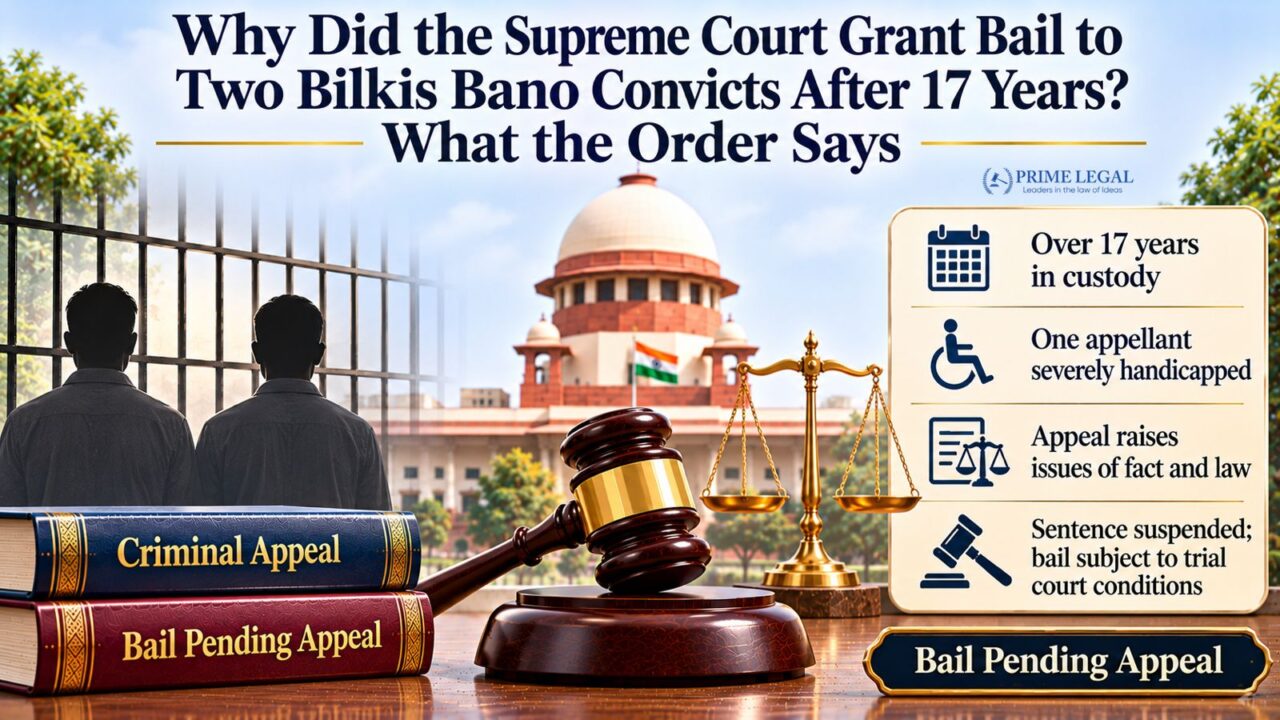
- It was noted that both the convicts had spent more than 17 years behind bars, taking into account the extended period of detention as an important ground for suspending their sentences.
- It was alleged that one of the convicts was affected by a serious physical disability, which the court took into consideration while deliberating the necessity of imprisonment pending their appeal.
- Both of the convicts appealed against their conviction passed by the Bombay High Court in 2017. The grounds of their appeals questioned facts and law still pending resolution.
- Their life sentences were suspended by the Supreme Court while the disposal of their appeals and released them on bail upon the imposition of certain conditions by the trial court.
- This decision to suspend their sentences does not absolve their convictions and innocence but only suspends their sentences pending the disposal of their appeals.
- Bilkis Bano was not made a party in the case and no information regarding the order was provided to her. It was alleged that she came to know about the ruling through the news media reports.
- The order was issued on 28 October 2026 by the Supreme Court Bench which consisted of Justices M.M. Sundresh and Prasanna B. Varale.
Analysis
In this case, the key issues relate to the balance between judicial discretion and the constitutional right of victims. The Supreme Court enjoys the power to stay the sentence during the pendency of the appeal, but it must be made in the context of a proper judicial exercise of the discretion. While imprisonment of the convicts and the disability of one of the applicants are relevant factors, equally necessary was the assessment of the gravity of the offenses and the facts of their conviction. Of course, the absence of the hearing of Bilkis Bano is problematic from the point of view of judicial procedure. In Jagjeet Singh v. Ashish Mishra (2022), the Supreme Court noted that victims have a separate right to take part in the proceedings and should not be seen only as spectators in the process of dispensing justice. The exact contours of participation of victims in each individual case of sentence suspension should be determined by the procedural law, but the victim’s interest cannot be overlooked. In addition, the case concerns Article 21 of the Constitution that is concerned with the right to life and personal liberty and has been read as including dignity and due process. It should be pointed out that the 2026 order needs to be distinguished from the 2024 remission order in that while the former concerns the suspension of sentence, the latter pertains to the reduction or cancellation of the sentence. However, the distinction does not rule out the necessity of judicial accountability.
The Supreme Court released bail for the two convicts mainly because of long term imprisonment of more than 17 years and because of the physical disability of one of the convicts, pending appeal. The most troubling aspect of the judgement is that Bilkis Bano was not even given a chance to speak when the Supreme Court freed them, despite the enormity of the crime they committed.
CONCLUSION
The Bilkis Bano case highlights the fact that there comes no end to the process of justice with a conviction of the accused in a crime. The survival of a victim from crimes of high magnitude is about more than just conviction, but also about protection, honor, participation, and the reassurance that their plight shall not be ignored when another round of trial occurs in the future. The Supreme Court of October 2026 ruling has once again brought back the spotlight on the tricky issue that relates to balancing the liberties of those convicted against the rights of the victim. The law provides for a stay on the order during a pending appeal; however, such power needs to be used considering the nature of the crime, the circumstances of the convict, and those of the victim as well. Failing to keep the survivor of a heinous crime informed about the developments of such cases is something that questions whether everyone is getting equal rights in the criminal justice procedure. In conclusion, justice is not to be measured only through the number of convictions achieved or the judicial orders issued but should also be measured through how the process is conducted. It acts as a lesson on how a justice system cannot claim to operate on the principle of the rule of law when a victim of the crime finds herself battling to be heard.
“PRIME LEGAL is a National Award-winning law firm with over two decades of experience across diverse legal sectors. We are dedicated to setting the standard for legal excellence in civil, criminal, and family law.”
Written by – Krittika Sengupta

