
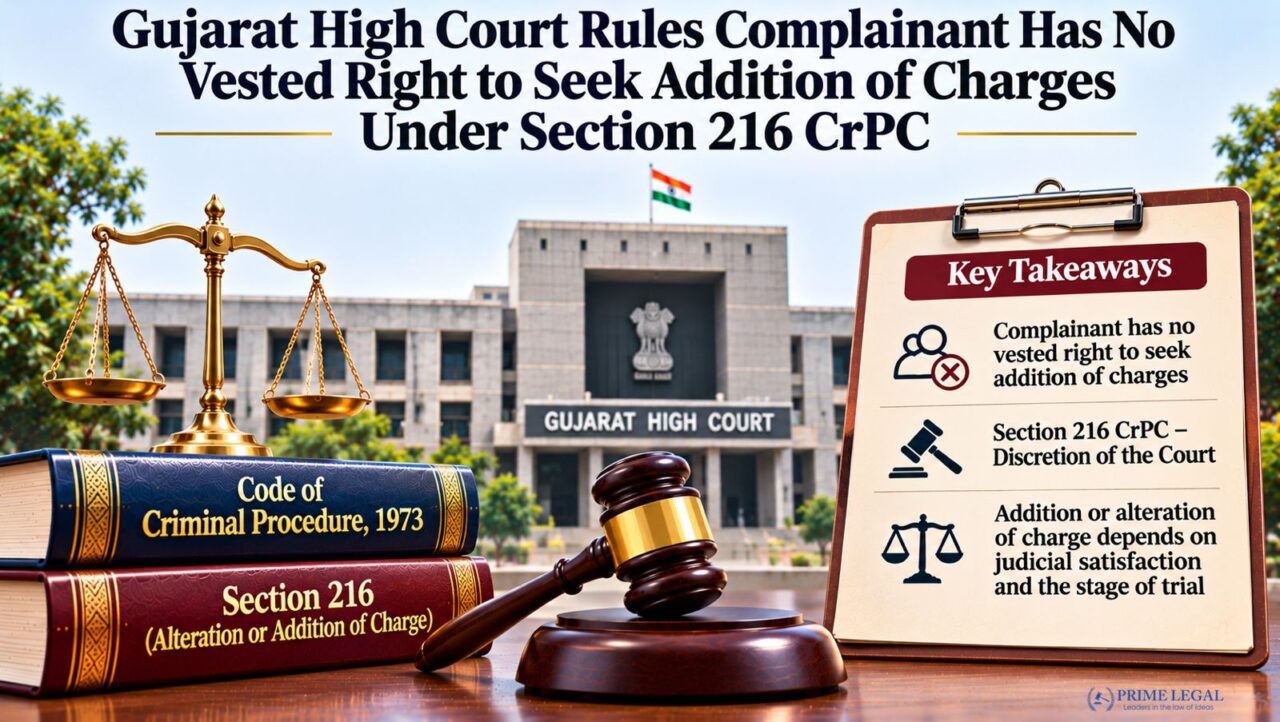
Case Name: Vankar Ramanbhai Shivramabhai v. State of Gujarat & Ors.
Case Number: R/Special Criminal Application (Quashing) No. 14792 of 2024
Date: 3 November 2026
Court: High Court of Gujarat at Ahmedabad
Quorum: Justice J. C. Doshi
FACTS
The applicant, who is the original complainant, filed an FIR (C.R. No. II-98 of 2019) at Balisana Police Station, District Patan, against the respondents under Sections 504, 294(KH), 506(2) and 114 of the Indian Penal Code, 1860.
It was claimed by the applicant that on 18 November 2019, the respondents verbally abused and intimidated him at his residence. It was further said by them that since he has already lost one leg, they will break another leg and kill him. The applicant was suffering from locomotory disability of more than 50% as per the certificate of disability.
Upon investigation, a charge sheet was filed, and Criminal Case No. 355 of 2021 was registered. An application under Section 216 of the Code of Criminal Procedure, 1973 (CrPC) was filed seeking addition of Section 92 of the Rights of Persons with Disabilities Act, 2016, because the accused intentionally insulted and humiliated him due to his disability.
The application was rejected by the Trial Court on 11 April 2022. The Sessions Court also refused to entertain his revision application. Disappointed with the above rulings, the petitioner challenged the same before the Gujarat High Court under Articles 226 and 227 of the Constitution of India.
ISSUES
- Did the facts and evidence warrant the inclusion of Section 92 of the Rights of Persons with Disabilities Act, 2016?
- Was it a right of the complainant to seek the inclusion or modification of charges under Section 216 of the CrPC?
- Could the High Court intervene in the matters of the lower court according to Article 227 of the Constitution of India?
LAW
- Section 216 of the Code of Criminal Procedure, 1973: Authorises the court to modify or make any additional charges at any point of time till the delivery of judgment if the circumstances justify such modification or additions.
- Section 92 of the Rights of Persons with Disabilities Act, 2016: Imposes penalties for committing atrocities against persons with disabilities. Section 92(a) imposes penalties for intentionally insulting or intimidating with an intention of disgracing a person with disability in a place in public view. Section 92(b) imposes penalties for assault or use of force against a person with disability with an intention of disgracing or outraging the modesty of a woman with disability
- Article 226 of the Constitution of India: Grants powers to High Courts to issue any direction, order or writ in respect of enforcement of fundamental rights and other legal matters.
- Article 227 of the Constitution of India: Grants supervisory powers to High Courts over the subordinate courts within their territorial jurisdiction.
ARGUMENTS
APPLICANT: Petitioner contended that even though the investigating officer knew about his disability and the certificate for it, he did not take into consideration Section 92 of the 2016 Act. He further argued that the accused deliberately harassed and humiliated him due to his disability. The case of Dr Nallapareddy Sridhar Reddy v. State of Andhra Pradesh, (2020) 12 SCC 467, was referred in support of the point that under Section 216 CrPC, the Court may amend/add charges at any stage before passing of judgment.
NON-APPLICANT: It was contended by the accused that there was no right on the part of the petitioners to request the inclusion of any specific charge under Section 216 CrPC since it was the prerogative of the Court alone. Relying upon Thakur Ram v. State of Bihar, AIR 1966 SC 911, they further contended that the Court could act in respect of such a provision independently. They contended further that none of the essential elements of Section 92 existed in the FIR in question and the complaint had been lodged with mala fide intentions.
ANALYSIS
The Court looked into Section 92 of the 2016 Act and noted that the insult or intimidation must be committed in public view and it must be done with the intention of humiliation of the aggrieved person on account of his disability for application of Section 92(a). However, the facts of the FIR have not satisfied the essential elements of the crime.
The Court has applied the principles laid down in P. Kartikalakshmi v. Sri Ganesh, (2017) 3 SCC 347, where it has been observed that alteration of the charge under Section 216 CrPC was purely discretionary of the Court and no one had any legal entitlement to ask for the said alteration. In the same way, the Court has applied the ruling in Anant Prakash Sinha v. State of Haryana, (2016) 6 SCC 105.
While the petition depended upon the expert opinion of Dr Nallapareddy Sridhar Reddy, the Court made it clear that even the availability of power under Section 216 does not provide any right to the complainant to compel the Court to exercise such power in a certain manner.
The Court did not find anything illegal in the decisions of the lower Courts for intervention under Article 227. The Court further held that the petition was frivolous and seemed to have been filed to harass the accused.
JUDGMENT
The order given by the Gujarat High Court was that the writ petition presented would be dismissed and that the amount of cost of Rs. 5,000 would be levied on the petitioner within 15 days. It was found by the court that all the conditions of Section 92 of the Rights of Persons with Disabilities Act, 2016 had not been met and that there was no legal claim in the complaint for the inclusion of some charges under Section 216 of the CrPC.
CONCLUSION
This case law brings out the point that the discretion to either add or modify the criminal charge lies within the Court’s authority and cannot be made an issue of right by the complaining party. In addition, the case law brings out the point that crimes committed under Section 92 of the Rights of Persons with Disabilities Act, 2016, must have some special elements. Finally, the case law brings out the point that litigation should not be used for harassment or delaying trials.
“PRIME LEGAL is a National Award-winning law firm with over two decades of experience across diverse legal sectors. We are dedicated to setting the standard for legal excellence in civil, criminal, and family law.”
WRITTEN BY: DEBARATI CHATTERJEE

