
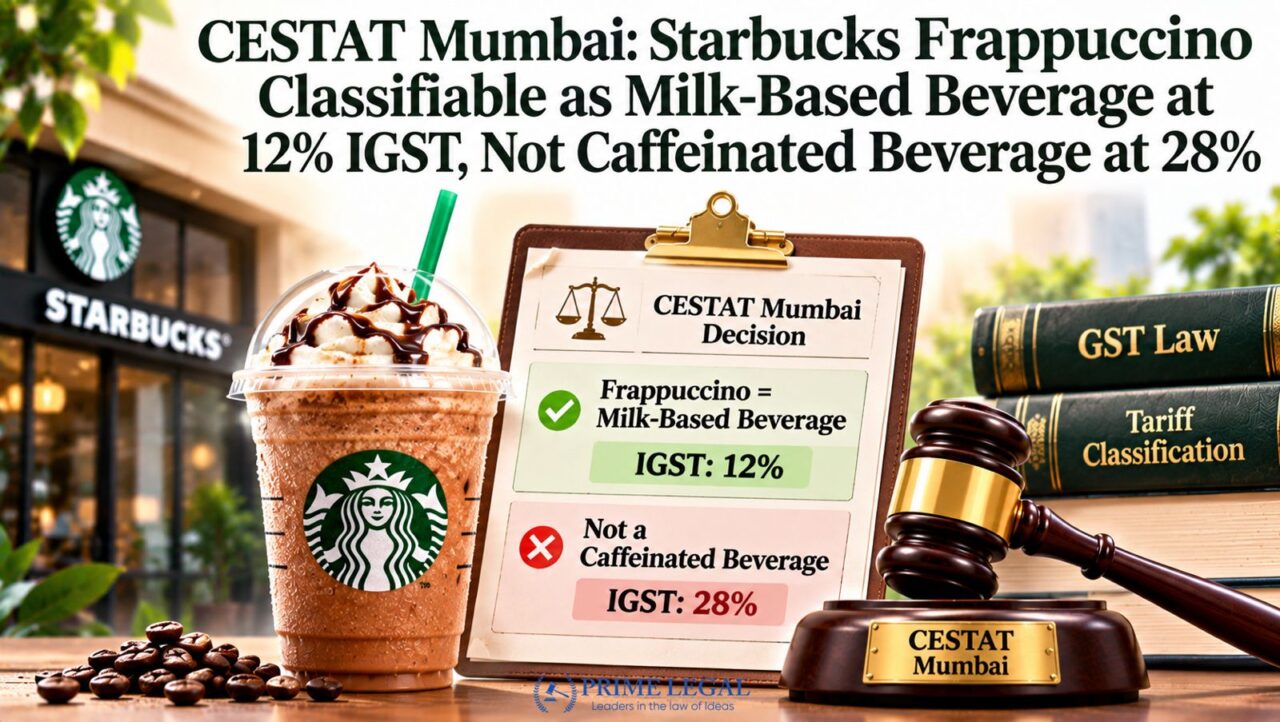
Case Name: Fortune Gourmet Specialities Pvt. Ltd. v. Commissioner of Customs, Nhava Sheva
Case Number: Customs Appeal No. 87352 of 2025
Date: 13th Day of November 2026
Court: Customs, Excise and Service Tax Appellate Tribunal (CESTAT), Mumbai
Quorum: Hon’ble Dr. Suvendu Kumar Pati, Member (Judicial) and Mr. Sanjiv Srivastava, Member (Technical)
FACTS
Fortune Gourmet Specialities Pvt. Ltd., the appellant, imported the products of Starbucks Frappuccino in the flavours of Coffee, Mocha and Caramel. They were beverages meant to be drunk without mixing with any other ingredients. They were imported into India as ready-to-drink milk beverages. The Appellant filed Bill of Entry No. 8757295 dated 20th May, 2022 declaring the said goods under Customs Tariff Heading (CTH) 2202 99 30 with tax @ 12% IGST.
In faceless assessment, the Customs had classified the aforesaid products under CTH 2202 99 90 as caffeinated beverages attracting 28% IGST. The appellant deposited the excess duty amounting to ₹55,724.36. Being aggrieved by the order passed by the Commissioner (Appeals), the appellant preferred an appeal before CESTAT, Mumbai.
ISSUES
- Should the imported Starbucks Frappuccino drinks be treated as milk-based drinks as per CTH 2202 99 30 or as caffeinated drinks as per CTH 2202 99 90?
- What is the applicable rate of IGST – 12% or 28%?
LAW
- Section 18 of the Customs Act, 1962 – Provisional Assessment: Provisional Assessment can be allowed in case of import of goods where the final assessment of duty cannot be made immediately due to some specific reasons.
- Customs Tariff Heading 2202 99 30: It is for milk beverages and IGST of 12% applies to it according to the notified GST rates.
- Customs Tariff Heading 2202 99 90: It is for all other beverages, including caffeine beverages, and IGST of 28% applies on it.
- Notification No. 01/2017-Integrated Tax (Rate), dated 28th June 2017: Rates of IGST on different types of goods.
- FSSAI Regulations, 2011 – Regulations 2.1.3 and 2.10.6(2): Standard requirements for flavoured milk and caffeine beverages, respectively. Regulation 2.10.6(2) is for the standard requirements of carbonated and non-carbonated caffeine beverages.
ARGUMENTS
APPELLANT – They contended that the imported goods constituted milk-based drinks having the extract of coffee in them and would fall under the head of CTH 2202 99 30, carrying IGST at the rate of 12%. It placed reliance on the composition of the product, declaration by the manufacturer, and the FSSAI standards. It observed that the flavoured milk is composed of milk, while the FSSAI standards for caffeinated beverages require the use of water. It further claimed that FSSAI had already recognised the product as being flavoured milk.
RESPONDENT – The Department supported the order made by the Commissioner (Appeals) and contended that the imported goods had caffeine and should be classified as caffeinated beverages subject to 28% IGST.
ANALYSIS
The tribunal considered the composition of the products, the packaging and labelling of the products, the FSSAI standards and the Customs Tariff Entry in question. It found that the imported products were predominantly milk-based beverages, while the caffeinated beverages falling under the applicable FSSAI standards were water-based.
It is pertinent to note that just because a product contains caffeine does not mean it can be classified as a caffeinated beverage for this tariff entry. Both the nature of the product and the ingredients used had to be considered. As the main base for the imported products was milk and the caffeine was naturally occurring due to the coffee extract, they did not fall under the scope of water-based caffeinated beverages falling under the 28% duty slab.
The Tribunal further noted that the tariff provision for beverages containing milk, CTH 2202 99 30, may be regarded as being more specific than the general or residual tariff provision, CTH 2202 99 90. It is because it has been based on the case of Hamdard (Waqf) Laboratories, 2026 (396) E.L.T. 3 (S.C.), where the principle of preferring a specific tariff entry over a residuary entry has been adopted. It also cited Dunlop India Ltd. v. Union of India, (1976) 2 SCC 241, wherein it was clarified that where the goods can reasonably fall under a specific classification, preference shall be given to the same.
In any event, the Tribunal concluded that the imported goods are beverages with milk and fall under the category of CTH 2202 99 30. Thus, they are not classified under the 28% IGST tariff entry for caffeinated beverages.
JUDGMENT
The CESTAT, Mumbai by its order dated 13th November, 2026 has allowed the appeal and set aside the order of the Commissioner (Appeals). It ruled that Starbucks Frappuccino had been classified properly under CTH 2202 99 30 with an IGST rate of 12% rather than 28%.
CONCLUSION
The ruling demonstrates that the classification of the beverage is to be made according to the true nature of the drink and the description used. The presence of caffeine alone in the beverage does not necessarily make it eligible for classification as a caffeinated drink.
“PRIME LEGAL is a National Award-winning law firm with over two decades of experience across diverse legal sectors. We are dedicated to setting the standard for legal excellence in civil, criminal, and family law.”
WRITTEN BY- DEBARATI CHATTERJEE
Fortune Gourmet Specialities Pvt. Ltd. v. Commissioner of Customs, Nhava Sheva (1)

