
INTRODUCTION:
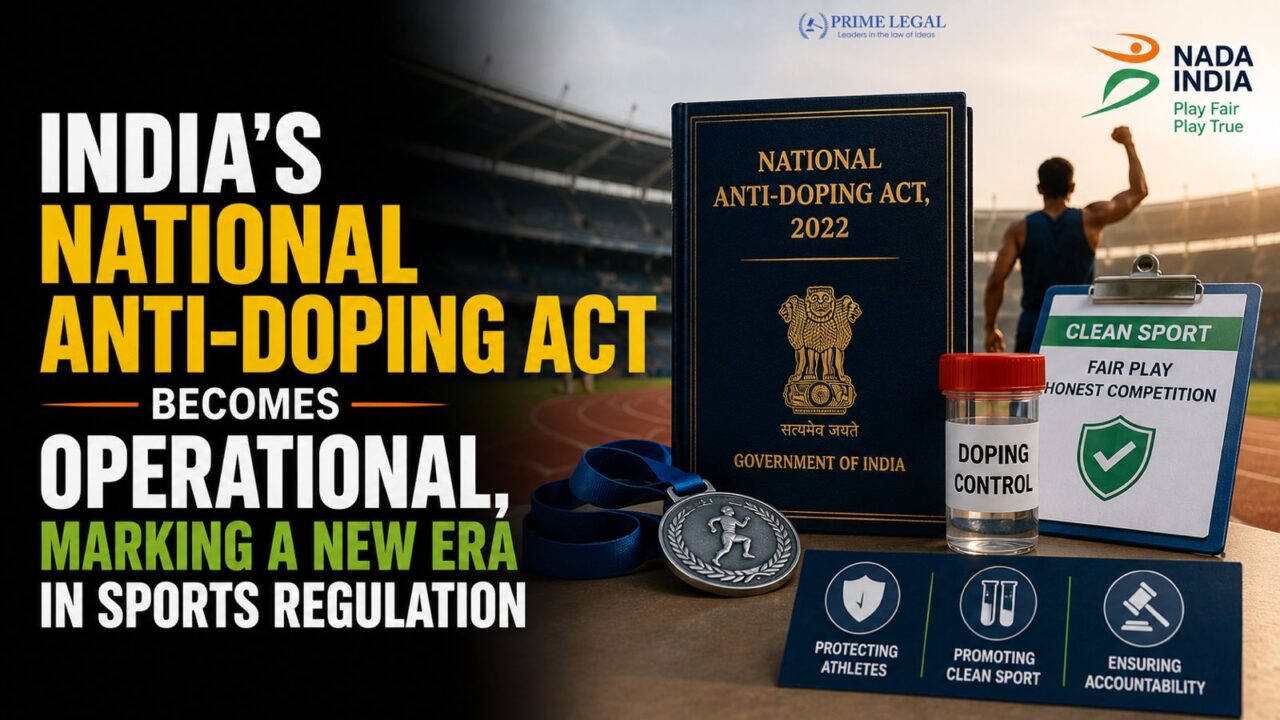
India has begun its journey into a new phase of sports governance. The National Anti-Doping Act, 2022, and the National Anti-Doping (Amendment) Act, 2025 have been brought into force. With these measures, the new anti-doping regulation in India is to become fully operational and legally enforceable. The new act and amendment are aligned with the World Anti-Doping Code (WADA Code) making this an important achievement for the country considering the number of doping infringements exposed at present.
BACKGROUND:
India enacted the National Anti-Doping Act in the year 2022 in order to materialize its obligations under the UNESCO International Convention Against Doping in Sport. The Act has laid down a framework through which the prevention and detection of doping in sports can be effectively achieved.
As the government has enforced the National Anti-Doping Act of 2022 and the provisions of the National Anti-Doping (Amendment) Act of 2025, there is expectation of considerable improvement in anti-doping practices.
The 2025 Amendment has changed the national policy to align it with the updated WADA Code. Further, National Anti-Doping Agency (NADA), National Dope Testing Laboratory (NDTL), and National Board for Anti-Doping are given more power and organization to function effectively.
The new reforms have been implemented in response to the increasing concerns around doping incidents in India, as recent cases have raised the demand for serious enforcement measures to deal with both individual violations and organized doping schemes.
KEY POINTS:
- The National Anti-Doping Act, 2022 and the National Anti-Doping (Amendment) Act, 2025 had been fully implemented by the Central Government.
- The measure will enable the country’s anti-doping laws to comply with the codified standards of the World Anti-Doping Code.
- These changes indicate that the powers of NADA, NDTL and the National Board for Anti-Doping in Sports will be improved.
- The proposed Amendment includes more procedural guarantees to help enhance enforcement and adjudication of anti-doping regulations.
- The Act has also laid down criminal liability for the trafficking and distribution of prohibited substances.
ANALYSIS:
The implementation of the new Act and amendment represent a shift from a regulatory anti-doping initiative to a complete statutory regime. As the law provides statutory status to NADA and its associated organisations, it increases the legitimacy of tests, investigations, disciplinary actions and appeals under the act. It also ensures better adherence to the international obligations under the WADA code, hence covering Indian sportspersons against sanctions resulting from the non-compliance with regulations.
A significant development is the passing of the National Anti-Doping (Amendment) Act, 2025, which aims to tackle organized doping instead of mere individual actions. Alongside the published amendments, the government has suggested introducing criminal provisions in relation to trainers, doctors, dealers and smugglers of the banned substances. The proposed reforms impose penalties including imprisonment for up to five years for those who consciously assist in doping, thereby changing the focus from regulating the athletes to eliminating the system enabling doping.
Reform measures reinforce procedural fairness including the right to be heard. Players will get notified about the disciplinary actions against them to have their cases heard by independent monitoring bodies like disciplinary and appellate committees. In view of the natural justice principles, the anti-doping policies are made more responsible and transparent. However, efficient performance of the policies will finally depend on availability of testing equipment, fast appeals, training for athletes, etc.
CONCLUSION:
The notification of the National Anti-Doping Act, 2022 and the National Anti-Doping (Amendment) Act, 2025 is a huge leap in the regulation of sports in India. It harmonizes domestic laws with international requirements, improving anti-doping organizations, and enhancing accountability not only among the athletes but also people involved in the entire process. The reforms can be considered as an improved way of ensuring the ethics in sports. The prosperity of these reforms will depend largely not only on implementation of the laws but also on establishing a culture of fair play.
“PRIME LEGAL is a National Award-winning law firm with over two decades of experience across diverse legal sectors. We are dedicated to setting the standard for legal excellence in civil, criminal, and family law.”
WRITTEN BY: SOMSUTA PAUL

