
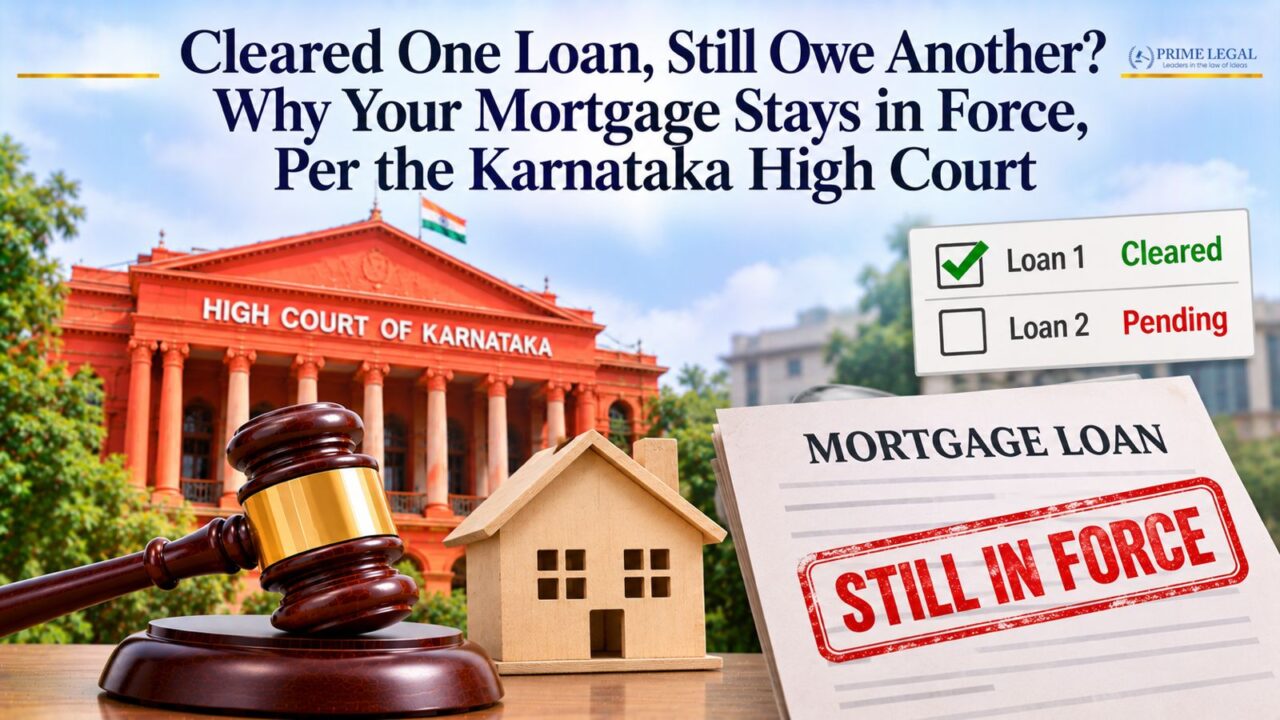
Case name: M/s. MBM Constructions v. Chief Manager, Bank of Baroda
Court: High Court of Karnataka at Bengaluru
Case Number: Writ Petition No. 15415 of 2025 (GM-RES)
Date of Judgment: 20 November 2026
Quorum: Single-Judge Bench: Hon’ble Mr. Justice B. Pramod
Facts of the case
The partnership firm known as M/s. MBM Constructions was availing overdraft facilities from Bank of Baroda and such facilities had been renewed on a regular basis from the year 2016 onwards. To obtain the loan, the petitioners mortgaged their residential property located in Dollars Layout, J.P. Nagar, Bengaluru. In this case, the petitioners claimed that they had paid off the debt of their first loan liability amounting to around ₹2.08 crore, hence, they were entitled to release of the mortgage and the original title deeds. However, the Bank allegedly demanded ₹2.93 crore and collected an excess amount of around ₹1.79 crore. Petitioners further claimed that the Bank had allowed the sale of their property for ₹3.30 crore, promising the discharge of the mortgage on receipt of the sale proceeds. Hence, they sold their property to a third party through a sale deed dated 9 December 2024 and the sale proceeds had been remitted to the Bank. But, the Bank did not release the property documents saying that they had mortgaged the same property as security for obtaining ₹10 crore loan from another firm known as M/s. Power Systems. Thus, aggrieved by the refusal of the Bank to release the documents and refund the alleged excess payment, MBM Constructions approached the Karnataka High Court under Article 226 of the Constitution of India seeking a writ of mandamus.
Issues Involved
- Whether the petitioner is entitled to be directed for refund of the said excess amount of ₹1,79,23,672.80 by the Bank.
- Whether the petitioner is entitled to discharge of the mortgage and return of the original title deeds on repayment of the first loan in view of the existence of second mortgage.
Legal Provisions
- Article 226 of the Constitution of India: Power of the High Courts to issue writs including writ of mandamus.
- Section 13 of the SARFAESI Act, 2002: Enforcement of security interest by secured creditors.
- Section 14 of the SARFAESI Act, 2002: Assistance of the Chief Metropolitan Magistrate/District Magistrate in taking possession of secured property.
Arguments:
Arguments from the Petitioner: MBM Constructions
In this case, the petitioner contended that it had fully settled its liability in connection with the first loan transaction. In doing so, the Bank had received an excess sum of nearly ₹1.79 crore in relation to the actual outstanding amount. Though the Bank had already received the total amount, it neither returned the excess amount to the petitioner nor gave back the original title deeds. The petitioner further submitted that the Bank had made a promise to it that the mortgage in question would be discharged once it had paid ₹3.30 crore. This sum was the sale consideration of the residential property in question. On the basis of this promise, the petitioner had sold the residential property to a third person through a registered sale deed dated 9 December 2024. All the sale proceeds were given to the Bank by the petitioner. Hence, the Bank could not avoid executing the deed of discharge in light of the payment being received from it.
Arguments on behalf of Respondent: Bank of Baroda
The Bank contended that the same property was mortgaged twice through two different loan arrangements. The first mortgage was of a loan facility of ₹1.50 crore provided to MBM Constructions. The second mortgage was of a loan facility of ₹10 crore made to M/s. Power Systems on 12 December 2019. While the first loan liability was discharged, the second loan was still outstanding. Hence, the Bank was entitled to hold the property as collateral until the second liability was settled. Further, the Bank refuted the claim that it granted permission or No Objection Certificate for the sale of the property. Moreover, it was pointed out that Arun Kumar had earlier submitted an undertaking to the High Court to follow the payment schedule and surrender possession of the property in the event of a default. This undertaking was not complied with by Arun Kumar, and hence contempt proceedings were initiated against him. Hence, the Petitioner was not entitled to discretionary relief under Article 226.
Analysis of the court:
The Karnataka High Court looked at both loan agreements and noticed that both mortgaged properties were mortgaged in respect of the same residential property. Despite the fact that the first loan taken by MBM Constructions was paid off, but the second mortgage regarding the loan for ₹10 crore taken by M/s. Power Systems remained outstanding. Thus, the discharge of the first loan could not result in the discharge of the second mortgage. The Court also considered the letter issued by the Bank dated 26 September 2024 and concluded that there was no permission or assurance on the part of the Bank that would enable the petitioner to sell the property free of mortgage. Neither registration of sale deed nor transfer of the money to the Bank could discharge the security agreement. In relation to the alleged excess payment, the Court observed that in order to determine the actual balance of the loan account it is necessary to reconcile the loan accounts and review relevant documents. It is not appropriate to deal with such financial disputes in writ jurisdiction. The Court also took into account the breach of an undertaking by the petitioner before the High Court. Considering these circumstances, it held that the petitioner had failed to establish an enforceable legal right warranting a writ of mandamus.
Conclusion
The High Court of Karnataka rejected the writ petition made by M/s. MBM Constructions against the Chief Manager of Bank of Baroda. According to the court, the writ petition for refund of excess amount or return of title deeds cannot succeed. It is because, first of all, the residential land remained mortgaged for the second loan agreement worth ₹10 crore made with M/s. Power Systems. In other words, no discharge of mortgage for this loan occurred. The Court also held that clearance of one loan account would not necessarily extinguish the other mortgage created on the same property. Besides, there was nothing in writing evidencing the grant of permission for sale or promise of discharge of mortgage by the bank. Another point in the case was that the question of alleged excess amount paid is an issue involving disputed accounting exercise. It should, thus, not be addressed in the present writ petition. The failure on part of the petitioner in keeping its promise was also taken into consideration while granting any discretionary relief. Therefore, the petition was dismissed and there is no order as to costs.
“PRIME LEGAL is a National Award-winning law firm with over two decades of experience across diverse legal sectors. We are dedicated to setting the standard for legal excellence in civil, criminal, and family law.”
WRITTEN BY: Krittika Sengupta

