
Case Name: 3S and Our Health Society v. Union of India & Others
Case Number: Miscellaneous App No. 1177/2025 in Writ Petition (Civil) No. 437/2024
Date: 26 November 2026
Court: Supreme Court of India
Quorum: Justice J.B. Pardiwala and Justice K. Vinod Chandran
FACTS
3S and Our Health Society, a nonprofit organisation, submitted an appeal for introducing Front-of-Package Nutrition Labelling (FoPNL) in packaged food items. It was stated that foods high in sugar, salt and saturated fats, like ultra-processed foods, contribute to increased risks of diseases like diabetes, obesity, cardiovascular disease, and hypertension. The petitioner wanted the implementation of warning labels on the front of the food items so that consumers could make wise decisions by being aware of the nature of food items. The Food Safety and Standards Authority of India (FSSAI) put forward the idea of the INR system that comprised a star rating of food based on its nutritional value. The petitioner rejected this system.
As many as 14,000 public comments were collected for the proposed labelling policy. As a result of various consultations and the suggestion of the expert committee, FSSAI recommended different types of labelling, including nutritional content and red hexagon warning labels. The petitioner had pointed out that these labels were ineffective and unclear with respect to size and location and the threshold level of nutrition.
ISSUES
- Whether Article 21 of the Constitution creates an obligation on the State, by virtue of the rights to health, nutrition, and information, to implement provisions like the FoPNL.
- Whether there were any shortcomings in the FoPNL scheme that rendered it ineffective.
LAW
- Article 21, Constitution of India: Safeguards the rights to life and personal liberty, which include the right to health, dignity, nutrition and healthy food.
- Article 47, Constitution of India: Enjoins upon the State to improve the nutritional level, standard of living and general health of the people.
- Section 16, Food Safety and Standards Act, 2006: Contains the duties of FSSAI for ensuring safe and wholesome food.
- Section 18, Food Safety and Standards Act, 2006: Enshrines general principles relating to food safety, including protection of consumers’ interests and consideration of international standards and practices.
- Section 18(2)(a)(ii), Food Safety and Standards Act, 2006: Makes it necessary to consider the international standards and practices at the time of formulation of food regulations, except when there is a justified reason for not doing so.
- Food Safety and Standards (Labelling and Display) Regulations, 2020: Provide the rules relating to the labelling of pre-packed foods, which should be clear, conspicuous and not misleading.
ARGUMENTS
PETITIONER: In its petition, the petitioner contended that consumption of unhealthy packaged foods is responsible for the increasing health problems in society. The petitioner stated that under Article 21 in conjunction with Article 47, the government must make efforts to safeguard the health of the people. It sought warning labels to be put on such foods, which would help people become aware of the health hazards involved in the use of these foods. It cited Consumer Education & Research Centre v. Union of India, (1995) 3 SCC 42; Paschim Banga Khet Mazdoor Samity v. State of West Bengal, (1996) 4 SCC 37; Vincent Panikurlangara v. Union of India, (1987) 2 SCC 165; Centre for Public Interest Litigation v. Union of India, (2013) 16 SCC 279; and Swami Achyutanand Tirth v. Union of India, (2016) 9 SCC 699.
RESPONDENTS: The Union of India and the FSSAI had argued that both of them were making efforts to introduce the nutritional labelling regime. The FSSAI had suggested the use of interpretative warning labels, which are in the form of red hexagons and had said that it would go ahead and frame the rules within four months.
ANALYSIS
The Court pointed out that under Article 21, the right to health included the positive obligation of the State to safeguard the individual from conditions hazardous to health. This has been reinforced further in Article 47, which makes it the duty of the State to improve the nutritional levels and health conditions. The Court said that the mere provision of hospitals and medical facilities was not enough, as prevention too was necessary.
The Court pointed out that FoPNL must be simple, visible, clear and easily comprehensible by people irrespective of their education and language barriers. The Court also pointed out that the proposed regime needed amendments in the nutrient thresholds, the design of the label, its size, pictorial representation, as well as in implementation.
The Court, through the cases of Consumer Education & Research Centre, Paschim Banga Khet Mazdoor Samity and Vincent Panikurlangara, acknowledged the duty of the State in relation to health. The Court also referred to the cases of Vishaka v. State of Rajasthan, (1997) 6 SCC 241 and Vineet Narain v. Union of India, (1998) 1 SCC 226.
JUDGEMENT
- Directions were issued to FSSAI on 26 November 2026 regarding revising and finalising the FoPNL framework. The directions were as follows:
- The labelling should take into account total sugars, saturated fat, and salt content, rather than added sugars and fats, and scientifically revise the threshold limits.
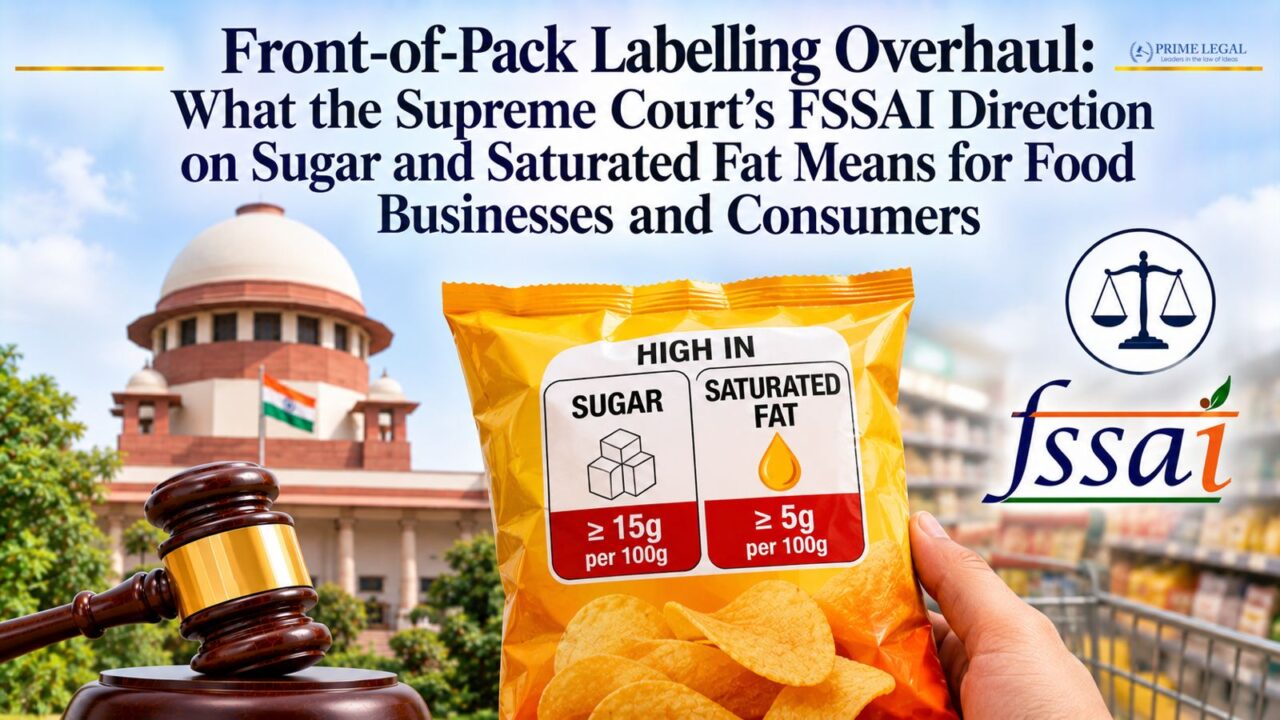
- Warning labels in the form of separate red hexagons with pictograms and the words “High Fat”, “High Sugar” and “High Salt” wherever applicable. Each warning label must have adequate prominence and the text should be clearly legible.
- FSSAI must properly define those food products that will be exempted from the warning labels, and prevent misuse of such warning labels on beverages.
- FSSAI will have to monitor the use of artificial preservatives and additives which might render the warning labels ineffective. The regulations must be implemented according to the timeline proposed, and the transition periods must not be used for any mischievous purposes.
- The Union Government will have to enhance nutritional literacy amongst the people, especially amongst children, by educating them practically. The matter was ordered to be listed after ten weeks for a report by FSSAI.
CONCLUSION
This judgment is an example of how the right to health under Article 21 comprises prevention and information needed to make proper decisions. It was made clear by the Supreme Court that the labelling on food items should really be used by consumers to recognise bad products rather than complicating the nutritional values on the label. This shows that the State has an obligation to regulate to safeguard the health of citizens, and sometimes judicial interference becomes necessary because of regulatory lapses.
“PRIME LEGAL is a National Award-winning law firm with over two decades of experience across diverse legal sectors. We are dedicated to setting the standard for legal excellence in civil, criminal, and family law.”
WRITTEN BY- DEBARATI CHATTERJEE

