
Introduction
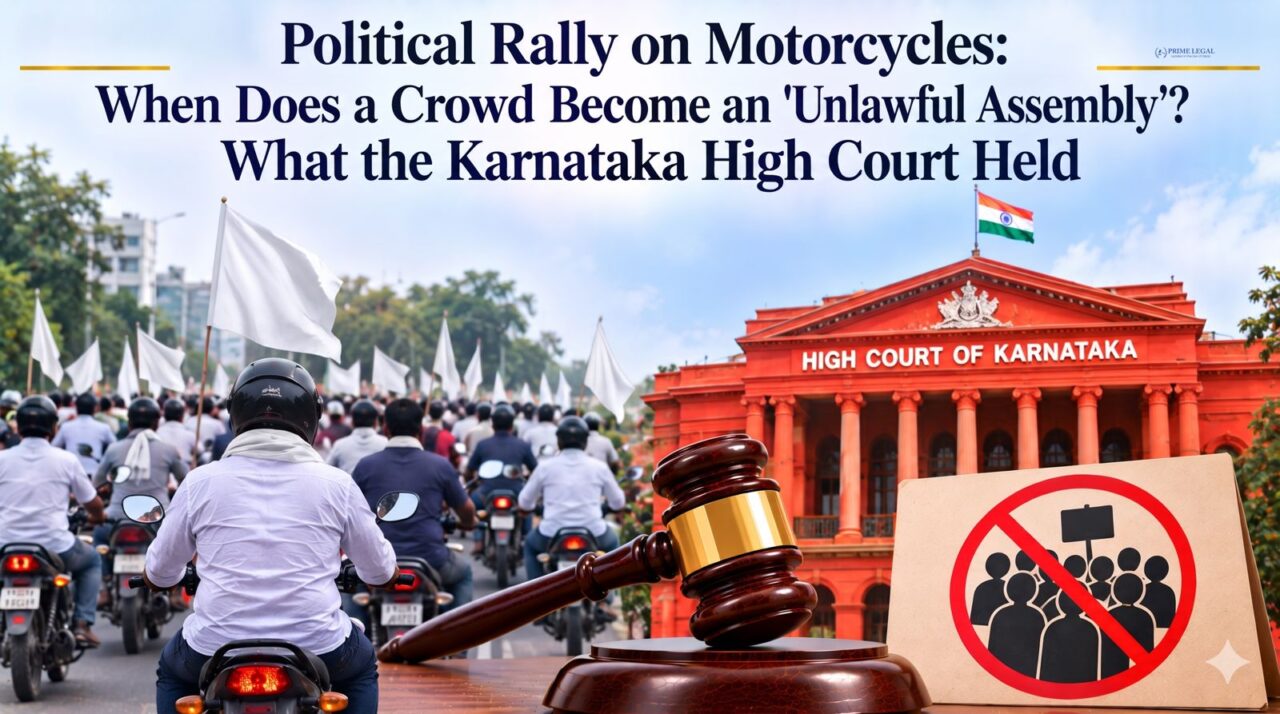
The Karnataka High Court, in a landmark judgement authored by Justice Suraj Govindaraj, laid down that mere presence in a large group and raising political sloganeering cannot per se make such an act tantamount to unlawful assembly under Section 141 of the Indian Penal Code, 1860. The Court held that an unlawful assembly must have a common object which falls under any of the objects defined under the Section. The dispute arose out of the allegation against Farooq Mugili, wherein he came along with 150 to 200 people in a motorbike to the complainant’s house, raised political slogans, assaulted the complainant and damaged his private property, including Devarakatte, a sacred platform. After this incident, the police registered a criminal case and charge sheet under a number of Sections which deal with unlawful assembly, rioting, criminal intimidation and destruction of property. In order to challenge the continuance of the proceedings, the petition was filed before the Karnataka High Court.
Background of the Case
The case arose out of a complaint filed by B. Vigneshwara Bhat on 19 May 2018. According to the complainant, at about 8:45 p.m., Farooq Mugili along with 150 to 200 others arrived near the complainant’s residence on motorcycles and started raising slogans in support of their political party. When the complainant tried to talk to them, he was allegedly abused and assaulted by some of them. It was also stated in the complaint that the said group had vandalized the property of the complainant as well as a religious place called Devarakatte. Accordingly, a criminal case was registered and an investigation was conducted. Subsequently, after the completion of the investigation, the charge sheet was filed on 26 July 2020 under Sections 143, 147, 148 and 506 read with Section 149 of the IPC and Sections 2(a) and 2(b) of the Karnataka Prevention of Destruction and Loss of Property Act. These sections relate to membership of unlawful assembly, rioting, use of deadly weapon, criminal intimidation and damage to property. Farooq Mugili filed an application in the Karnataka High Court challenging the criminal proceedings.
Key points:
- The Karnataka High Court held that the gathering of 150–200 people and raising political slogans does not automatically constitute an unlawful assembly.
- Under Section 141 IPC, an assembly of five or more persons becomes unlawful only when its members share a common object falling within one of the categories specified in the section.
- Mere participation in a political gathering or raising slogans is not sufficient to establish an unlawful common object.
- The Court found that the investigation material did not establish any specific common object shared by the persons assembled.
- The mahazar did not record any damage or destruction to the complainant’s property or the sacred platform (Devarakatte).
- The witness statements did not disclose any specific act of violence or injury that could substantiate the allegations of assault and rioting.
- There was no material showing that the petitioner possessed a deadly weapon or participated in violence, as required to attract Section 148 IPC.
- The allegations of criminal intimidation under Section 506 IPC were also insufficient because the statements did not specify the nature of the alleged threat or circumstances establishing criminal intimidation.
- Section 149 IPC could not be invoked because the prosecution had failed to establish the existence of an unlawful assembly and its common object.
- The Court clarified that the absence of independent witnesses or a wound certificate, by itself, would not be sufficient grounds to quash criminal proceedings. The decisive factor was that even the available witness statements did not establish the essential ingredients of the alleged offences.
- The Court held that the allegations and investigation material did not disclose the offences charged against the petitioner.
- Accordingly, the Karnataka High Court allowed Farooq Mugili’s petition under Section 482 CrPC and quashed the criminal proceedings, holding that their continuation would amount to an abuse of the process of law.
Analysis of the Case
The crucial point of this judgment is that of the Court’s interpretation of Section 141 IPC and the requirement that criminal liability should rest on the statutory ingredients of the offence and not on assumptions made about the size or nature of the gathering. Section 141 provides for five persons sharing an unlawful object under the Section. Consequently, the presence of a crowd and political slogans does not, in itself, prove that there was an unlawful assembly. The judgment refers to the evidence regarding destruction or loss of property under Sections 2(a) and 2(b) of the Karnataka Prevention of Destruction and Loss of Property Act. The mahazar prepared during the course of the investigation did not mention anything about any damage to the property, thereby casting doubts on the allegations made by the prosecution. Moreover, the witness evidence did not adequately support the allegations of violence, criminal intimidation or any other criminal offence. This shows that a mere filing of a charge sheet is not sufficient grounds for conducting a criminal trial since the evidence submitted does not disclose the statutory ingredients of the offences. Nevertheless, the decision does not give any protection to political meetings, where evidence establishes an unlawful common object or criminal conduct, the relevant provisions can still apply.
Judgment
The Karnataka High Court, comprising Justice Suraj Govindaraj, accepted the criminal petition filed by Farooq Mugili and dismissed the criminal proceedings instituted against him. The Court ruled that an assembly of five or more persons is not deemed as unlawful on account of the number of persons assembled at a given location. The prosecution needs to show that the persons assembled had a common objective as mentioned in Sections 141 IPC. Relying upon this principle, the Court ruled that the allegation of arrival of 150-200 persons on motorcycles and raising political slogan was, per se, not enough to constitute the act of unlawful assembly. Then, the allegations related to damaging of property were examined. It appears from the investigation mahazar that there was no question of damage and destruction of the property. Moreover, witness evidence failed to prove acts of violence. Therefore, essential elements of Sections 143, 147, 148, 149 and 506 IPC as well as Sections 2(a) and 2(b) of the Karnataka Prevention of Destruction and Loss of Property Act could not be proved. Continuing with prosecution of the case would be nothing but misuse of the process of law.
Conclusion
This decision is important since it ensures that the distinction is maintained between legal political activity and criminal conduct. The Karnataka High Court has made it clear that merely coming together in large numbers and raising political slogans is not sufficient to make a person liable for criminal offenses under Section 141 IPC. It will have to be proved that there was a common unlawful object and the required materials for the offenses should be produced by the prosecution. This decision also emphasized that any allegations of assault, intimidation, and property damage should be backed up by evidence collected during investigation. A criminal charge cannot be sustained merely based on the fact that there has been an allegation in the complaint or a charge sheet. On the other hand, it is not being said here that political gatherings are immune from criminal law. In case of violence, intimidation, destruction of property or pursuit of an unlawful common object, the relevant criminal laws can be applied.
“PRIME LEGAL is a National Award-winning law firm with over two decades of experience across diverse legal sectors. We are dedicated to setting the standard for legal excellence in civil, criminal, and family law.”
Written by – Krittika Sengupta

