
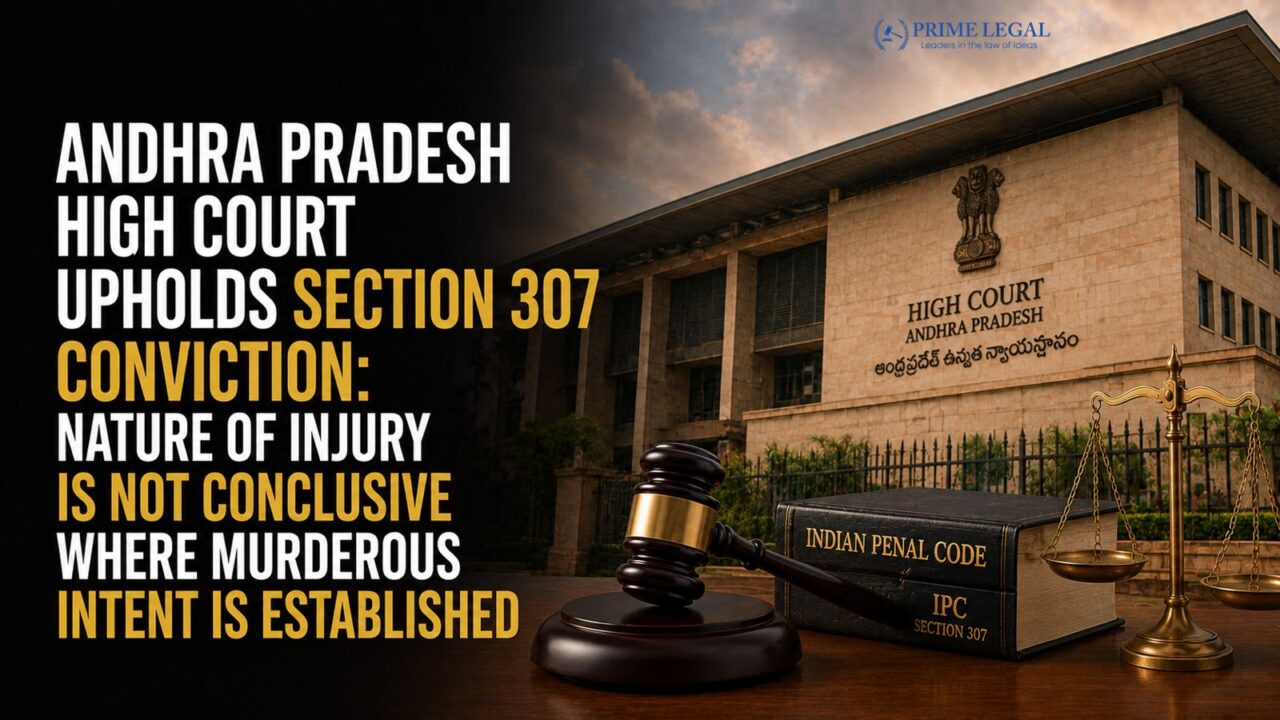
CASE NAME: Setty Bhaskara Rao v. State of Andhra Pradesh
CITATION: APHC010548992009
CASE NUMBER: CRIMINAL REVISION CASE NO: 793/2009
COURT: In the High Court of Andhra Pradesh at Amaravati
DATE OF JUDGMENT: 21st July, 2026
QUORUM: Hon’ble Sri Justice Subhendu Samanta
FACTS
In this instance, Setty Bhaskara Rao (Petitioner) has moved this Criminal Revision Case before the VII Additional District Judge (Fast Track Court), Visakhapatnam challenging a judgment dated 27th April, 2009 passed by the same Court. The lower appellate court had upheld his conviction for the offence under Section 307 of Indian Penal Code (IPC), but reduced his prison time from five to three years.
The origin of the argument is a feud that has existed for a long time. Both the Petitioner and the victim (P.W.2) lived in the same village, were neighbours and were having frequent altercations. Earlier, Petitioner was convicted and fined Rs. The 50/- was a sum in a particular case with P.W.2, which was to give rise to a longstanding animosity. The Petitioner allegedly attacked P.W.2 with a knife on 9th April, 2005 in the afternoon. The Petitioner got provoked out of this resentment and in this provocation, he inflicted eleven strokes of knife on the victim’s neck. P.W.2 shouted for assistance, which brought other villagers into the picture, then after which the Petitioner ran away. Based on the investigation, the trial court sentenced Petitioner to five years rigorous imprisonment and a fine of Rs. 3,000/-. 1,000/-, which he subsequently appealed.
ISSUES
- The injuries suffered by the victim was termed “simple” and “failed to establish the essential ingredients of an attempt to murder” under Section 307 of the IPC.
- Did the trial court commit an error when it took the testimony of the victim’s close relatives during the trial when the independent witnesses turned hostile?
- If the case did raise a sudden provocation alleviation of the charge under Section 307 of IPC to Section 324 of IPC was warranted.
LEGAL PROVISIONS
- Essential aspects of Section 307 of the Indian Penal Code (IPC), 1860.
- Section 324 of the Indian Penal Code, 1860 (IPC).
- Section 397/401 of Code of Criminal Procedure (CrPC).
Precedents referred to:
- Hari Singh v. Sukhbir Singh and others, (1988) 4 SCC 551.
ARGUMENTS
APPELLANT
The Petitioner contended that the victim’s injuries were just “simple” injuries and that no intention to cause the death of the victim could be seen in such injuries. He said it was a provocation and there was no medical evidence to bolster a attempted murder charge. Moreover, he pointed out that all of the independent witnesses and mediators connected with the weapon recovery had turned hostile, with the prosecution being solely on the victim’s close relatives. Lastly, Petitioner asked for mercy as he has been facing criminal trial for almost 20 years and pleaded for change in the charges and sentencing to a mere fine under Section 324 of IPC.
RESPONDENT
The Petitioner’s arguments were strongly challenged by the State which contended that the prosecution had built a case for conviction beyond any doubt. They noted that the testimony of the relatives of the victim does not have to be ignored because of their familial relationship because their testimony was reliable and trustworthy. The State pointed out that the Petitioner has a clear motive for his conduct based on the conviction and fine he received earlier. They emphasised that the Petitioner had made it clear that he intended to kill the victim, having attacked him without provocation and inflicting eleven stabs on a very vulnerable part of his body, the neck.
ANALYSIS
The High Court emphasised that the wording of Section 307 of the IPC – which requires the prosecution to establish that the accused acted with the intention or knowledge that their actions would be likely to cause death – was especially stringent. The Court had differentiated between the present case and the precedent cited, that of hari singh. In Hari Singh, the attacker struck the victim on the head with the blunt end of a weapon, whereas in this case, the Petitioner repeatedly inflicted injuries on the victim’s vital parts using a knife.In Hari Singh, the attacker struck the victim with the blunt end of a weapon on the head; in this case, the Petitioner struck the victim repeatedly with a knife on a vital part.
The Court noted the quantity of strikes (11 to the neck) were the result of the victim being very active to struggle to survive and evade the attacks. The defence put forward no rational explanation for why a total of eleven blows was delivered when it was only a “sudden provocation”. The Court was very clear on the simple medical injuries issue, that the medical severity of the wounds is not enough to establish an offence under Section 307 of the IPC. The meaning of the intent to kill is what is important and for and by eleven times you can make a knife go into someone’s neck just as well with a simple or grievous injury. Moreover, the Court affirmed the evidence of the victim’s relatives as credible, as familial relationships do not automatically discredit a witness’s credibility.
JUDGEMENT
The High Court of Andhra Pradesh quashed the criminal revision petition and completely failed to find any valid reason to set aside the concurrent findings recorded by the courts below. Conviction under Section 307 IPC and three-year imprisonment was strongly upheld. The Court set aside the earlier order which had suspended his sentence and remanded the Petitioner to the trial court or the jail authorities to spend the remaining period, but issued a non-bailable warrant if the Petitioner failed to do so within six weeks.
CONCLUSION
This judgment is an important reminder that, when it comes to attempted murder, the courts will focus not only on the medical diagnosis of physical injuries, but on the nature of the attack and the intention behind it. It makes clear that where it is clear from the actions of an attacker that the intention was to kill, the Section 307 IPC charge cannot be dropped because the victim miraculously survived and he or she suffered from “simple” injuries.
“PRIME LEGAL is a National Award-winning law firm with over two decades of experience across diverse legal sectors. We are dedicated to setting the standard for legal excellence in civil, criminal, and family law.”
WRITTEN BY: GAURAV VIBHU RANJAN.
Read the Judgement copy below:

