
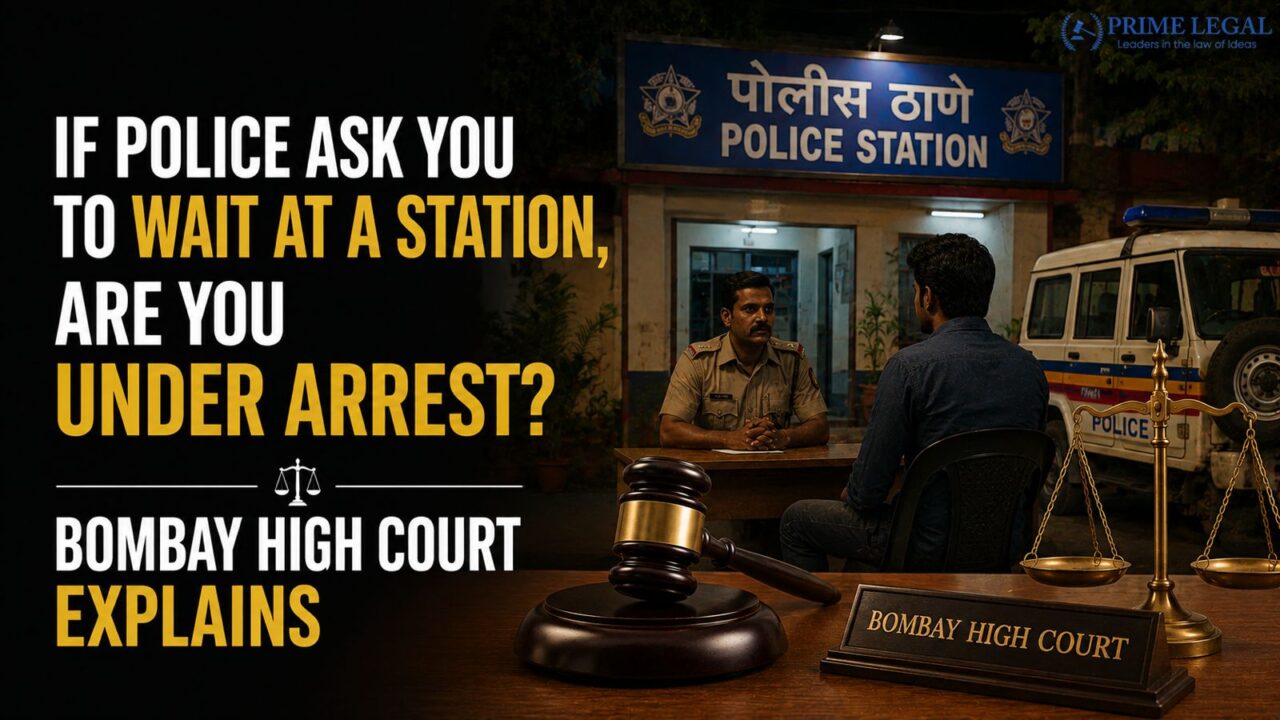
CASE NAME: Manohar Sharad Pathare v. The State of Maharashtra & Ors.
CASE NUMBER: Writ Petition No. 3221 of 2026
COURT: High Court of Judicature at Bombay, Criminal Appellate Jurisdiction
DATE: 21 August, 2026
QUORUM: Sarang V. Kotwal, J. and Ranjitsinha Raja Bhonsale, J.
FACTS
The petitioner filed this writ petition seeking release of his brother (the detenu) from custody, contending that his arrest was illegal and in breach of Article 21 and Article 22(2) of the Constitution, along with Sections 47, 48 and 58 of the BNSS, 2023. The detenu was named an accused in a case registered at Dongri Police Station under the POCSO Act and Section 74 of the BNS, arising from an FIR lodged by a father alleging offences against his 11-year-old daughter, in circumstances connected to the detenu’s closeness with the informant’s wife while the informant was working abroad.
The detenu reported to the Dongri Police Station between 11 a.m. and 12 noon on 10th June 2026. He was formally shown as arrested only at 8:15 p.m. that evening and produced before the Special Court the next day at 3:46 p.m. The case of the petitioner was based on a simple proposition that if in fact his liberty was curtailed the moment he entered the station then his production before the Magistrate was after the expiry of the 24 hours period prescribed by law and his arrest was illegal.
ISSUES
- Does a person’s presence at a police station, with restricted movement, itself amount to “arrest” for computing the 24-hour period under Article 22(2)?
- Can custody and arrest be treated as legally interchangeable, or does the law draw a meaningful distinction between them?
- Was the delay between the detenu’s arrival and his formal arrest reasonably explained by the investigating agency?
LEGAL PROVISIONS
Article 21 and Article 22(2) of the Constitution of India Sections 47, 48 and 58 of the Bharatiya Nagarik Suraksha Sanhita, 2023 Sections 10 and 12 of the Protection of Children from Sexual Offences Act, 2012; Section 74 of the BNS, 2023 Case Laws: Hanumant Jagganath Nazirkar v. State of Maharashtra, 2025 SCC OnLine Bom 2508; Directorate of Enforcement v. Subhash Sharma, SLP (Criminal) No. 1136 of 2023; Dhanshala Prakash Vishwakarma v. State of Maharashtra & Ors., Criminal Writ Petition No. 4539 of 2025; Mohd. Avesh Mohd. Hanif Potiyawala v. State of Maharashtra, Criminal Writ Petition No. 380 of 2026
ARGUMENTS
PETITIONER: Counsel argued that from the moment the detenu stepped into the police station, his movement was completely restricted and he remained under the complete control of the officers amounting, in substance, to an arrest regardless of when it was formally recorded. Relying on Nazirkar, she argued that being reachable by phone doesn’t rule out custody, and cited Subhash Sharma and Dhanshala Vishwakarma as instances where courts had found the 24-hour period genuinely breached.
RESPONDENTS: Relying on an affidavit from the investigating inspector, the State maintained that the detenu was actually arrested only at 8:15 p.m., following a genuine investigative delay the officer concerned had been occupied escorting a separate accused, in an unconnected case, to hospital and then to a remand hearing. Until then, the detenu retained full personal liberty, as reflected in call records showing him in continuous conversation with various people until nearly 7 p.m. Counsel for the victim added that custody and arrest are distinct legal concepts, and one does not automatically trigger the other.
ANALYSIS
The Bench examined each precedent the petitioner relied on and found the facts didn’t line up. In Nazirkar, the accused had been personally escorted to hospital by the police, keeping him under police control throughout despite his phone calls. In Subhash Sharma and Dhanshala Vishwakarma, the accused had been taken into custody at odd, unexplained hours, in one case even before the FIR was registered leaving no doubt they weren’t free. None of that matched the facts here.
What proved decisive instead was the reasoning in Potiyawala: custody does not automatically amount to arrest, and police are entitled to call a named accused in for enquiry and satisfy themselves before formally arresting him. The detenu here wasn’t picked up from home or intercepted anywhere; he walked in voluntarily on being contacted, and the delay in attending to him was explained by the investigating officer’s genuine, unrelated commitment involving another accused’s medical emergency and remand. Far from suggesting confinement, the detenu’s own phone records showed him freely conversing with others well into the evening.
JUDGMENT
The Court held that mere presence at a police station, without more, does not amount to arrest under Article 22(2), which speaks of a person being “arrested and detained in custody.” Finding the police explanation reasonable and the procedure free of fault, the Bench treated 8:15 p.m. as the actual moment of arrest, meaning production before the Magistrate fell well within the 24-hour window. The petition was dismissed, with the detenu given liberty to pursue bail on its own merits.
CONCLUSION
The ruling draws a line that carries weight well beyond this one case between a citizen cooperating with a police inquiry and one actually deprived of liberty. Not every hour spent at a police station converts automatically into custodial time for constitutional purposes; context and a credible explanation for delay still count.
“PRIME LEGAL is a National Award-winning law firm with over two decades of experience across diverse legal sectors. We are dedicated to setting the standard for legal excellence in civil, criminal, and family law.”
WRITTEN BY: MAHFUZA FATHIMA
Read the Judgement copy below:
Manohar Sharad Pathare vs State of Maharashtra

