
INTRODUCTION
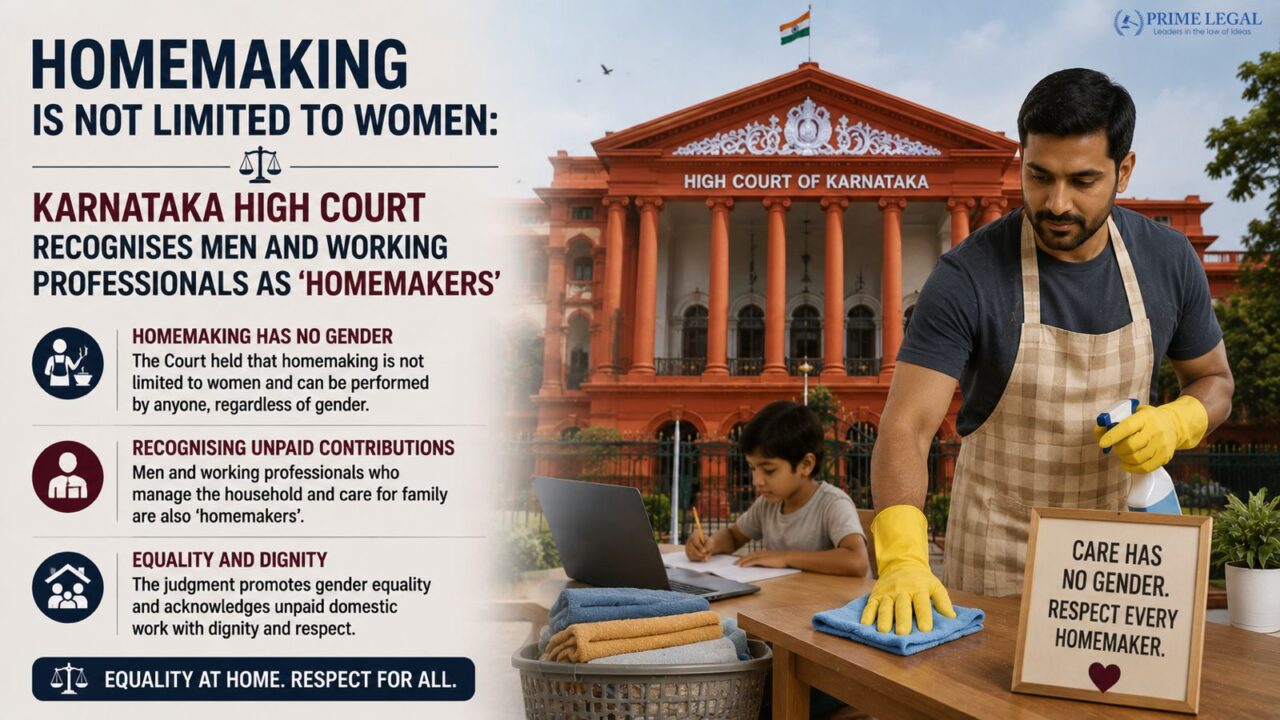
The Karnataka High Court has observed that the term “homemaker” is gender-neutral and not confined to women without higher education or employment, but extends the principle of compensation for homemakers to include men and employed professionals. This judgment was given by Hon. Dr. Justice Chillakur Sumalatha on 4th August 2026 for cross appeals in cases where compensation had been granted to her because she is a homemaker although she is a postgraduate.
BACKGROUND
The claimant, who sustained injuries in a road accident in October 2013 involving a Karnataka State Road Transport Corporation (KSRTC) bus, had been awarded ₹4,55,243 with 8% annual interest by the Motor Accident Claims Tribunal, Bengaluru, in MVC No. 4871/2015. The KSRTC contested the decision in MFA No. 6955/2018 with regard to the liability of paying certain costs incurred, but the claimant has cross-appealed, MFA No. 8569/2018, seeking enhancement of the compensation, including a claim for loss of future earnings.
KEY POINTS
- According to KSRTC, the expenses of Rs.3,35,243 towards medical treatment which includes inpatient bills of Apollo BGS Hospital and Fortis Hospitals have already been reimbursed by ICICI Lombard General Insurance Company and, thus, ought to be deducted from the amount awarded to avoid double benefits.
- But then again, the Court did not hold in favor of the argument in view of the decision of the Supreme Court in New India Assurance Co. Ltd. v. Dolly Satish Gandhi (SLP No. 18267/2025) wherein the Supreme Court ruled that Mediclaim payment is contractual and is paid for because of the payment of the premium while compensation payable under the Motor Vehicles Act is statutory and should not be deducted from compensation since the two are at par different positions.
- On enhancement, the claimant’s counsel submitted she held a Master’s degree in Biotechnology and had worked as a guest lecturer earning ₹35,000 per month between August 2012 and March 2013, but the Tribunal had declined to award loss of future earnings for want of evidence that she was working at the time of the October 2013 accident.
- The claimant’s counsel argued, in the alternative, that her permanent disability entitled her to compensation for loss of services as a homemaker; KSRTC countered that her higher educational qualification meant she could not be regarded as a homemaker.
- The Court held that any individual who “renders services to family members at home,” including a working person, professional or breadwinner, qualifies as a homemaker regardless of educational qualification, and that the term is gender-neutral and covers men as well as women.
- Applying a notional monthly income of ₹8,000 per Karnataka State Legal Services Authority guidelines, a multiplier of 18 following Sarla Verma v. Delhi Transport Corporation, and the Tribunal’s assessed 10% whole-body disability, the Court computed future loss at ₹1,72,800, and added ₹24,000 for three months during which the claimant, as a homemaker, could not render household services while recovering from her injuries.
RECENT DEVELOPMENTS
The Court dismissed KSRTC’s appeal in MFA No. 6955/2018 in its entirety and allowed the claimant’s appeal, MFA No. 8569/2018, in part, enhancing the Tribunal’s award by ₹1,96,800. The enhanced amount was directed to carry interest at 6% per annum, a reduction from the 8% awarded by the Tribunal, from the date of the petition until deposit, excluding a 114-day delay period covered by a separate interlocutory order. KSRTC was directed to deposit the enhanced sum within eight weeks of receiving a certified copy of the judgment, after which the claimant is permitted to withdraw the full amount.
CONCLUSION
Beyond resolving the quantum dispute, the ruling has broader precedential value for how motor accident claims tribunals value homemaker status, expressly decoupling it from a claimant’s educational background or professional history. By holding that qualities such as caregiving and sacrifice, rather than employment status, define a homemaker, and that the label applies irrespective of gender, the Court has widened the pool of claimants who may seek compensation for loss of household services following a disabling injury, while separately reaffirming that Mediclaim reimbursements do not reduce a claimant’s entitlement to statutory compensation under the Motor Vehicles Act.
“PRIME LEGAL is a National Award-winning law firm with over two decades of experience across diverse legal sectors. We are dedicated to setting the standard for legal excellence in civil, criminal, and family law.”
WRITTEN BY: DRISHTITA BANIK

